
.jpg)
4 min walk · Yunusemre
İvaz Paşa Mosque
- High
- Place of worship
Language · 1 published
Viewpoint · Şehzadeler, Manisa
Niobe Ağlayan Kaya

The Weeping Rock of Niobe — Ağlayan Kaya on the roadside marker — is a natural cliff formation on the northern flank of Mount Sipylus above Manisa, in Dere Mahallesi — formerly Karaköy — at Çaybaşı, along the stream of the same name. Seen from below, the rock face resembles a seated woman's head and shoulders, and porous limestone in the cliff lets rainwater seep through it, so the face appears to weep after rain. Antiquity attached the figure of Niobe to it: in Greek myth, Apollo and Artemis killed all fourteen of Niobe's children on Mount Sipylus after she boasted of her fertility over their mother Leto, and the grief-stricken Niobe was turned to stone here, weeping without end. The ancient geographer Pausanias described the formation in his writings on the region.
This is a distinct feature from the Manisa relief at Akpınar, about five kilometres east of the city on the same mountain, and the two are often confused. The Manisa relief is an artificial Hittite-period carving, a seated figure roughly eight by ten metres identified as the goddess Kybele, cut into a rock face and accompanied by Luwian hieroglyphic inscriptions; the Ministry's own cultural inventory dates it to the 13th century BCE. Pausanias identified that carved figure with Cybele too, made by Broteas, the same mythical sculptor tradition sometimes links to the Niobe story, which is very likely the root of the confusion between the two sites. But the Weeping Rock is an unworked natural formation given a mythological reading, while the Manisa relief is a deliberately carved monument with legible inscriptions; current sources treat them as two separate features on the same mountain, and this page describes the Weeping Rock only.
Checked 2026-08-24 · Source
There is no built structure here beyond the rock formation itself and its immediate surroundings along Çaybaşı stream. The Weeping Rock is the whole of what a visitor comes to see: the profile in the cliff face, most legible from a specific viewing angle and distance rather than up close, and the seep of water down its surface after rain that gave rise to its name.
The site sits within a forested stream valley on the mountain's lower slope, at the edge of Manisa's built-up area rather than deep inside the national park higher up the mountain. It sits directly on the road that continues up to Spil Dağı Milli Parkı's own gate, only a few minutes' drive above the city rather than anywhere near the 24 km mark where that gate stands.
Checked 2026-08-24
Viewing the rock itself — reading the profile in the cliff, seeing the association with the Niobe myth, taking photographs from the marked point — is fifteen to twenty minutes, and that figure alone is the category default this page used to carry.
But the rock is not a stop along a route a visitor is already driving; reaching it from central Manisa means turning onto the Spil Dağı road specifically and driving a short distance up it before the city gives way to the stream valley, then finding parking and walking to the viewing point. Counting that drive out and back, and the time spent parking and walking in, a realistic visit is closer to thirty to forty minutes door to door for a driver coming from the city centre with the Weeping Rock as the specific destination, even though the time actually spent looking at the rock is still under twenty minutes.
It is a short stop rather than a destination to build a half-day around, and it combines naturally with a longer drive up Spil Dağı, since it sits on the first stretch of the same road.
Checked 2026-08-24
After rain is when the rock most visibly "weeps," since the seep through its porous limestone depends on recent rainfall rather than being a constant trickle — practically, that favours the wetter months from autumn through spring over the dry Aegean summer.
Outside of that, any daylight visit shows the formation; there is no seasonal closure recorded for the site, and unlike the museum or the national park gate, there are no posted hours to plan around.
Checked 2026-08-24
Free. Sources describing the site place it outside the boundary of Spil Dağı Milli Parkı, the ticketed national park higher on the mountain, and record no admission fee for the Weeping Rock or the area around it. Its position — a few minutes onto the Spil Dağı road from the city, well short of the point roughly 24 km up where the park's own gate stands — is consistent with that reading, though no source consulted for this page states the exact line of the park's boundary against this specific site, so this should be taken as the best available reading rather than a certainty.
If that reading is wrong and the site does sit inside the park's boundary, the park's own admission would apply: 60 TRY per adult (30 TRY reduced) plus a separate vehicle fee from 60 TRY for a bicycle to 1,800 TRY for a coach. A driver heading up this road with any uncertainty about the boundary should carry that amount rather than assume the free reading holds.
Checked 2026-08-24 · Source
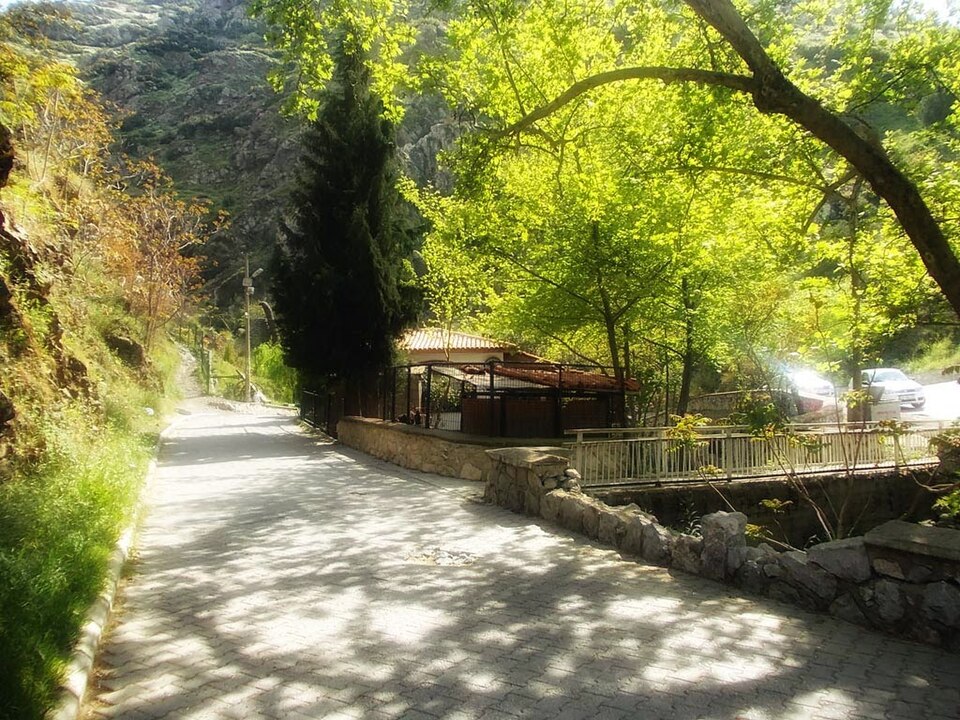
The Weeping Rock is close to Manisa's city centre, in Dere Mahallesi along the Çaybaşı stream, reachable by car or on foot from central Manisa without driving the full distance to the national park higher on the mountain. Manisa has no metro and no useful rail service within the city, so a car, taxi or local bus toward Dere Mahallesi is the practical way to reach it.
This differs from Spil Dağı Milli Parkı itself, which sits about 23 to 24 km from the centre and effectively requires a private vehicle, since no public transport serves the park gate. The Weeping Rock, by contrast, is a matter of minutes from the city on the same road, before it climbs into the mountain proper.
Checked 2026-08-24
The rock is best viewed from a set distance and angle; up close, the resemblance to a face is far less obvious, so visitors expecting a dramatic close-up carving may be disappointed — it is a natural formation, not a sculpture, and reads correctly only from where it is meant to be seen.
There is no dress code or photography restriction recorded for the site. Because it sits in a stream valley, the ground near the water can be uneven or slick after the rain that makes the rock "weep," so footing needs attention on a wet visit — the same rain that makes the visit worthwhile is the rain that makes the path awkward.
Checked 2026-08-24
The classic shot is taken from below and slightly to the side, the angle from which the profile in the cliff reads most clearly as a face; a photograph taken directly underneath loses the resemblance entirely.
Shooting after rain captures the water streaks that give the rock its name, and overcast light suits the grey limestone better than harsh midday sun, which flattens the texture that makes the face legible.
Checked 2026-08-24
Viewing the formation itself takes fifteen to twenty minutes, but a realistic visit from central Manisa — the drive up the Spil Dağı road, parking and walking in — runs closer to thirty to forty minutes door to door.
No. They are two separate features roughly five kilometres apart on Mount Sipylus. The Weeping Rock is an unworked natural formation; the Manisa relief at Akpınar is a deliberately carved, inscribed Hittite-period monument. Sources routinely confuse the two.
No fee is recorded, and the sources this page uses place it outside the ticketed boundary of Spil Dağı Milli Parkı. The exact boundary line is not stated in those sources, so a driver with any doubt should still carry the park's own admission — 60 TRY per adult plus a vehicle fee — in case that reading is wrong.
After rain, when water seeps visibly through the porous limestone. The site can be visited at any time, but the wetter months from autumn through spring give the best chance of seeing the effect.
A car, taxi or local bus toward Dere Mahallesi (formerly Karaköy) makes it straightforward; it sits only a few minutes onto the road that continues up to the national park, well short of that park's own 24 km gate.
You can approach it, but the face is legible only from a specific distance and angle rather than up close, where the resemblance to a face largely disappears.
Loading the interactive map…
The interactive map could not be loaded.
Last updated:
Source: OpenStreetMap contributors ·