
2 min walk · Şehzadeler
Sultan Hamamı
- High
- Historic monument
Language · 1 published
Activity · Şehzadeler, Manisa
| Monday | 10:00 – 18:00 |
|---|---|
| Tuesday | 10:00 – 18:00 |
| Wednesday | 10:00 – 18:00 |
| Thursday | 10:00 – 18:00 |
| Friday | 10:00 – 18:00 |
| Saturday | 10:00 – 18:00 |
| Sunday | 10:00 – 18:00 |
Checked 2026-08-25 · Source
Once a year Manisa climbs onto the roof of a mosque and throws medicine at its own population.
The medicine is mesir macunu, a dark, sticky, intensely spiced paste. The story the city tells about it starts in 1527, when Merkez Efendi, the physician at the Sultan Mosque complex, mixed it for Hafsa Sultan — mother of Süleyman the Magnificent, who lived in Manisa while her son governed the province — and she recovered. She asked that the remedy be given to everyone rather than kept for the palace, and the distribution has been repeated every spring since. The 2026 edition was the 486th, which puts the first public scattering around 1540, thirteen years after the paste itself.
UNESCO inscribed the festival on the Representative List of the Intangible Cultural Heritage of Humanity in 2012, and its listing describes what still happens: a chef and his apprentices make the paste from forty-one fresh spices and herbs, fourteen women wrap it in small squares of paper, twenty-eight imams and apprentices bless it, and it is thrown from the top of the minaret and from the domes of the Sultan Mosque to the crowd below.
That crowd is the point. This is not a tasting event with a stall and a queue. It is a city standing shoulder to shoulder in a mosque courtyard with its arms in the air, catching paper twists of something that was, four and a half centuries ago, a prescription.
The paste itself is not for everyone. It is sweet first, then hot, then bitter in the back of the throat, and it tastes like what it is — a sixteenth-century pharmacy reduced to a spoonful. Children eat it for the sugar. Older Manisalılar eat it because their parents did.
Checked 2026-08-24 · Source
The festival runs as a sequence, and the throw is only its last twenty minutes.
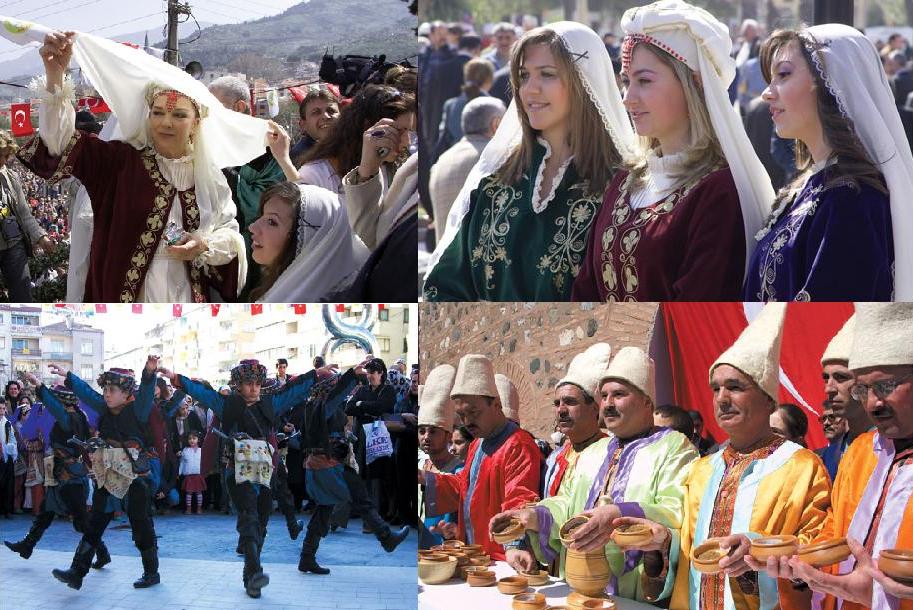
It opens on 21 March with Nevruz, the spring equinox, which is what the scattering was originally timed to. The mixing ceremony — the Mesir Karma Töreni — is held at the Şifahane, the old healing house inside the Sultan Mosque complex, where the forty-one spices go into the cauldron in front of whoever wants to watch. It is the calmest part of the week and the one where you can actually see the thing being made rather than being thrown at you.
Between the opening and the finale the city fills with processions in Ottoman dress, folk dance troupes from the districts and from abroad, panels on the paste's pharmacology, a mesir-themed fashion show at Yeni Han, and concerts in the squares. Manisa turns its centre over to the festival for the week in a way few Turkish provincial capitals still do.
The scattering closes it. The wrapped pieces are carried up into the mosque, the imams bless them, and they come down over the courtyard in handfuls. People catch what they can, eat some on the spot, and take the rest home — the paste is traditionally shared with anyone in the household who could not come.
What you will not find is a ticketed enclosure, an assigned seat, or a viewing platform. Everyone stands in the same courtyard.
Checked 2026-08-24 · Source
Two hours covers the finale properly: an hour to get into the courtyard and find a spot where you can raise your arms, twenty minutes or so of scattering, and the slow untangling of the crowd afterwards.
The scattering itself is short. If you arrive as it starts you will see it from the back of a very dense crowd, over other people's phones, and you will catch nothing.
If you are giving the festival a day rather than a moment, budget four to five hours and put the mosque at the end of it: the mixing ceremony and the exhibitions in the morning, the processions through the centre in the middle of the day, the throw in the afternoon.
If you are giving it the week, understand that it is a city-wide programme rather than a single site, and the schedule is published a few weeks ahead rather than fixed to the same hours each year.
Checked 2026-08-24
The festival is anchored to Nevruz, 21 March, and traditionally runs to the 24th; the UNESCO listing records it as 21 to 24 March. In practice the province publishes its own programme each year and the closing scattering is placed on a weekend day, so the exact date of the throw moves.
That matters more than it sounds. Travelling to Manisa for the festival and arriving on the wrong day means arriving for a normal Tuesday at a mosque. Confirm the year's dates on the governor's office or municipality site before booking anything.
March in Manisa is early spring at 70 m above sea level under a 1,500 m mountain: cool mornings, mild afternoons, and rain that comes through in bands rather than settling in. The courtyard has no cover. A jacket you can move your arms in beats an umbrella you will not be able to hold up in the crowd.
Outside the festival, mesir macunu is sold in every confectioner in the city all year, which is the answer for anyone who wants the paste rather than the event.
Checked 2026-08-24 · Source
Nothing about the scattering is sold. There is no ticket, no gate and no reserved area, and the paste that comes off the mosque is given away — that is the whole tradition, and charging for it would end it.
The rest of the week's programme, the concerts and the processions included, is put on by the municipality and the governor's office as public events.
The commercially made paste in the shops is a different thing from the festival paste and is priced like any confectionery, by the box.
If you want to be certain of getting some without the crush, buy a box in the bazaar on the way in. It will not have been thrown off a minaret at you, which for most visitors turns out to be the part they came for.
Checked 2026-08-24
The Sultan Mosque stands in Şehzadeler, the old core of Manisa, on the slope below Mount Sipylus and a few minutes on foot from the Manisa Museum and the bazaar. Anywhere in the historic centre is walking distance.
From İzmir the city is about an hour by road and slightly less by train — the İZBAN and regional services run to Manisa station, which sits below the old town, and the walk up from it takes about fifteen minutes.
On the day of the scattering the streets around the mosque complex are closed and the ordinary traffic pattern of the centre stops applying. Park on the flat part of the city and walk up, or leave the car at the hotel entirely.
The mosque complex is on a slope, and the courtyard fills from the low side first. Coming in from above gets you a shorter walk through a thinner crowd.
The complex you are standing in was endowed by Hafsa Sultan herself in the 1520s: mosque, medrese, hamam and the şifahane where the paste was first mixed. The festival happens where the story happened, which is rarer than it sounds and is worth ten minutes of looking around before the crowd arrives.
Checked 2026-08-24
The crowd is the hazard. It is dense, it surges when the throwing starts, and it contains a lot of children on shoulders and older people who came for the tradition rather than the sport of it. If you are tall you will catch more paste than the people in front of you; standing where you block a child from a once-a-year moment is a poor way to spend it.
Not everything that is thrown is caught. Pieces land on the ground, on heads, on other people's coats. Eat what you have caught cleanly and leave the rest.
Forty-one spices and herbs is a long ingredient list, and the paste is sugar-heavy. Anyone with a spice or pollen allergy should treat it as an unknown rather than a sweet.
Pickpocketing is the usual risk of any dense Turkish crowd; a bag worn in front is enough.
And check the date twice. The festival's opening is fixed to Nevruz but the scattering is not, and news coverage from an earlier year is not a schedule.
Checked 2026-08-24
The throw happens above you and fast, against a bright March sky, with a mosque dome behind it. A wide lens and a fast shutter beat any amount of reach: the picture is the arms and the faces, not the individual twist of paper in flight.
Shooting from the low side of the courtyard puts the minaret and the domes above the crowd and gives the frame something to sit against. From the high side you get the crowd itself, which is the better picture of the two if you can find a step to stand on.
The mixing ceremony at the Şifahane is the calmer photographic opportunity by a wide margin — steam, copper, forty-one open sacks of spice, and a room you can move around in.
It is a working mosque and a religious blessing precedes the scattering. Photograph the ceremony, not people at prayer, and put the camera down when the imams begin.
Checked 2026-08-24
It opens on 21 March, at Nevruz, and traditionally runs to the 24th; UNESCO records the festival as 21 to 24 March. The province sets each year's programme and places the closing scattering on a weekend day, so confirm the date on the governor's office or municipality site before travelling — the 486th edition opened on 21 March 2026.
Forty-one fresh spices and herbs, mixed and cooked by a chef and his apprentices to the traditional method, then wrapped in small squares of paper. It was formulated as a medicine rather than a sweet, though what is sold in shops today is confectionery.
No. There is no ticket and no enclosure, and the paste thrown from the mosque is given away — giving it away is the tradition being kept. Boxed mesir macunu in the city's confectioners is sold like any other sweet.
From the top of the minaret and from the domes of the Sultan Mosque, over the courtyard, after twenty-eight imams and their apprentices have blessed it. Fourteen women wrap the pieces beforehand.
Merkez Efendi, the physician at this complex, made the paste in 1527 for Hafsa Sultan, mother of Süleyman the Magnificent, who was living in Manisa. She recovered, and asked that it be given to the public rather than reserved for the court. The scattering has repeated every spring since, 486 times by 2026.
Yes. UNESCO inscribed the Mesir Macunu festival on the Representative List of the Intangible Cultural Heritage of Humanity in 2012, which is why the preparation and the scattering are still done to the recorded method rather than modernised.
Loading the interactive map…
The interactive map could not be loaded.
Last updated:
Source: OpenStreetMap contributors ·