
2 min walk · Şehzadeler
Sultan Hamamı
- High
- Historic monument
Language · 1 published
Historic monument · Şehzadeler, Manisa
Sultan Camii
| Per person | Free entry |
|---|
Checked 2026-08-24
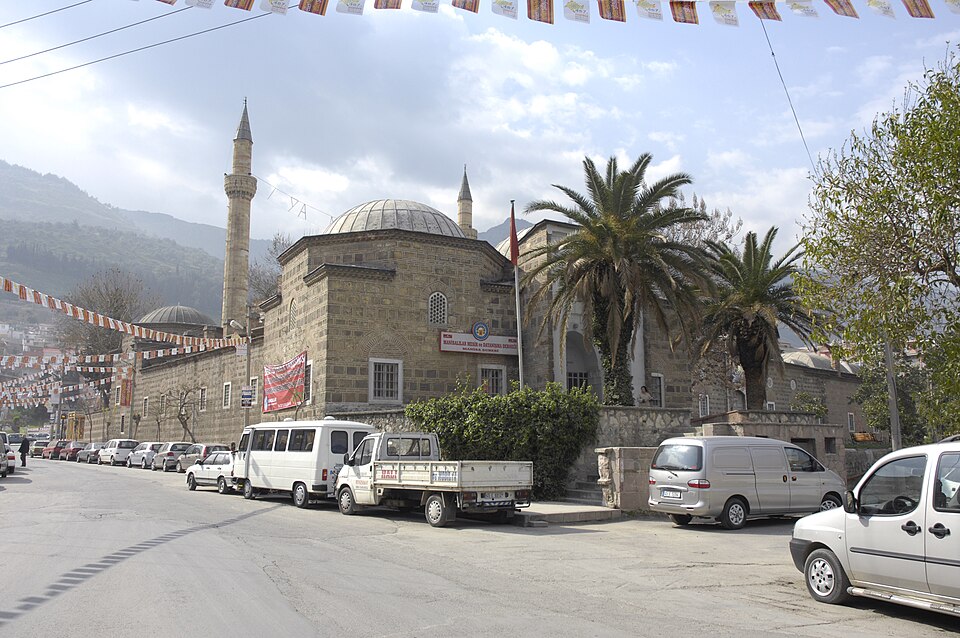
The Sultan Mosque is the centrepiece of Manisa and the reason the city has a festival. Hafsa Sultan — wife of Selim I and mother of Süleyman the Magnificent — commissioned it in 1522, when her son was governing the province as a prince.
It was never only a mosque. The külliye she endowed held a madrasa, a hospice, an elementary school, a double bath and a hospital, which is the building the Mesir story comes out of. The mosque itself is covered by a single central dome and carries two minarets.
Five centuries later the complex is still the stage for the Mesir Macunu Festival every March, which UNESCO inscribed on its Representative List of the Intangible Cultural Heritage of Humanity in 2012.
Checked 2026-08-24 · Source
One dome, two minarets, and a courtyard that fills with several thousand people once a year.
The prayer hall sits under a single central dome — a simpler scheme than the Muradiye's dome and half-domes a few hundred metres away, and sixty years older. The two minarets are the ones the paste is thrown from during the festival.
The buildings of the külliye stand around it: the madrasa, the hospice, the school, the double bath and the hospital where, by tradition, the physician Merkez Efendi made the paste that cured Hafsa Sultan. Not all of them are open, and none is ticketed.
Checked 2026-08-24 · Source
Half an hour, unless it is the last week of March.
The prayer hall is a single domed space and does not take long to read. Twenty minutes inside, ten in the courtyard, and the rest of the complex is exterior viewing.
During the festival, from 21 to 24 March, the calculation changes completely: the courtyard and the streets around it hold thousands of people waiting for the paste, and a visit becomes an afternoon.
Checked 2026-08-24
21 to 24 March if you want the festival; any other time if you want the building.
The Mesir Macunu Festival is the event Manisa is known for across Turkey. The paste is prepared from 41 spices and herbs, wrapped in paper by a team of women, blessed by the imams, and thrown from the minaret and the domes to the crowd below. Thousands come.
Outside March, the ordinary rules apply: mid-morning or mid-afternoon, outside prayer times, and not at noon on a Friday. Spring and autumn are the comfortable seasons in Manisa generally.
Checked 2026-08-24 · Source
Free. It is a working mosque, and admission to a working mosque in Turkey costs nothing.
The festival is free as well — the paste is thrown to the crowd, not sold to it, and there is no ticket, no stand and no seating.
Rates for anything inside the surviving buildings of the külliye are not published on the sources this page uses and are not reproduced here.
Checked 2026-08-24
On foot. The Sultan Mosque stands in Şehzadeler, the historic half of Manisa on the lower slope of Mount Spil, within a few hundred metres of the Muradiye and the museum.
No transport is needed inside the Ottoman core; the bazaar streets run downhill from the mosques. Town buses cover the rest of the city.
Reaching Manisa: four trains a day from İzmir Basmane take about 90 minutes, local buses cover the 40 km in about 35 minutes, and İzmir Adnan Menderes airport is roughly 65 km away.
Checked 2026-08-24 · Source
Shoulders and knees covered, shoes off at the threshold, headscarf for women — usually lent at the door. The hall closes to visitors during the five daily prayers, and the times move through the year.
In festival week the mosque stops being a quiet building. The crowd in the courtyard is dense and the paste is thrown into it; this is not a place to be with a small child on your shoulders or a bag you cannot hold onto.
The rest of the külliye is not uniformly open. Some buildings are in use, some are not, and turning up does not guarantee entry to anything but the mosque.
Manisa sees few foreign visitors and has no scam economy around its monuments. Nobody will offer to guide you for a fee.
Checked 2026-08-24
Two minarets and a single dome against Mount Spil is the frame, and it works best from the courtyard's far corner in late afternoon.
Inside, photography is not restricted, but the courtesies of a working mosque hold: not during prayer, and not pointed at people praying. The hall is lit for worship and a flash is both rude and useless.
The festival is the harder photograph and the better one — paper packets in the air off a sixteenth-century minaret, and several thousand hands under them. Get position early; the courtyard fills long before the throwing starts.
Checked 2026-08-24
Hafsa Sultan — the wife of Selim I and mother of Süleyman the Magnificent — commissioned it in 1522, while her son was governing the province from Manisa as a prince.
A madrasa, a hospice, an elementary school, a double bath and a hospital. The hospital is the building the Mesir paste tradition comes out of.
From 21 to 24 March every year, at this mosque. The paste is made from 41 spices and herbs, wrapped in paper, blessed, and thrown from the minaret and the domes to the crowd. UNESCO inscribed it on the Representative List of the Intangible Cultural Heritage of Humanity in 2012.
A spiced paste with a five-hundred-year tradition in Manisa, made from 41 spices and herbs. It commemorates the recovery of Hafsa Sultan, who by tradition was cured by it.
No. It is a working mosque and admission is free, as it is at every mosque in Turkey. The festival is free too — the paste is thrown to the crowd, not sold.
The Sultan Mosque is sixty years older — 1522 against 1583–86 — and simpler: one central dome against the Muradiye's dome and three half-domes. The Muradiye is Mimar Sinan's design and holds the İznik tilework; the Sultan Mosque holds the festival.
Loading the interactive map…
The interactive map could not be loaded.
Last updated:
Source: OpenStreetMap contributors, Wikidata ·