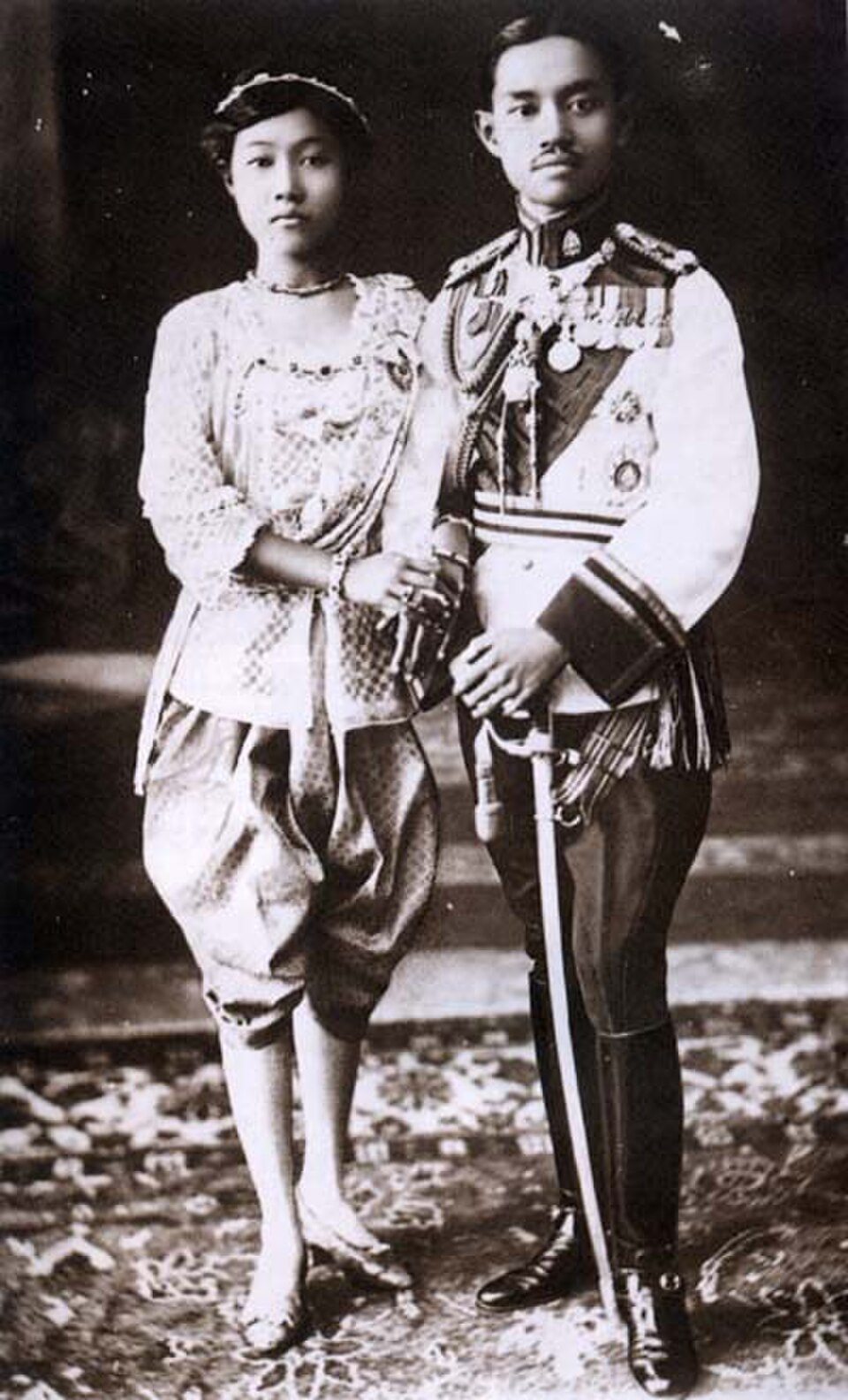
Sukhothai Palace is a royal residence on Samsen Road in Dusit district, Bangkok, and it is not a visitor attraction: it remains in use and is closed to the public. Queen Saovabha, the wife of King Chulalongkorn, commissioned it in 1918 as a wedding gift for her youngest son, Prince Prajadhipok, the Prince of Sukhothai, and his wife Rambhai Barni, and King Vajiravudh gave the palace its name. Its interest is historical rather than touristic. Prajadhipok became King Rama VII, the last absolute monarch of Siam and the first constitutional one, and this house was the couple's home before and after his reign; it is regarded as a masterpiece of the period's blending of Western architecture with Thai decorative art. What a traveller can see today is the gate, the walls and the roofline from a public street, and nothing more.
The palace is built as three connected residences rather than one block: the Yai, or great, residence, the Mai, the wooden one, and the Nam, the water residence, joined by a raised covered walkway carried on wood carvings and finished with Thai patterned eaves. Brick and plaster carry the Western form of the elevations while the carved timber and the eaves do the Thai work, which is what the description of the palace as a masterpiece of combination refers to. None of the three interiors can be visited and no floor plan is published for visitors, so what follows from this is practical rather than descriptive: the buildings are read from outside, through a gateway and over a wall, and the raised walkway between them is the element most often visible from the street.
Allow 15 minutes at Sukhothai Palace, and treat it as a stop rather than a destination. There is no interior to visit, no ticket hall and no route to walk, so the time goes on the approach along Samsen Road, a look at the gate and the roofs behind it, and the short walk on to whatever comes next in Dusit. Anyone building a day around King Prajadhipok should give the hours to a museum that can actually be entered and keep this address as the five-minute footnote that shows where the man lived; a longer stay outside an occupied royal residence achieves nothing and draws attention that is better avoided.
There are no opening hours to work around at Sukhothai Palace, because there is no opening. The only timing that matters is daylight and traffic. Samsen Road is a working artery and the pavement outside a guarded compound is not a place to linger after dark, so mid-morning or late afternoon on a weekday suits a passing look, and it fits the way most people reach this part of Dusit, on the way to or from the wider royal quarter. Rainy season afternoons, roughly June to October, bring heavy downpours with nowhere to shelter along this stretch, which is a real consideration for a stop that exists entirely on the street.
There is no ticket, because Sukhothai Palace is not open to the public. No admission price and no visiting hours were recorded for this page, and none were invented. What was checked: the Thai and English Wikipedia articles on the palace, which describe it as an occupied royal residence and publish no visitor information; and a search for an operator-published page for the palace, which returned none, since the property passed to the Crown Property Bureau after King Prajadhipok's death and neither that office nor the royal household publishes a visitor page for it. Any site offering tours or tickets to Sukhothai Palace is not describing this building.
Sukhothai Palace stands on Samsen Road in Dusit district, in the northern part of the royal quarter, north of Rattanakosin island. It is reached the way the rest of Dusit is reached, by taxi or by river, and it sits within a walk of the wider Dusit royal precinct for anyone already in the area. Because there is no entrance to head for, the address serves to place the building rather than to route a visit: the palace is identified from the road by its gate and by the roofline of the three residences behind the wall. Do not expect signage in English, and do not expect a car to be able to stop outside.
This is an active royal residence, and that governs everything about visiting it. The Thai Wikipedia article describes the palace as the residence of Princess Sirivannavari; the English article names it as the residence of Princess Bajrakitiyabha and Princess Sirivannavari. Either way there are guards, and a foreign visitor loitering at the gate, filming the sentries or attempting to enter will be moved on at best. Thailand's lèse-majesté law is enforced, and comments or images that could be read as disrespect towards the monarchy carry real legal consequences, so keep both to yourself. Dress and behave as you would outside any occupied private house. There are no facilities, no shade and no visitor entrance here; anyone expecting a palace to tour has come to the wrong address and should not attempt to argue the point with the guard.
Photograph Sukhothai Palace from the public pavement, briefly, and leave. The frames available are the gate, the boundary wall and the upper storeys and roofs of the three residences rising behind it, which is enough to record that the building exists and what its style is. Do not photograph the guards, the sentry box or anyone entering or leaving, do not use a long lens over the wall, and do not fly a drone anywhere near an occupied royal residence. A wide lens from across the road handles the gate better than a close approach, and morning light falls on the street side. If a member of the security staff indicates that photography should stop, stop; there is no photograph of this building worth an argument.
Checked 2026-08-25
Common questions
Can you visit Sukhothai Palace in Bangkok?
No. Sukhothai Palace is an occupied royal residence and is not open to the public. There is no ticket, no visiting hours and no interior tour; the building can only be seen from the public street outside.
Who built Sukhothai Palace and when?
Queen Saovabha, the wife of King Chulalongkorn, commissioned the palace in 1918 as a wedding gift for her youngest son, Prince Prajadhipok, the Prince of Sukhothai, and his wife Rambhai Barni. King Vajiravudh bestowed its name.
Who has lived at Sukhothai Palace?
Prince Prajadhipok and Rambhai Barni lived here before he became King Rama VII, and returned to the palace after a period at Amphorn Sathan Residential Hall. After the revolution of 1932 the couple left for England, where the king abdicated in 1935 and died in 1941 without returning. The property then passed to the Crown Property Bureau and was used for government offices. Queen Rambhai Barni came back to Thailand permanently in 1968 and lived here until her death in 1984, and Crown Prince Vajiralongkorn, later King Rama X, lived here afterwards.
What does Sukhothai Palace look like?
It is three linked residences, called the Yai, the Mai and the Nam, joined by a raised walkway carried on wood carvings and finished with Thai patterned eaves. The elevations are brick and plaster in a Western form, with the Thai contribution carried by the carved timber work.
Is Sukhothai Palace connected to the ancient city of Sukhothai?
No. The palace takes its name from the royal title of its first occupant, Prince Prajadhipok, who was the Prince of Sukhothai, and it stands on Samsen Road in Dusit district, Bangkok. The historic city of Sukhothai is far to the north in its own province and is an entirely separate site.
Is Sukhothai Palace worth going out of the way for?
Only for someone already interested in King Prajadhipok or in early twentieth century Thai royal architecture, and only as a short stop on the way to somewhere else in Dusit. Fifteen minutes on the pavement is the whole of the visit, and there is nothing to enter.
Nothing non-essential is set before you choose, in regions where consent is required. If you decline, ads still appear but they are non-personalised, and analytics is switched off entirely.