
_%E0%B8%AA%E0%B8%96%E0%B8%B2%E0%B8%99%E0%B8%B5%E0%B8%A3%E0%B8%96%E0%B9%84%E0%B8%9F%E0%B8%AB%E0%B8%B1%E0%B8%A7%E0%B8%A5%E0%B8%B3%E0%B9%82%E0%B8%9E%E0%B8%87_%E0%B9%80%E0%B8%82%E0%B8%95%E0%B8%9B%E0%B8%97%E0%B8%B8%E0%B8%A1%E0%B8%A7%E0%B8%B1%E0%B8%99_%E0%B8%81%E0%B8%A3%E0%B8%B8%E0%B8%87%E0%B9%80%E0%B8%97%E0%B8%9E%E0%B8%A1%E0%B8%AB%E0%B8%B2%E0%B8%99%E0%B8%84%E0%B8%A3.jpg)
_%E0%B8%AA%E0%B8%96%E0%B8%B2%E0%B8%99%E0%B8%B5%E0%B8%A3%E0%B8%96%E0%B9%84%E0%B8%9F%E0%B8%AB%E0%B8%B1%E0%B8%A7%E0%B8%A5%E0%B8%B3%E0%B9%82%E0%B8%9E%E0%B8%87_%E0%B9%80%E0%B8%82%E0%B8%95%E0%B8%9B%E0%B8%97%E0%B8%B8%E0%B8%A1%E0%B8%A7%E0%B8%B1%E0%B8%99_%E0%B8%81%E0%B8%A3%E0%B8%B8%E0%B8%87%E0%B9%80%E0%B8%97%E0%B8%9E%E0%B8%A1%E0%B8%AB%E0%B8%B2%E0%B8%99%E0%B8%84%E0%B8%A3_(3).jpg)


6 min walk · เขตสัมพันธวงศ์
Wat Traimit
- Must see · Heritage site
- Place of worship
Language · 1 published
Historic monument · เขตปทุมวัน, Bangkok
สถานีรถไฟกรุงเทพ
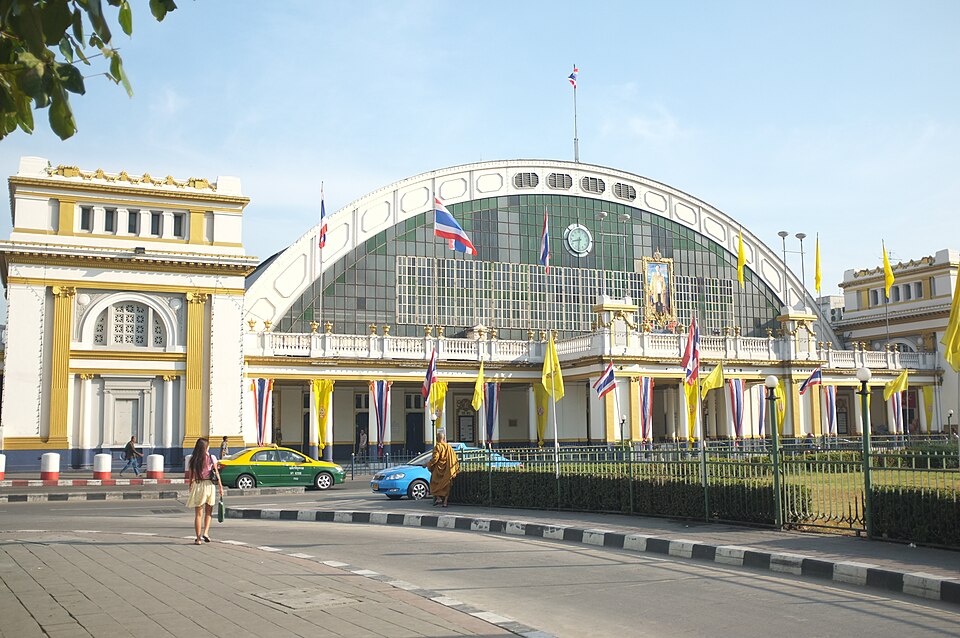
Bangkok (Hua Lamphong) railway station is the former central passenger terminal of Thailand, a domed Italian neo-Renaissance building in Pathum Wan operated by the State Railway of Thailand. It opened on 25 June 1916 after six years of construction begun in 1910, spanning the reigns of King Chulalongkorn and King Vajiravudh, on a site the railway had previously used as its maintenance centre. The State Railway always called it Bangkok station, Sathani Krung Thep; Hua Lamphong was the popular name, borrowed from a canal and a road that once ran nearby, and it became official on 19 January 2023 when the station was renamed Bangkok (Hua Lamphong) railway station. That was the same day the long-distance network moved out. Today the station is no longer Thailand's railway hub but it is still a working station, and it is the one railway building in Bangkok that people visit for its own sake.
Checked 2026-08-25 · Source
The building is a two-storey air-conditioned hall with two main entrances, 14 platforms, 14 tracks and 22 ticket counters, and its architecture is the reason to walk in. The facade was designed by the Turin-born Mario Tamagno, who with his countryman Annibale Rigotti was also responsible for Bang Khun Phrom Palace and the Ananta Samakhom Throne Hall; whether the model was Frankfurt Hauptbahnhof or Torino Porta Nuova has never been settled. Inside, the vault carries decorated wooden roofing and stained-glass windows, and above the two entrances to the platforms hang large pictures of King Chulalongkorn and Queen Saovabha Phongsri inaugurating the first intercity service from Bangkok to Ayutthaya on 26 March 1896. A preserved JNR Class C56 locomotive, SRT number 714, stands on the concourse. In front of the building is a fountain topped by Erawan, which replaced the large air-raid shelter built there during the bombing of Bangkok in the Second World War. The right-hand part of the building once held the ten-room Rajdhani Hotel, a transit hotel that operated from 1927 to 1969. Freight left long ago, moved to the Phahonyothin yard in 1960 because the 120-rai site could not expand.
Checked 2026-08-25 · Source
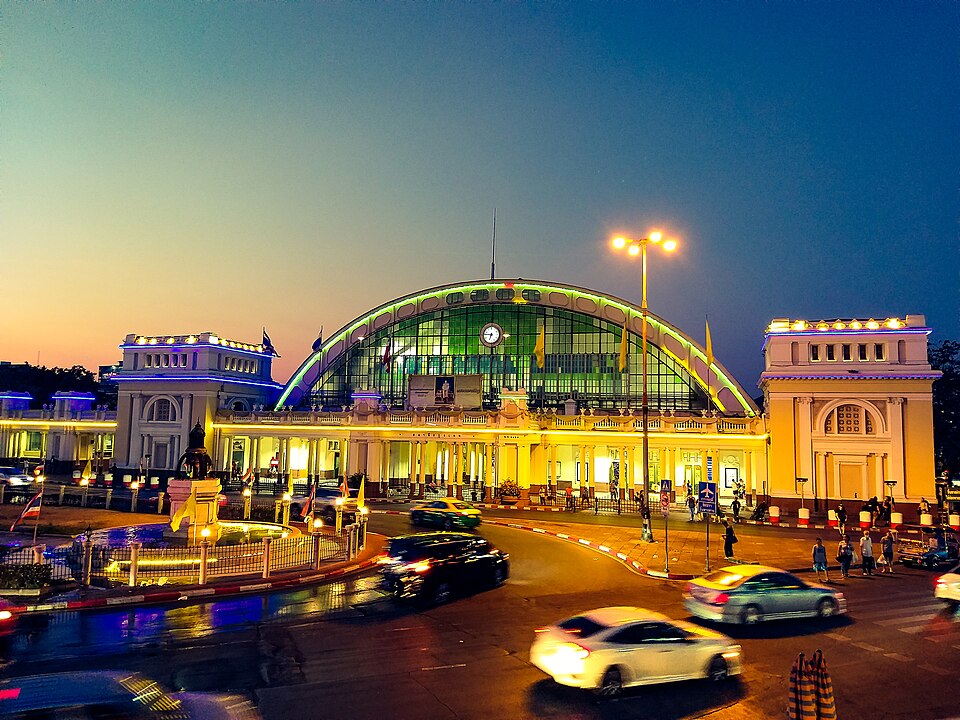
Allow about forty-five minutes at Hua Lamphong if the point of the visit is the building rather than a train. That covers the main hall and its stained glass, the royal portraits above the platform entrances, the preserved C56 locomotive, a walk to the end of a platform and the Erawan fountain outside. Travellers actually catching a service should arrive earlier than that and treat the forty-five minutes as time spent looking rather than time spent queueing. This figure is an editorial judgement; the State Railway of Thailand publishes no suggested visit length.
Checked 2026-08-25
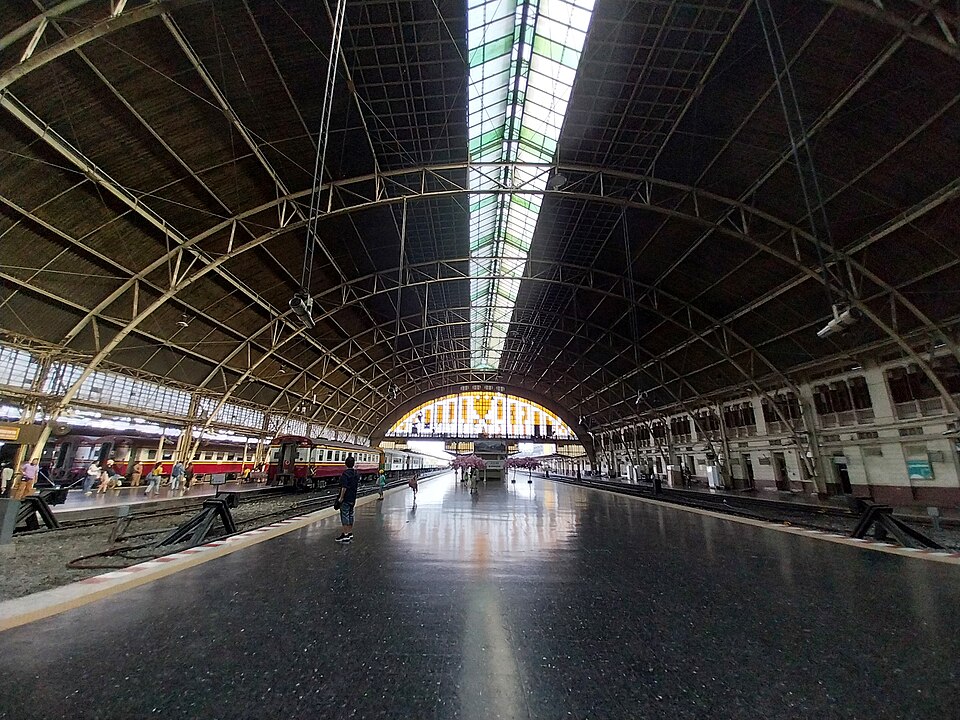
Hua Lamphong is quieter than it was. Before 2020 the station handled around 200 trains and about 60,000 passengers a day; since 19 January 2023 the long-distance services have terminated at Krung Thep Aphiwat Central Terminal, leaving Hua Lamphong to ordinary and commuter trains on the Northern, Northeastern and Southern lines and to all Eastern line services. The practical effect for a visitor is that the concourse is now photographable at times when it used to be impassable. Early morning gives the best light through the arched end window and the calmest hall; late afternoon brings the commuter departures, which is when the platforms feel like a working railway again. The building is air-conditioned, which makes it a reasonable place to be during the hottest part of a Bangkok afternoon.
Checked 2026-08-25 · Source
ssmtour records no admission for Hua Lamphong. It is a railway station, not a museum: entering the building and the concourse costs nothing, and what the 22 counters sell is rail tickets, priced by service and by distance. Claude tried to read the State Railway of Thailand's own site at railway.co.th on 25 August 2026 to confirm ticket-office hours and any published fares, and the host did not respond from this network; the SRT D-Ticket site at dticket.railway.co.th returned a page with no readable station or hours content. Because no operator page could be read, no opening hours and no admission figures are recorded here, and none are guessed. Travellers should confirm fares and counter hours with the State Railway directly.
Checked 2026-08-25
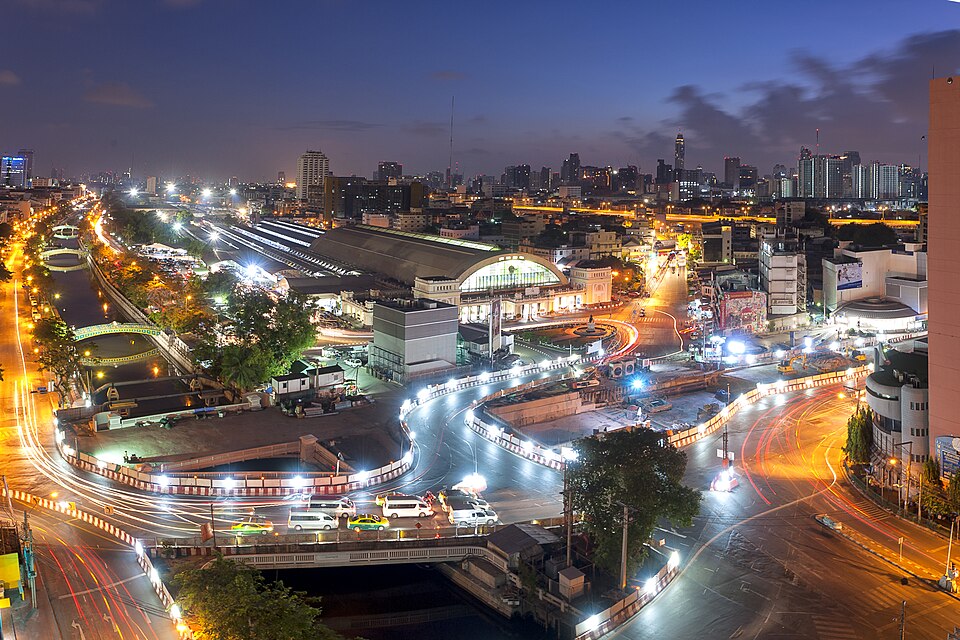
Hua Lamphong is on Rama IV Road in Rong Mueang, Pathum Wan, and the simplest arrival is by metro: since 2004 the station has been linked by an underground passage to Hua Lamphong MRT station on the Blue Line, so a visitor reaches the concourse without crossing Rama IV Road on foot. Bangkok Mass Transit Authority buses stop on Rama IV, the Khlong Phadung Krung Kasem boat service runs beside the station, and taxis and motorcycle taxis wait outside. The station has parking and cycle parking. One historical note that confuses map readers: the original Hua Lamphong railway station belonged to the private Paknam Railway Line, stood opposite the present building, opened in 1893 and closed in 1960; today's Hua Lamphong MRT station lies beneath its site.
Checked 2026-08-25 · Source
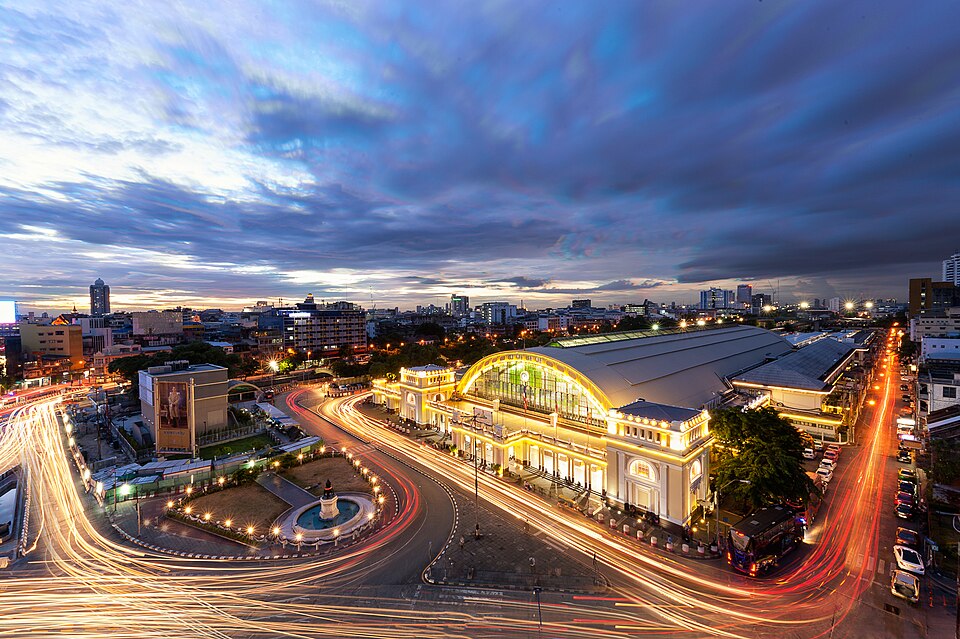
The first thing to check is whether the train you want still leaves from here at all. Since 19 January 2023 the special express, express and rapid services on the Northern, Northeastern and Southern lines depart from Krung Thep Aphiwat Central Terminal, several kilometres north, and a traveller who arrives at Hua Lamphong with a long-distance ticket has come to the wrong station; only ordinary and commuter trains on those lines, and all Eastern line services, still use Hua Lamphong. The second is the station's uncertain future: it was scheduled to close as a railway station in 2021 and be converted into a museum, the move was delayed after opposition, and it is planned as a future station on the southern extension of the SRT Dark Red Line, so its role can change again. The third is ordinary station discipline - platforms here are at track level and trains are shunted across them, so photographers stepping backwards for a wider frame should look behind them first. Nothing on this page should be taken as a current timetable; confirm departures with the State Railway before travelling.
Checked 2026-08-25 · Source
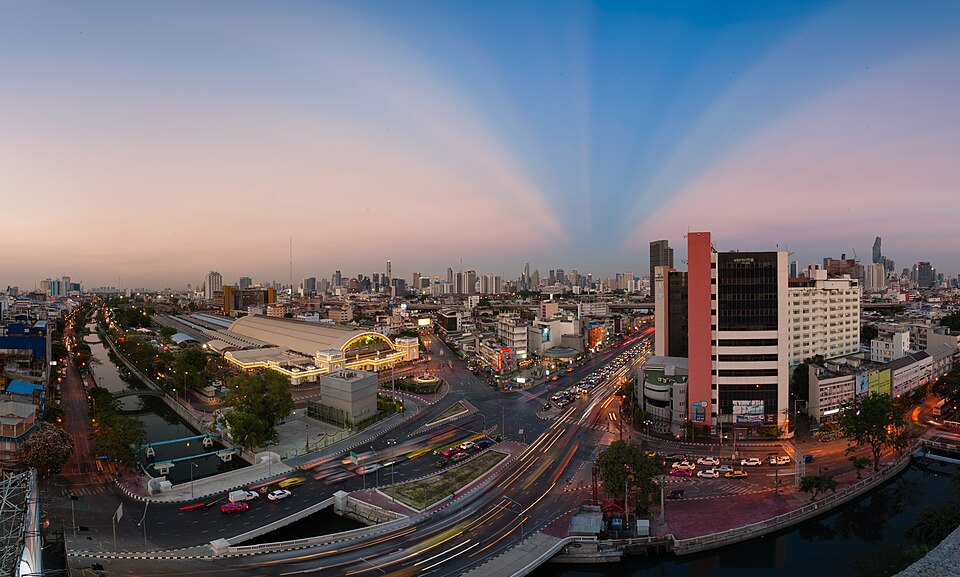
The picture everyone comes for is the main hall from the concourse floor, looking towards the great arched window, and it is best in the first two hours after opening light reaches it, when the beam falls the length of the vault and the crowd is thin. Shoot from the upper level for the geometry of the roof ribs and from floor level for the scale of the arch against people. The stained glass rewards a longer lens and a still moment. Outside, the facade is a symmetrical subject that wants to be photographed square-on from across the forecourt, with the Erawan fountain in the foreground if a foreground is needed. The preserved C56 locomotive is a difficult subject in a busy hall - work close, use the boiler line as a lead, and wait for the concourse behind it to clear. This is editorial judgement, not an operator rule; no published photography restriction for the station was found.
Checked 2026-08-25
No. Since 19 January 2023 the long-distance special express, express and rapid services on the Northern, Northeastern and Southern lines have terminated at Krung Thep Aphiwat Central Terminal instead. Hua Lamphong still serves ordinary and commuter trains on those lines, and all Eastern line services terminate here.
The station opened on 25 June 1916, after six years of construction that began in 1910. The front of the building was designed by the Turin-born architect Mario Tamagno, who worked with Annibale Rigotti on several early twentieth-century public buildings in Bangkok, and the style is Italian neo-Renaissance.
No admission is recorded for Hua Lamphong on this site: it is a working railway station, and entering the concourse costs nothing. Claude could not reach the State Railway of Thailand site at railway.co.th on 25 August 2026 to confirm ticket-office hours or fares, so no hours and no prices are recorded here rather than estimated.
Hua Lamphong MRT station sits directly beneath the area in front of the railway station and has been connected to it by an underground passage since 2004, so no street crossing on Rama IV Road is needed. Buses, the Khlong Phadung Krung Kasem boat service, taxis and motorcycle taxis also serve the station.
The vaulted main hall with its decorated wooden roofing and stained glass, the large pictures of King Chulalongkorn and Queen Saovabha Phongsri inaugurating the first Bangkok to Ayutthaya service on 26 March 1896 above the platform entrances, a preserved JNR Class C56 locomotive numbered SRT 714, and the Erawan fountain outside, which stands where a wartime air-raid shelter once did.
It was scheduled to close as a railway station in 2021 and be converted into a museum, with the central terminal role moving to Krung Thep Aphiwat, but the plan was delayed after opposition and the station kept running. It is also planned as a future station on the southern extension of the SRT Dark Red Line.
Loading the interactive map…
The interactive map could not be loaded.
Last updated:
Source: OpenStreetMap contributors, Wikidata ·