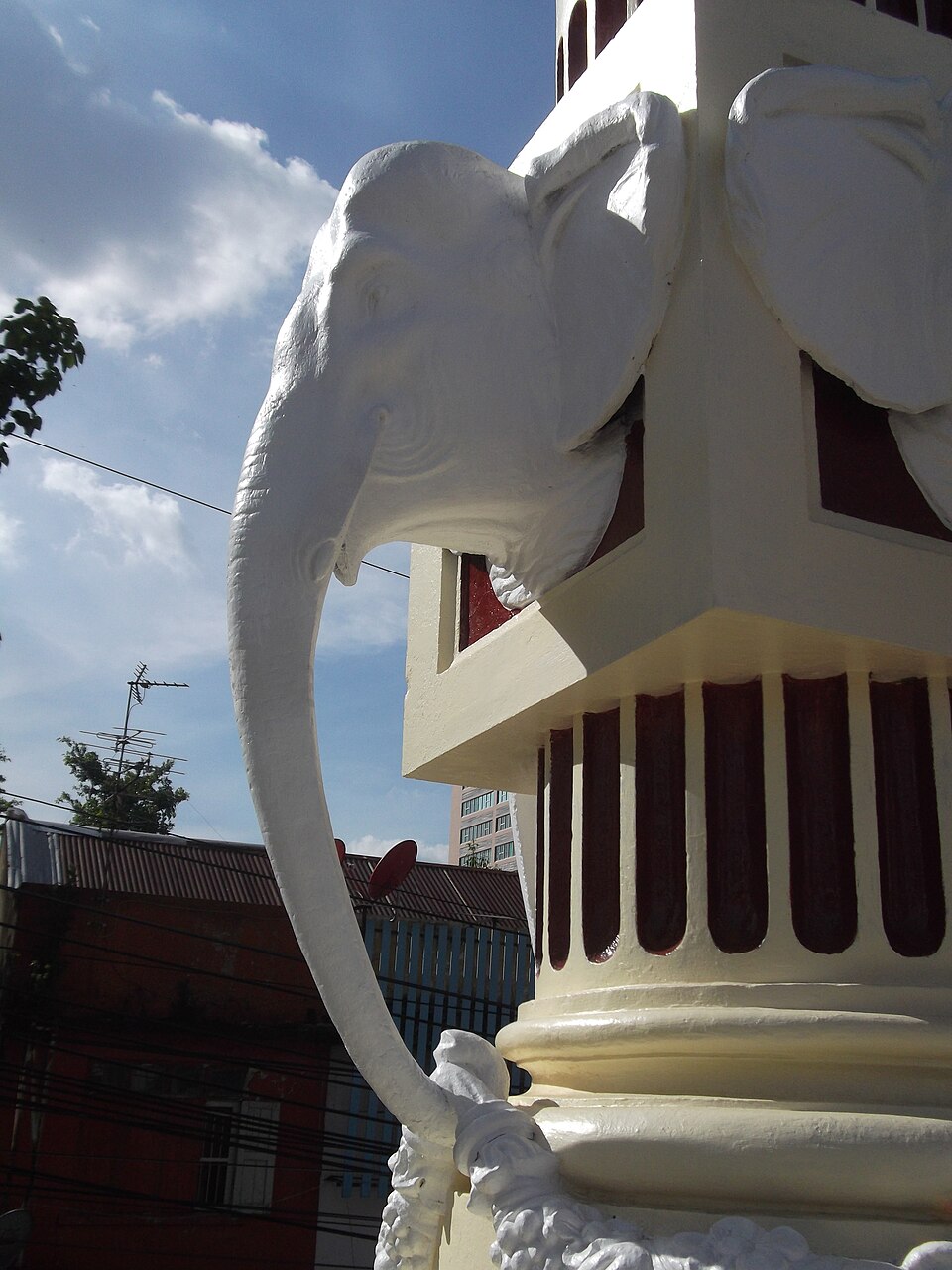
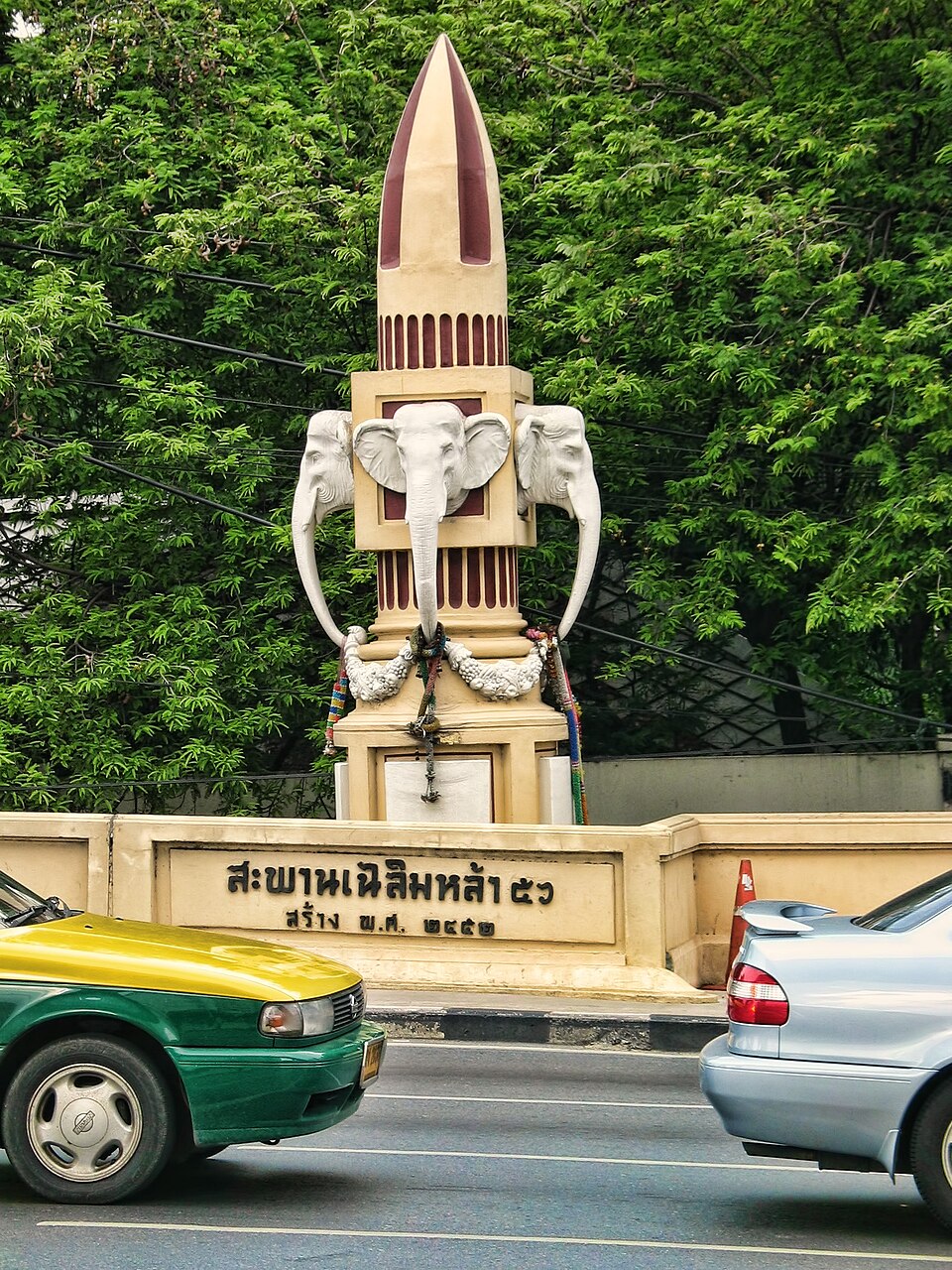
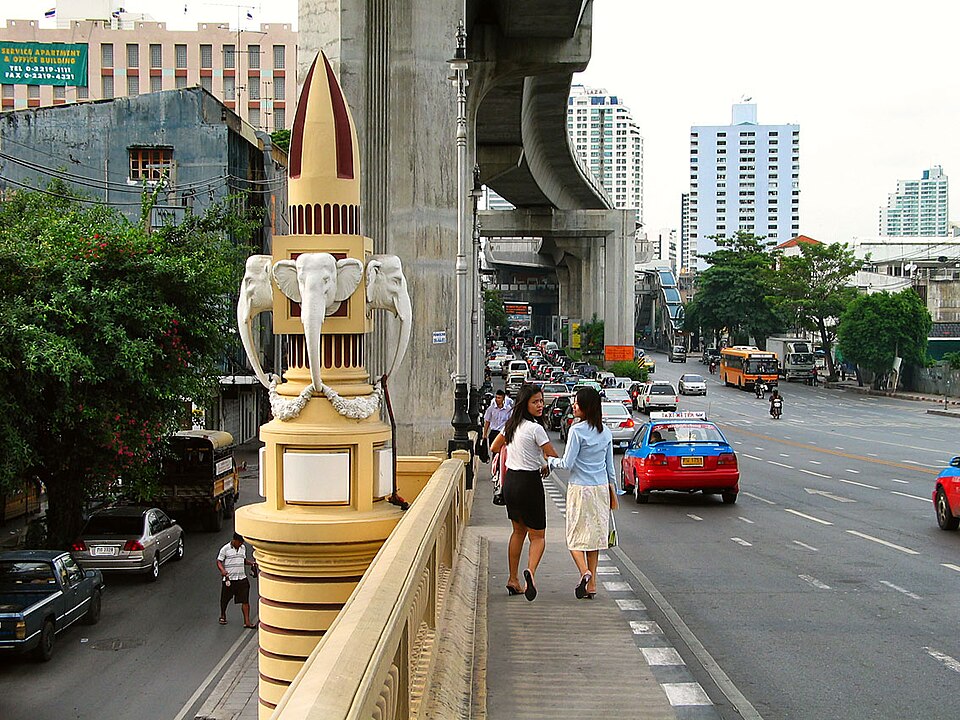
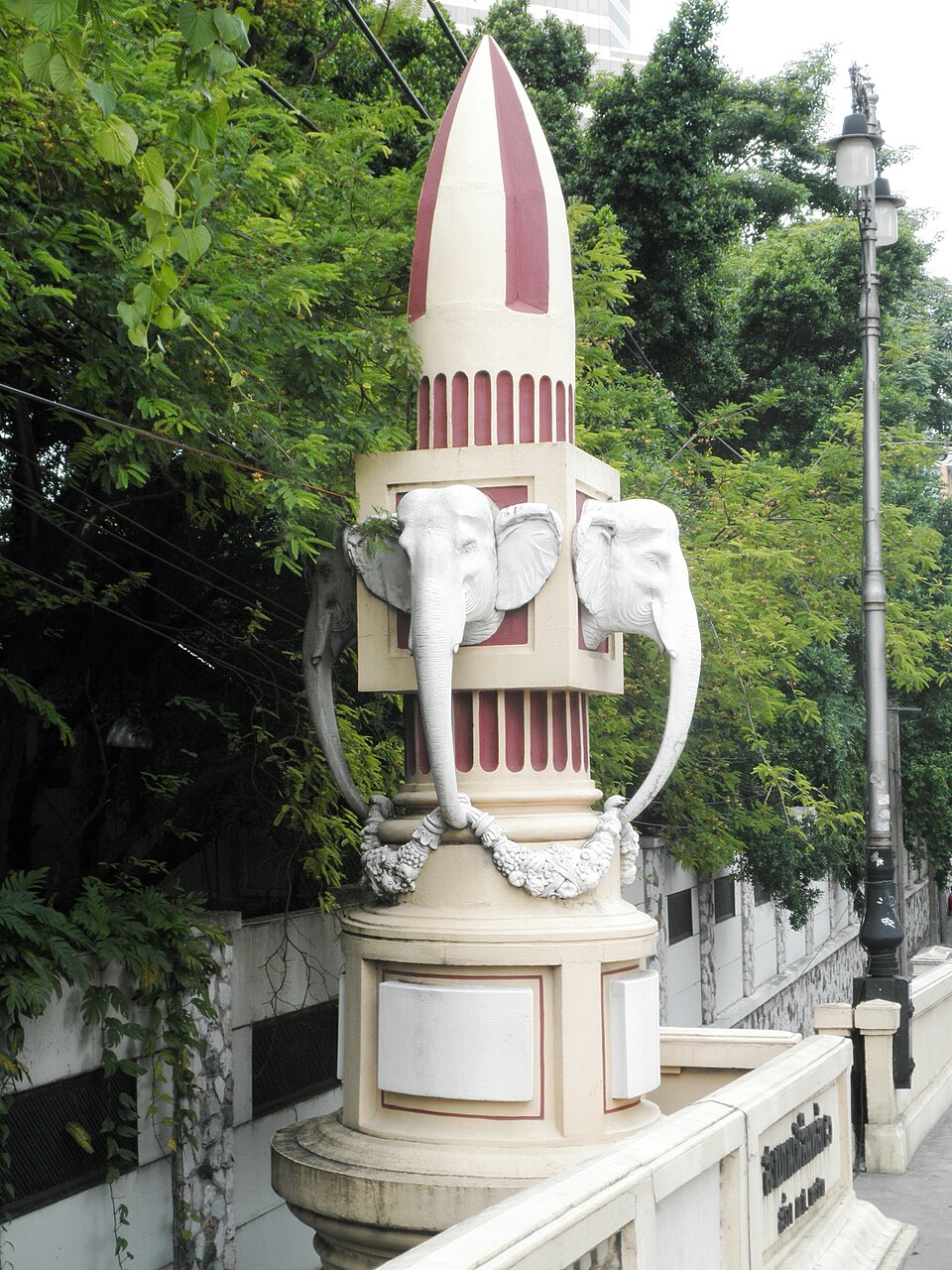
Chaliam La 56 Bridge carries Phaya Thai Road over Khlong Saen Saep on the boundary between Pathum Wan and Ratchathewi, a short reinforced-concrete arch that most of Bangkok knows by its nickname rather than its name: Saphan Hua Chang, the Elephant Head Bridge, after the four elephant heads set at its approaches. It was built for King Chulalongkorn and opened on 15 November 1909, the fifteenth of the commemorative Chaloem bridges he had built across the city's canals, each one tied to a birthday; the 56 in the name is that birthday, and the royal monogram at the centre of the parapet is his. Thai authorities list it as a registered historic structure. Almost nobody travels to Bangkok to see it, and that is rather the point of it: it is a piece of Rama V's city still doing the job it was built for, under six lanes of traffic, a minute's walk from a canal-boat pier and a shopping district that did not exist when it was poured.
The bridge is the exhibit and it takes only a slow lap of both parapets to read. Four cast elephant heads sit at the entrances to the span, and the small royal cipher of King Chulalongkorn is set at the middle of the balustrade, whose openwork detailing follows the Western decorative fashion of the Thai court around 1909. The structure is a concrete arched beam rather than the iron truss or the timber decking used on older canal crossings, and the road has since been widened around the original fabric to carry modern traffic, so the historic ornament now reads as an inner rail with a much larger roadway wrapped past it. Below the deck, Khlong Saen Saep is a working waterway: the Saphan Hua Chang pier sits against the bridge, and the long low express boats that use it arrive every few minutes with their side awnings raised against the spray. The canal, the pier, the elephant heads and the traffic are the whole of the visit.
Fifteen minutes is enough, and that is the figure recorded for this entry. Five of those minutes go on the two parapets and the elephant heads, five on the pier steps looking back at the arch from water level, and five on waiting for a gap in the traffic long enough to photograph the monogram without a motorcycle in the frame. Nobody should build a half-day around Chaliam La 56 Bridge; it works as a deliberate three-minute detour on the way between Siam and the Bangkok Art and Culture Centre, or as the first stop of a walk east along the canal bank.
Late afternoon suits the bridge best. The elephant heads and the balustrade face across the canal, so low sun rakes them from the side and the concrete stops looking flat and grey, and the canal boats run at their busiest, which is what makes the setting worth standing in. Weekday rush hours, roughly 07:00 to 09:00 and 16:00 to 19:00, put the heaviest traffic on the deck and the longest queues on the pier gangway; a Sunday morning gives the quietest crossing and the emptiest footway. Rain is the real constraint rather than heat: the footway is narrow, umbrellas do not pass one another comfortably, and the boats throw water over the pier fence.
Checked 2026-08-25
Photograph
· Fotograf / Photographer: Heinrich Damm (User:Hdamm, Hdamm at de.wikipedia.org) ·
CC BY 2.0
There is no admission and no ticket of any kind, because Chaliam La 56 Bridge is a public road crossing and not a managed attraction. No operator publishes hours for it either: it is open in the sense that a street is open, at every hour of the day and night, with the pier beneath it keeping its own timetable. No opening-hours or admission record is stored for this entry, because there is no operator page to read one from. The only money a visit here can cost is the canal-boat fare if the walk continues by water.
The bridge sits on Phaya Thai Road where it crosses Khlong Saen Saep, between the Ratchathewi and Pathum Wan sides of the canal, and it is easiest to reach on foot from the BTS. Ratchathewi station is the closest stop on the Sukhumvit line and the walk south along Phaya Thai Road arrives at the north parapet; from National Stadium station on the Silom line the walk runs north instead, past the Bangkok Art and Culture Centre. By water, the Saphan Hua Chang pier is on the Golden Mount line of the Khlong Saen Saep boat service, which runs from 05:30 to 20:30 on weekdays and until 19:00 at weekends, charges between 8 and 22 baht in cash, and requires a change of boat at Pratunam for anything continuing east. Arriving by taxi is possible but pointless, since a car cannot stop on the span itself.
The hazard here is traffic, not crime. The footway over Chaliam La 56 Bridge is narrow, the kerb is high, motorcycles use the pavement when the lanes lock up, and there is no safe way to stand in the roadway to photograph the arch head-on, so the ornament has to be shot from the pavement or from the pier below. The pier gangway is metal, wet for most of the day and slippery in sandals; the boats do not wait long, and the ticket collector moves along the outside gunwale while the boat is running, which visitors should not imitate. Canal water is dirty and gets thrown over the pier fence when two boats pass. No dress rule applies, since this is a street. There is no shade and no seating anywhere on the crossing, so the middle of a hot afternoon is genuinely unpleasant rather than merely warm.
The two useful positions are the pier deck and the far pavement. From the pier, the arch, the boats and the balustrade line up in one frame and the bridge finally looks like a bridge rather than a road; from the opposite pavement, a long lens compresses the elephant heads against the traffic behind them. Late afternoon light comes along the canal rather than across it, which is the only time the concrete relief shows any depth. Nothing here is restricted, but pointing a camera at the pier staff or into the boats is discourteous, and a tripod on the footway blocks it completely. A wide lens is worth carrying: there is no room to step back from the parapet.
Checked 2026-08-25
Common questions
Why is Chaliam La 56 Bridge called the Elephant Head Bridge?
The nickname Saphan Hua Chang, Elephant Head Bridge, comes from the four elephant heads placed at the approaches to the span. The formal name, Chaliam La 56, commemorates King Chulalongkorn's 56th birthday, and his royal monogram is set at the centre of the balustrade.
When was Chaliam La 56 Bridge built?
It was built for King Chulalongkorn and opened on 15 November 1909. It was the fifteenth bridge in his series of commemorative Chaloem bridges over Bangkok's canals, and it is a registered historic structure.
Is there an entrance fee for Chaliam La 56 Bridge?
No. The bridge is a public road crossing on Phaya Thai Road, free to walk over at any hour. No operator publishes opening hours or an admission price for it, so none is recorded here.
How do visitors reach the bridge by public transport?
On foot from BTS Ratchathewi or BTS National Stadium, or by canal boat to Saphan Hua Chang pier on the Golden Mount line of the Khlong Saen Saep boat service, which runs 05:30 to 20:30 on weekdays and to 19:00 at weekends for a cash fare of 8 to 22 baht.
How long does a visit take?
About fifteen minutes, which covers both parapets, the elephant heads and a look back at the arch from the pier below. It is a detour on a longer walk rather than a destination in itself.
What is the best time of day to see it?
Late afternoon, when the sun comes along the canal and lights the relief on the balustrade, and the canal boats are frequent. Weekday rush hours put heavy traffic on a narrow footway and long queues on the pier.
Nothing non-essential is set before you choose, in regions where consent is required. If you decline, ads still appear but they are non-personalised, and analytics is switched off entirely.

.JPG)


.jpg)
