
3 min walk · เขตบางกอกน้อย
Thonburi Railway Station
- Must see · Heritage site
- Museum
Language · 1 published
Museum · เขตบางกอกน้อย, Bangkok
พิพิธภัณฑ์การแพทย์ศิริราช
| Monday | 10:00 – 17:00 |
|---|---|
| Tuesday | Closed |
| Wednesday | 10:00 – 17:00 |
| Thursday | 10:00 – 17:00 |
| Friday | 10:00 – 17:00 |
| Saturday | 10:00 – 17:00 |
| Sunday | 10:00 – 17:00 |
Checked 2026-08-25 · Source
The Siriraj Medical Museum is a cluster of six museums of medical curiosities inside Thailand's oldest hospital, on the Thonburi bank of the Chao Phraya, and it is the most useful antidote in Bangkok to a week of gilded temples. Pathology, forensic medicine, parasitology, anatomy and prehistory each have their own halls within the Faculty of Medicine Siriraj Hospital at Mahidol University, and the collections are teaching material first and public exhibits second. That is what gives the place its particular character: these are specimens assembled to train doctors, displayed with the clinical directness of a lecture rather than the softening of a visitor attraction. Conjoined twins, parasitic infestations, preserved organs showing the course of a disease, forensic reconstructions of violent death and the remains of executed criminals are all on open display, labelled in Thai and English. It is not a freak show and it is not a gentle afternoon. Visitors come away with a clearer sense of twentieth-century Thai medicine, of tropical disease, and of what a teaching hospital accumulates over its working life. Anyone squeamish about human remains should read the rest of this page before committing to the ferry crossing.
Checked 2026-08-25
The halls divide by discipline. The pathology museum holds specimens showing disease progression through organs and tissue. The forensic museum is the one people remember, and the one that draws the strongest reactions: it documents causes of death — trauma, drowning, gunshot, industrial accident — with photographs and preserved evidence, and includes the preserved body of a notorious mid-century murderer. The parasitology museum lays out the tropical parasites of Southeast Asia at a scale that is genuinely instructive about why public-health campaigns look the way they do here. The anatomy museum handles skeletal and dissected material, and the prehistory collection covers the archaeological human remains excavated in Thailand. Alongside these sits Siriraj Bimuksthan, the museum of the hospital and the neighbourhood's own history, housed in the restored Thonburi railway station buildings — a much gentler room, and the one to end on. The Congdon Anatomical Museum is a separate hall on the same campus, and it closes half an hour earlier than the rest at 16:30, which is worth knowing before working out an order of visit.
Checked 2026-08-25
Allow ninety minutes. The operator publishes no suggested duration, so that figure is judgement, built from walking the medical museum's halls in sequence — pathology, forensic, parasitology, anatomy, prehistory — at reading pace, with the labels actually read rather than skimmed. Ninety minutes is comfortable for the medical collections alone. Adding Siriraj Bimuksthan and its hospital-history galleries pushes the visit past two hours, and anyone who wants the Congdon Anatomical Museum too should budget half a day and start early, because Congdon shuts at 16:30 while the rest run to 17:00. The other constraint on timing is emotional rather than logistical: most visitors reach saturation somewhere in the forensic hall, and the last two museums get skimmed as a result. Doing the collections in reverse order, or splitting them around a break in the hospital grounds, gets more out of the ninety minutes than pushing straight through.
Checked 2026-08-25
The museums open Wednesday to Monday, 10:00 to 17:00, and close on Tuesdays and on public holidays. The closed Tuesday is the single most common wasted crossing here, because it is unusual — most of Bangkok's museums take Monday off, and a visitor moving from one to the next on autopilot will arrive on the wrong day. Ticket counters shut well before the halls do: sales for a single-museum ticket stop at 16:00 and sales for the two-museum ticket stop at 15:00, so a 16:30 arrival buys nothing at all. The best hour is 10:00, at opening, which is judgement rather than an operator statement: school and university groups fill the halls later in the morning, and the museum itself takes group bookings of up to 500 people in a day, with guided tours running on Mondays and Wednesday to Friday. For months, November to February is the cool dry season, and it also makes the river crossing from Wang Lang or Tha Chang pier a pleasure rather than an endurance.
Checked 2026-08-25 · Source
The recorded admission is 300 THB per person for foreign visitors, taken from the operator's own visitor page. That price is the combined ticket covering two museums, and the same page publishes a tiered rate: 300 THB for foreign adults, 100 THB for Thai adults, and 30 THB for children under 18 of any nationality. Both the foreigner and the Thai price are recorded here rather than averaged into a single figure, because they are two different published prices and a visitor needs to know which one applies. The page also refers to a single-museum ticket, whose sales close at 16:00, but it does not publish what that ticket costs — so no single-museum price is recorded, and anyone planning around one should ask at the counter. One important caveat about sourcing: the operator's live host refused every connection from here on 25 August 2026, so this price was read from the Internet Archive's snapshot of the operator's visitor page taken on 6 June 2026. Confirm at the counter before assuming the tier still holds.
Checked 2026-08-25 · Source
The museums sit inside the working Siriraj Hospital compound in Bangkok Noi, on the Thonburi side of the river, and the river is the right way to arrive. Cross-river ferries land at Wang Lang pier and at the Rot Fai pier, both a short walk from the museum buildings; from the Rattanakosin side the crossing takes minutes from Tha Chang. MRT Itsaraphap is the rail option. A car is not needed and is actively unhelpful — this is a functioning tertiary hospital with a permanent traffic problem of its own, and parking inside the compound is scarce and prioritised for patients. Once inside the gates, the museums are signposted but the campus is large and the buildings are ordinary hospital blocks rather than a museum entrance, so allow ten minutes of walking and be prepared to ask. Anyone arriving from the Grand Palace side can walk to Tha Chang and cross, which turns the transfer into the most pleasant fifteen minutes of the day.
Checked 2026-08-25
Photography is the first restriction and it is enforced: the medical museums prohibit photographing the specimens, and staff will intervene. Do not treat this as a suggestion. Second, the content itself is genuinely distressing and there is no soft path through it — the forensic hall in particular includes human remains, injury photography and the preserved body of an executed murderer. It is not appropriate for young children, and several visitors a day leave early. Third, the timing traps: the museums are closed on Tuesdays and on public holidays, ticket sales stop at 16:00 for a single-museum ticket and 15:00 for the combined one, and the Congdon Anatomical Museum closes at 16:30 while the others run to 17:00. Fourth, this is a hospital. Visitors share the corridors and the ferry pier with patients and families in distress; the volume and the phone cameras that are normal at a tourist site are not appropriate here. Dress is not ceremonially regulated as it is at the temples, but shoulders covered and quiet shoes are the courteous minimum inside a ward building.
Checked 2026-08-25
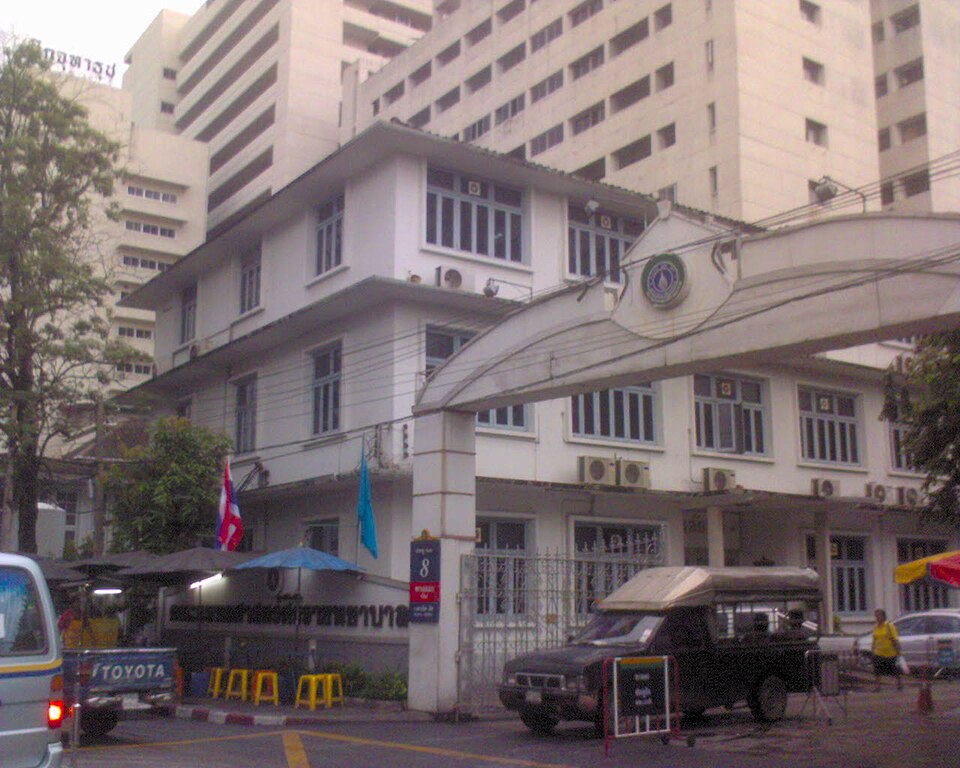
The short answer is that the interior is off limits. Photographing the specimens in the medical museums is prohibited, so a visitor planning around images should reset expectations before arriving: the pictures from this visit will be of the hospital compound, the Thonburi railway station buildings that house Siriraj Bimuksthan, and the river crossing, not of the collections. That is not a small consolation. The restored station buildings are handsome late-nineteenth and early-twentieth-century brick and timber, they photograph well in the low sun of the first hour after opening, and they sit against the water. The ferry crossing itself gives the best angle in the neighbourhood on the Thonburi bank, with the hospital buildings low against the river and the Rattanakosin skyline behind. Carry a camera that is easy to put away rather than one that has to be carried openly through the wards. The single Commons image available for this page, a general view of Siriraj Hospital by Sry85 under CC BY 2.5, is a fair indication of what is actually photographable here.
Checked 2026-08-25
Tuesdays and public holidays. The museums run Wednesday to Monday, 10:00 to 17:00. The closed Tuesday catches people out because most other Bangkok museums close on Mondays instead, so a visitor moving through the city's museums on autopilot will pick the wrong day.
The operator publishes a combined two-museum ticket at 300 THB for foreign adults, 100 THB for Thai adults, and 30 THB for children under 18 of either nationality. A single-museum ticket also exists — its sales close at 16:00 — but the operator does not publish its price, so no figure for it is recorded here.
Earlier than closing. Sales for a single-museum ticket stop at 16:00 and sales for the two-museum combined ticket stop at 15:00, while the halls stay open until 17:00. The Congdon Anatomical Museum closes earlier still, at 16:30.
No. Photographing the specimens in the medical museums is prohibited and staff enforce it. The hospital compound outside, the restored Thonburi railway station buildings that house Siriraj Bimuksthan, and the river crossing are the photographable parts of the visit.
Not for young ones. The forensic hall includes human remains, injury photography and the preserved body of an executed murderer, and the pathology and parasitology collections are equally direct. The operator does price a children's ticket at 30 THB for under-18s, but the content is a matter of judgement rather than of ticketing.
Cross the river. Cross-river ferries land at Wang Lang pier and Rot Fai pier, both a short walk from the museum buildings, and the crossing from Tha Chang on the Grand Palace side takes minutes. MRT Itsaraphap is the rail alternative. Driving is the worst option: the compound is a working hospital and its parking is scarce.
Loading the interactive map…
The interactive map could not be loaded.
Last updated:
Source: OpenStreetMap contributors, Wikidata ·