Tha Phra Chan is a pier on the east bank of the Chao Phraya on Rattanakosin Island, in Phra Nakhon District, and the name has spread from the jetty to the whole warren of lanes behind it — Bangkok's best known market for Thai amulets, along with astrologers, bookshops, shophouses and food stalls. The name means "moon pier": tha is a pier or jetty, phra chan the moon. It comes from Fort Phra Chan, one of fourteen fortifications thrown up around the Grand Palace in the early Rattanakosin period, when moats and forts were built to shield the new capital on the riverbank. The forts were demolished as the city outgrew them, but their names stuck to the streets. The land Tha Phra Chan now occupies was the palace of Prince Prachaksinlapakhom, the founder of Udon Thani Province, who dedicated it to the privy purse; a ferry company later rented the site. Thammasat University's Tha Phra Chan campus stands immediately beside the pier and shares its name.
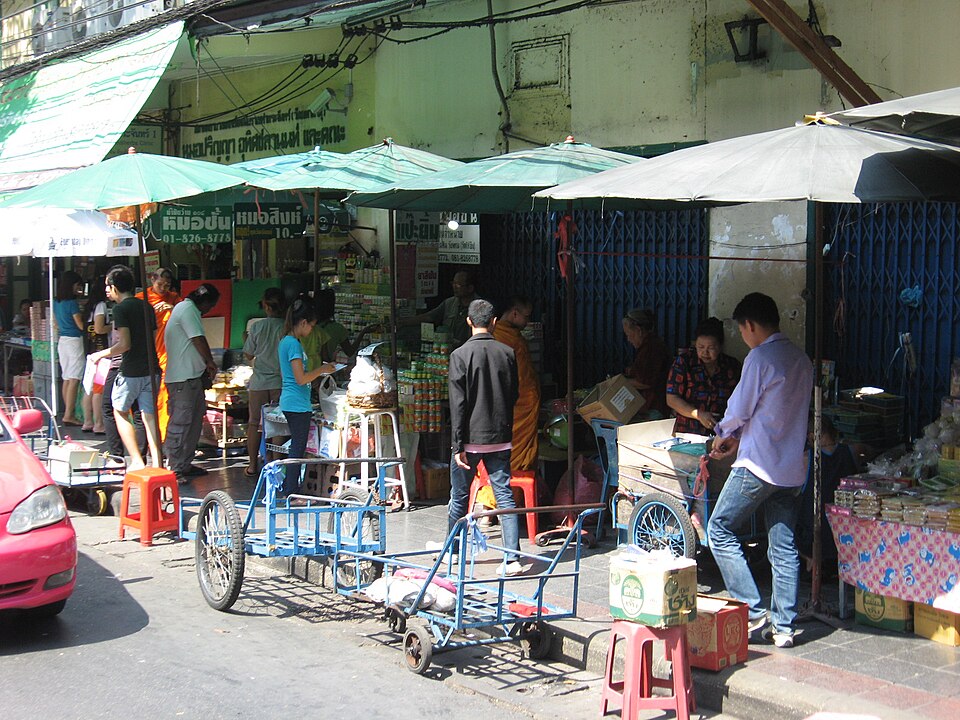
There is no gate and no single building at Tha Phra Chan — what is inside is a street pattern. Phra Chan Road runs inland from the pier and is one of the oldest roads in Bangkok. Its north side is the wall of the Front Palace, now serving as the wall of Thammasat University; its south side is Wat Mahathat Yuwaratrangsarit. Big Burma padauk trees shade the length of it. The road was once longer: the section that is missing today survives as the walkway running through the middle of Sanam Luang. Off that spine sit the amulet stalls the area is known for, trays and glass cases of small Buddha images and monk medallions, worked over by buyers with loupes, and beside them the astrologers who read for walk-up customers. Bookshops, restaurants and food stalls fill the rest, serving a student population as much as a visiting one. The pier itself is a working jetty, not a viewing platform, with a ticket booth, a covered waiting area and a gangway that fills and empties every few minutes.
Allow an hour. That is enough to walk Phra Chan Road end to end under the padauk trees, work through two or three rows of amulet trays, eat something from a stall, and take the cross-river ferry and come back. Tha Phra Chan does not reward a schedule — there is no route through it and nothing that has to be seen in order — so the hour is a browsing budget rather than a tour length. Visitors who actually intend to buy an amulet should double it, because the transaction is slow by design: the seller produces a case, the buyer examines it, and neither is in a hurry. Visitors using the pier only as a river crossing on the way to Siriraj or Wat Rakhang need fifteen minutes at most.
Tha Phra Chan is busy during the day, when its ferry link carries commuters between the Phra Nakhon side of the river and Thonburi on the west bank. That commuter traffic is the reason the area has a rhythm at all: mornings and the end of the working day are when the jetty is most crowded and the food stalls busiest. The amulet trade is a daytime one — the stalls need daylight for buyers to examine what they are being sold, and the trays come out and go away with the sun. A weekday late morning catches the market working without the peak crush at the gangway. This is a Rattanakosin street market rather than a monument, so the calendar that matters is the university's and the river's, not a temple's: term time fills the food lanes, and the days around a royal ceremony on Sanam Luang change the traffic on every road in the quarter.
Nothing is sold at the entrance to Tha Phra Chan, because there is no entrance: the market lanes and Phra Chan Road are public streets and the pier is a public jetty. The only money a visitor needs is for the cross-river ferry and for whatever they buy. No fare for that crossing appears on the operator's own site — the Chao Phraya Express Boat website publishes fares for its Orange, Yellow, Green-Yellow and Red passenger lines, and Tha Phra Chan is not among the piers those lines list, so for this crossing the rate is not published and the fare is paid in cash at the booth. Amulet prices are not posted and are not meant to be: they are set piece by piece between seller and buyer, and a stated "price" for an amulet market would be a fiction.
Tha Phra Chan sits between Sanam Luang and the river, and the simplest approach on foot is across Sanam Luang and down Phra Chan Road, with the Thammasat wall on one side and Wat Mahathat on the other; that walkway through the middle of Sanam Luang is the vanished stretch of the same road. From the water, the pier's own service is the cross-river ferry to Wang Lang on the Thonburi bank, which puts Siriraj Hospital, Wat Rakhang and Thon Buri railway station — the Bangkok Noi station that is the origin of the Southern Line and of the Kanchanaburi branch, the Death Railway — within a short walk on the far side. Arriving by river rather than by road is worth doing in this direction as well as the other, because the approach shows the Rattanakosin bank as a wall of temple roofs before the lane swallows it.
The amulet market is a specialist trade and a visitor is the least informed person on the street. Value here rests on provenance, temple, monk and age, all of which are argued over by collectors with reference books; a small image can be a souvenir or an expensive mistake, and no one at the stall is obliged to explain which. Buy for the object rather than for its supposed rarity, and treat any offer of a "temple bargain" made by someone who approaches on the street as the same scam it is elsewhere in Rattanakosin. Amulets are religious objects and the stalls are handled as such: ask before touching a tray and before pointing a lens into it. The street layout is not permanent either — the Bangkok Post reported in September 2015 that Tha Phra Chan's street vendors were to be cleared, and vending in the quarter has been reorganised more than once since, so a particular row of stalls may have moved. Thammasat's Tha Phra Chan campus behind the wall is a working university, not part of the attraction. At the pier, the gangway is narrow and boards quickly; commuters have somewhere to be, so stand clear of the ramp until the boat is tied.
The photograph most people want here is a close one: hands over a glass case, a loupe held to an amulet, a tray of medallions in flat shade. Ask first — several sellers will refuse, and a refusal is about the trade and its rivalries rather than about the visitor. Shade is the technical problem, because the stalls sit under awnings while the lane outside is in hard tropical light, so meter for the tray and let the street blow out rather than the reverse. Phra Chan Road itself photographs best in the late afternoon, when the padauk canopy breaks the light into patches along the old Front Palace wall. From the jetty, the long view is west across the river to the Thonburi bank, and it is at its best in the last hour before sunset with the ferries crossing into the light. Do not block the gangway for it.
Checked 2026-08-25
Common questions
What is Tha Phra Chan known for?
Tha Phra Chan is best known as a marketplace for Thai amulets and for astrologers, and it is also full of shops, book stores, restaurants and food stalls. The name refers both to the pier on the Chao Phraya and, more broadly, to the area around it and around Thammasat University's campus of the same name.
What does the name Tha Phra Chan mean?
It literally means "moon pier" — tha is a pier or jetty and phra chan is the moon. The name comes from Fort Phra Chan, one of fourteen fortifications built around the Grand Palace in the early Rattanakosin period. The forts were later demolished but their names stayed attached to the streets and quarters of Rattanakosin Island.
How long should a first visit take?
About an hour covers Phra Chan Road, a pass through the amulet stalls, something from a food stall and a ride on the cross-river ferry. Allow two hours if the intention is actually to buy an amulet, because the examination and the haggling are unhurried. Fifteen minutes is enough if the pier is only being used as a river crossing.
Is there an admission charge?
No. Phra Chan Road and the market lanes are public streets and the jetty is a public pier, so admission is not stated anywhere and nothing is sold at a gate. The cross-river ferry fare is paid in cash at the booth; it does not appear on the Chao Phraya Express Boat website, whose published fares cover its Orange, Yellow, Green-Yellow and Red passenger lines.
Where does the ferry from Tha Phra Chan go?
It crosses to Wang Lang Pier on the Thonburi bank, carrying commuters between the Phra Nakhon side and the west bank. Siriraj Hospital, Wat Rakhang and Thon Buri railway station — colloquially Bangkok Noi station, the origin of the Southern Line including the Kanchanaburi Line — are on the opposite side.
What should a visitor be careful about at the amulet market?
Amulet value depends on provenance and is judged by collectors, not by price tags, so buy for the object rather than for a claimed rarity, and ignore anyone who approaches on the street with a bargain. Ask before handling or photographing a tray, since amulets are religious objects. Stall rows also move: the Bangkok Post reported in September 2015 that Tha Phra Chan's street vendors were to be cleared.
Nothing non-essential is set before you choose, in regions where consent is required. If you decline, ads still appear but they are non-personalised, and analytics is switched off entirely.


_(28328053075).jpg)
_(27711849474).jpg)
.jpg)