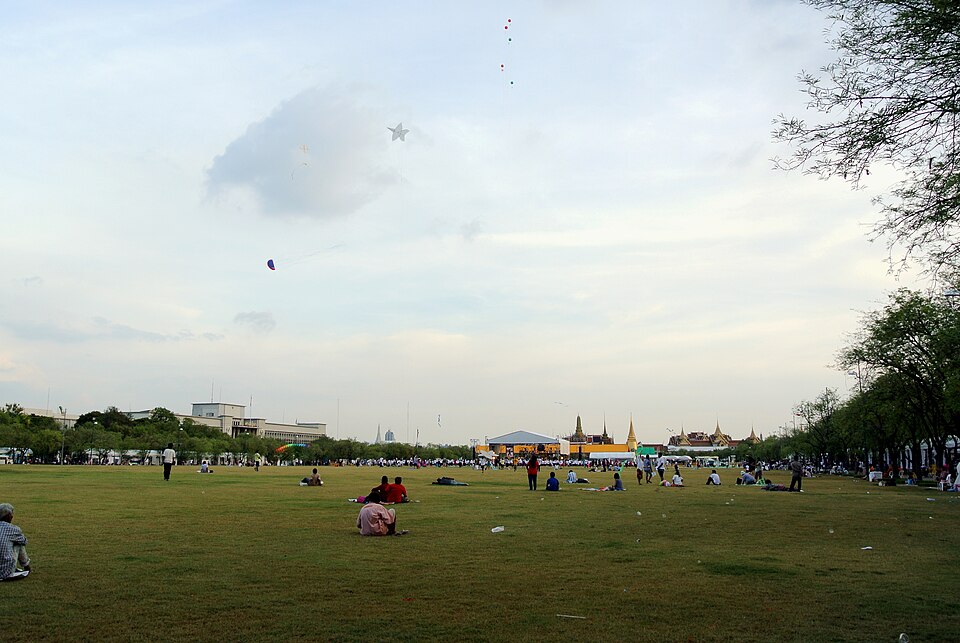
Sanam Luang, "royal turf", officially Thong Sanam Luang, is the great open field in front of Wat Phra Kaew and the Grand Palace in Phra Nakhon district - 74.5 rai, about 119,200 square metres of grass ringed by tamarind trees in the historic centre of Bangkok. Its older name was Thung Phra Men, the royal cremation ground, and that is what it has been used for since the reign of King Rama I: the cremations of kings, queens and high-ranking princes are held here. King Rama IV changed the name to Thong Sanam Luang in 1855. The Fine Arts Department lists it as a historical site, registered in the Royal Thai Government Gazette on 13 December 1977. The Bangkok Metropolitan Administration manages it as public open space today, open daily from 05.00 to 22.00 with no entry fee. It is the only place in Bangkok where the palace, the sky and a crowd can all be in view at once.
Sanam Luang is deliberately empty, and its contents are its trees, its edges and its history. Following a visit to the Javanese court, where he admired the gardens around the sultan's palace, King Rama V ordered two rows of tamarind trees planted around the field; two more rows were added around 1967, bringing the total to 783 trees. The Royal Chronicle describes the field as lying between the Royal Palace and the Front Palace, with the funeral pyre set at the centre and the two palaces' pavilions facing each other north and south, music played from opposite sides. Under King Rama III the ground was planted with rice, to demonstrate to other nations that Siam was so fertile that even the land before the Grand Palace was cultivated; in the rainy season it flooded, and people caught frogs, crabs and ricefield rats in the standing water. King Rama IV built a walled enclosure and a small hall here for the Royal Ploughing Ceremony. King Rama V cleared the older structures and enlarged the field for the centennial celebration of Bangkok in 1897. Kite flying belongs here too - the Royal Chronicles record King Rama II flying a star-shaped chula kite before the Temple of the Emerald Buddha while the Prince of the Front Palace flew a plain pakpao kite at Sanam Luang.
Allow about forty minutes at Sanam Luang. That is enough to cross the field, walk part of the tamarind avenue, take in the view of the Grand Palace walls and Wat Phra Kaew from the open ground, and reach the far side towards Thammasat University and the National Museum. There is no building to enter and no exhibition to work through, so the time is entirely walking and looking, and shade is limited to the tree lines. This is an editorial estimate; the Bangkok Metropolitan Administration publishes opening hours for the field but no suggested visit length.
Sanam Luang is open every day from 05.00 to 22.00 according to the Bangkok Metropolitan Administration, and the two ends of that window are the usable ones: the field is unshaded, and between mid-morning and mid-afternoon it is punishing. Early morning brings exercisers and the best light on the Grand Palace walls; the hour before sunset brings kite flyers when the wind allows, and the palace roofs turn gold. The other consideration is the ceremonial calendar. The field is a working royal ground, used for the Royal Ploughing Ceremony in May and for state occasions, and it has hosted royal cremations including that of King Bhumibol Adulyadej on 26 October 2017 and the celebrations for the bicentennial of Bangkok in 1982 and the golden jubilee in 1996. During preparations for a ceremony the field may be fenced, and it was named as one of the ceremony venues for the 2025 SEA Games. Check before making a special trip.
Entry to Sanam Luang is free. The Bangkok Metropolitan Administration's own park page for the field states no entry charge and gives the opening hours as 05.00 to 22.00 daily, read on 25 August 2026, and those are the values recorded on this page. No ticket office exists, and no part of the field is separately ticketed. Visitors should note that the Grand Palace and Wat Phra Kaew across the road are a different matter entirely and charge their own admission; the free ground ends at the kerb.
Sanam Luang lies on Ratchadamnoen Nai Road in Phra Borom Maha Ratchawang subdistrict, Phra Nakhon, immediately north of the Grand Palace, and almost everyone arrives on foot as part of a walk through the old royal quarter - the Grand Palace and Wat Phra Kaew on one side, the National Museum and Thammasat University on the other. From the river, the Chao Phraya express boat pier at Tha Chang puts you a few minutes' walk from the southwest corner. Taxis reach the surrounding roads easily. The Bangkok Metropolitan Administration lists parking and restrooms among the facilities at the field itself. From the Democracy Monument, Ratchadamnoen Avenue runs straight here, which is exactly the axis its builders intended.
Sanam Luang is a royal ceremonial ground facing the Grand Palace, and it should be treated as one. Dress modestly - visitors here are usually on their way into or out of Wat Phra Kaew, where covered shoulders and knees are required - and behave with restraint near any ceremony, guard or preparation in progress. Political conduct on this ground has legal weight in Thailand: during the 2020 protests demonstrators installed a "Second Khana Ratsadon Plaque" in the field, it was removed within 24 hours, and protest leaders were charged with damaging a historical site, the field being a registered monument since 13 December 1977. Practically: there is almost no shade, so bring water, a hat and sunscreen; the field closes at 22.00; and the ground is grass and earth, which turns soft in the rainy season. Be sceptical of anyone who approaches at the palace end to say the Grand Palace is closed today and offer an alternative tour - that is the oldest scam in this part of Bangkok, and the palace's own gate is the only place worth asking.
Sanam Luang exists to give the Grand Palace something to be seen across, and that is the picture: the spires and the white walls of Wat Phra Kaew from the open grass, with enough foreground of field to show how much space they stand in. Shoot it in the last hour of light, when the roofs go gold and the sky behind them still holds colour; at midday the whites clip and the grass goes grey. The tamarind avenues are the other subject, four rows of them, best used as a frame or as a receding line rather than photographed head-on. Kites, when they are flying, want a long lens and a low angle so the string leads out of the frame. Keep ceremonies, guards and any royal preparation out of the frame unless you are certain photography is welcome there - restraint is the rule near the palace. This is editorial judgement; no published photography restriction for the field itself was found.
Checked 2026-08-25
Common questions
What are Sanam Luang's opening hours?
The Bangkok Metropolitan Administration's park page for Sanam Luang gives the hours as 05.00 to 22.00 daily, read on 25 August 2026. The field may be fenced off during preparations for royal ceremonies or state occasions, so check before making a special trip.
Is there an entrance fee for Sanam Luang?
No. The Bangkok Metropolitan Administration's own page for the field states that entry is free, as read on 25 August 2026. The Grand Palace and Wat Phra Kaew opposite are separately ticketed and are not covered by this.
What is Sanam Luang used for?
It is the royal ceremonial ground of Bangkok. Formerly called Thung Phra Men, the royal cremation ground, it has been used for the cremations of kings, queens and high-ranking princes since the reign of King Rama I, including that of King Bhumibol Adulyadej on 26 October 2017, and for the Royal Ploughing Ceremony and state celebrations. It is public open space at other times.
How big is Sanam Luang and why is it lined with trees?
The field covers 74.5 rai, about 119,200 square metres. King Rama V ordered two rows of tamarind trees planted around it after a visit to the Javanese court, where he admired the gardens around the sultan's palace; two more rows were added around 1967, bringing the total to 783 trees.
How long should I spend at Sanam Luang?
About forty minutes is enough to cross the field, walk part of the tamarind avenue and take in the Grand Palace and Wat Phra Kaew from the open ground. There is no building to enter, so the time is walking and looking. This is an editorial estimate rather than an operator figure.
Is Sanam Luang a protected historical site?
Yes. The Fine Arts Department lists Sanam Luang as a historical site, registered in the Royal Thai Government Gazette on 13 December 1977 under its older name Thung Phra Men. Damaging the site is an offence: protest leaders were charged after a commemorative plaque was installed in the field during the 2020 protests.
Nothing non-essential is set before you choose, in regions where consent is required. If you decline, ads still appear but they are non-personalised, and analytics is switched off entirely.


_%E0%B8%97%E0%B9%89%E0%B8%AD%E0%B8%87%E0%B8%AA%E0%B8%99%E0%B8%B2%E0%B8%A1%E0%B8%AB%E0%B8%A5%E0%B8%A7%E0%B8%87_%E0%B9%80%E0%B8%82%E0%B8%95%E0%B8%9E%E0%B8%A3%E0%B8%B0%E0%B8%99%E0%B8%84%E0%B8%A3_%E0%B8%81%E0%B8%A3%E0%B8%B8%E0%B8%87%E0%B9%80%E0%B8%97%E0%B8%9E%E0%B8%A1%E0%B8%AB%E0%B8%B2%E0%B8%99%E0%B8%84%E0%B8%A3.jpg)
_%E0%B8%AA%E0%B8%99%E0%B8%B2%E0%B8%A1%E0%B8%AB%E0%B8%A5%E0%B8%A7%E0%B8%87_%E0%B9%80%E0%B8%82%E0%B8%95%E0%B8%9E%E0%B8%A3%E0%B8%B0%E0%B8%99%E0%B8%84%E0%B8%A3_%E0%B8%81%E0%B8%A3%E0%B8%B8%E0%B8%87%E0%B9%80%E0%B8%97%E0%B8%9E%E0%B8%A1%E0%B8%AB%E0%B8%B2%E0%B8%99%E0%B8%84%E0%B8%A3_Sanamluang_(1).jpg)
_%E0%B8%AA%E0%B8%99%E0%B8%B2%E0%B8%A1%E0%B8%AB%E0%B8%A5%E0%B8%A7%E0%B8%87_%E0%B9%80%E0%B8%82%E0%B8%95%E0%B8%9E%E0%B8%A3%E0%B8%B0%E0%B8%99%E0%B8%84%E0%B8%A3_%E0%B8%81%E0%B8%A3%E0%B8%B8%E0%B8%87%E0%B9%80%E0%B8%97%E0%B8%9E%E0%B8%A1%E0%B8%AB%E0%B8%B2%E0%B8%99%E0%B8%84%E0%B8%A3_Sanamluang_(2).jpg)
_%E0%B8%AA%E0%B8%99%E0%B8%B2%E0%B8%A1%E0%B8%AB%E0%B8%A5%E0%B8%A7%E0%B8%87_%E0%B9%80%E0%B8%82%E0%B8%95%E0%B8%9E%E0%B8%A3%E0%B8%B0%E0%B8%99%E0%B8%84%E0%B8%A3_%E0%B8%81%E0%B8%A3%E0%B8%B8%E0%B8%87%E0%B9%80%E0%B8%97%E0%B8%9E%E0%B8%A1%E0%B8%AB%E0%B8%B2%E0%B8%99%E0%B8%84%E0%B8%A3_Sanamluang_(3).jpg)
_%E0%B8%AA%E0%B8%99%E0%B8%B2%E0%B8%A1%E0%B8%AB%E0%B8%A5%E0%B8%A7%E0%B8%87_%E0%B9%80%E0%B8%82%E0%B8%95%E0%B8%9E%E0%B8%A3%E0%B8%B0%E0%B8%99%E0%B8%84%E0%B8%A3_%E0%B8%81%E0%B8%A3%E0%B8%B8%E0%B8%87%E0%B9%80%E0%B8%97%E0%B8%9E%E0%B8%A1%E0%B8%AB%E0%B8%B2%E0%B8%99%E0%B8%84%E0%B8%A3_Sanamluang_(4).jpg)