
3 min walk · Savski Venac
Museum of Yugoslav History
- Must see
- Museum
Language · 1 published
Museum · Градска општина Савски венац, Belgrade
Кућа цвећа
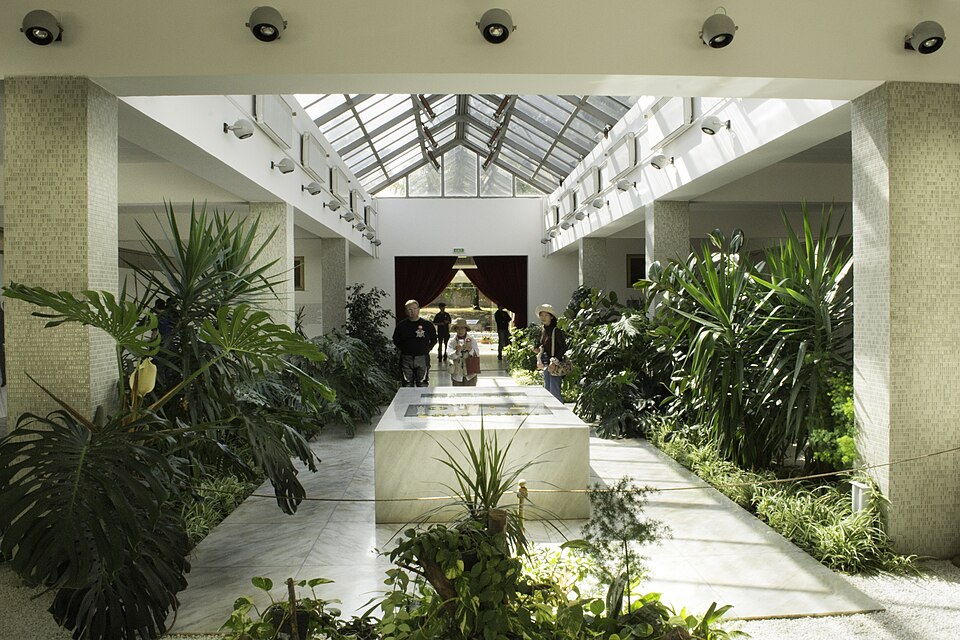
The House of Flowers is Tito's grave, and it was built as a greenhouse.
Stjepan Kralj designed it and it was completed in 1975 as a winter garden with rooms for work and rest — 902 m², a flower garden in the middle and a corridor down each side.
Josip Broz Tito was buried in it in May 1980. His wife Jovanka Broz was laid beside him in 2013.
Between 1982 and 2012 more than seventeen million people came here, which is a number without parallel for a grave in this part of Europe.
It is now part of the Museum of Yugoslavia in Dedinje.
Checked 2026-08-23 · Source
A white marble slab under a glass roof, and the relay batons.
The grave is a plain block in the middle of the garden the building was designed around. There is no iconography and no inscription beyond the name and the dates.
The surrounding rooms display the Relay of Youth — the batons carried across Yugoslavia each year and presented to Tito on 25 May, with the photographs, the written messages and the rally programmes from 1957 onward. Hundreds of them, each designed by a different republic, factory or school.
The wider Museum of Yugoslavia holds the state gifts, which are a strange and specific collection: what governments and workers' collectives thought was appropriate to send a head of state.
Checked 2026-08-23 · Source
Ninety minutes for the whole Museum of Yugoslavia complex.
The House of Flowers itself takes twenty minutes, of which the batons are most.
The other buildings on the site hold the gifts and the temporary exhibitions and take another hour.
Dedinje is a residential hill of embassies and villas a few kilometres south of the centre; there is nothing else here for a visitor and this is a dedicated trip rather than a stop.
Allow half a day including the journey each way, and treat the batons rather than the grave as the part that takes the time.
Checked 2026-08-23 · Source
Any day it is open, and not on 25 May unless you want the crowd.
25 May was the Day of Youth, Tito's official birthday, and 4 May is the anniversary of his death; both bring people who come to remember rather than to look, and both are worth seeing and worth respecting.
The site closes one day a week.
The glass roof makes the mausoleum hot in summer afternoons and bright at midday, which is when the marble reads best.
Checked 2026-08-23 · Source
The Museum of Yugoslavia charges admission, which covers the House of Flowers and the other buildings on the site. Current rates are not published on the sources this page uses and are not reproduced here.
Guided tours in English are offered at set times.
There is no separate ticket for the grave alone.
Checked 2026-08-23 · Source
Dedinje, on Botićeva street, a few kilometres south of the centre.
Trolleybuses and buses from Slavija Square run up the hill in about fifteen minutes. A taxi from the centre is inexpensive and is what most visitors take.
There is no metro in Belgrade; trams, buses and trolleybuses run instead, and the old town is walkable end to end.
Checked 2026-08-23 · Source
It is a grave, and for many visitors it is a grave that matters personally. People come to mourn, particularly around 4 and 25 May, and behaviour that would pass in a museum does not here.
The site closes one day a week.
The museum presents Yugoslavia rather than adjudicating it, which visitors expecting either a denunciation or a celebration find unsatisfying in both directions.
Dedinje is uphill and there is nothing else nearby; allow for the journey both ways.
Photography inside the mausoleum is permitted but flash and posing at the grave are not appropriate.
Checked 2026-08-23 · Source
The grave under the glass roof, with daylight falling on white marble in a green room, is the photograph, and it works at midday when the light is straight down.
Posing at the grave is not appropriate; people are standing there for reasons of their own.
The relay batons are the strongest photographic subject on the site — hundreds of objects in cases, each one an entire design brief from a vanished country.
The building from outside is a low modernist pavilion in a garden and gives very little; the interior is the whole of it.
Checked 2026-08-23
Yes, since May 1980. His wife Jovanka Broz was buried beside him in 2013.
A winter garden of 902 m² with rooms for work and rest, designed by Stjepan Kralj and completed in 1975 — five years before it became a grave.
More than seventeen million between 1982 and 2012 — a number without parallel for a grave in this part of Europe.
The Relay of Youth batons, carried across Yugoslavia each year and presented to Tito on 25 May. Hundreds are displayed with the photographs, messages and rally programmes from 1957 onward.
Yes, the Museum of Yugoslavia, which also holds the state gifts. One ticket covers the whole site.
4 May, the anniversary of Tito's death, and 25 May, the Day of Youth and his official birthday. Both bring people who come to remember rather than to look.
Loading the interactive map…
The interactive map could not be loaded.
Last updated:
Source: OpenStreetMap contributors, Wikidata ·