

2 min walk
Station of Abraham
- Must see
- Historic monument
Language · 11 published
Place of worship · Mecca
| Monday | 00:00 – 23:59 |
|---|---|
| Tuesday | 00:00 – 23:59 |
| Wednesday | 00:00 – 23:59 |
| Thursday | 00:00 – 23:59 |
| Friday | 00:00 – 23:59 |
| Saturday | 00:00 – 23:59 |
| Sunday | 00:00 – 23:59 |
Checked 2026-08-31 · Source
Read from the OpenStreetMap access tags; anything not listed has no tag recorded.
Set the group type to family in the planner and the day window contracts to about three quarters of a solo day.
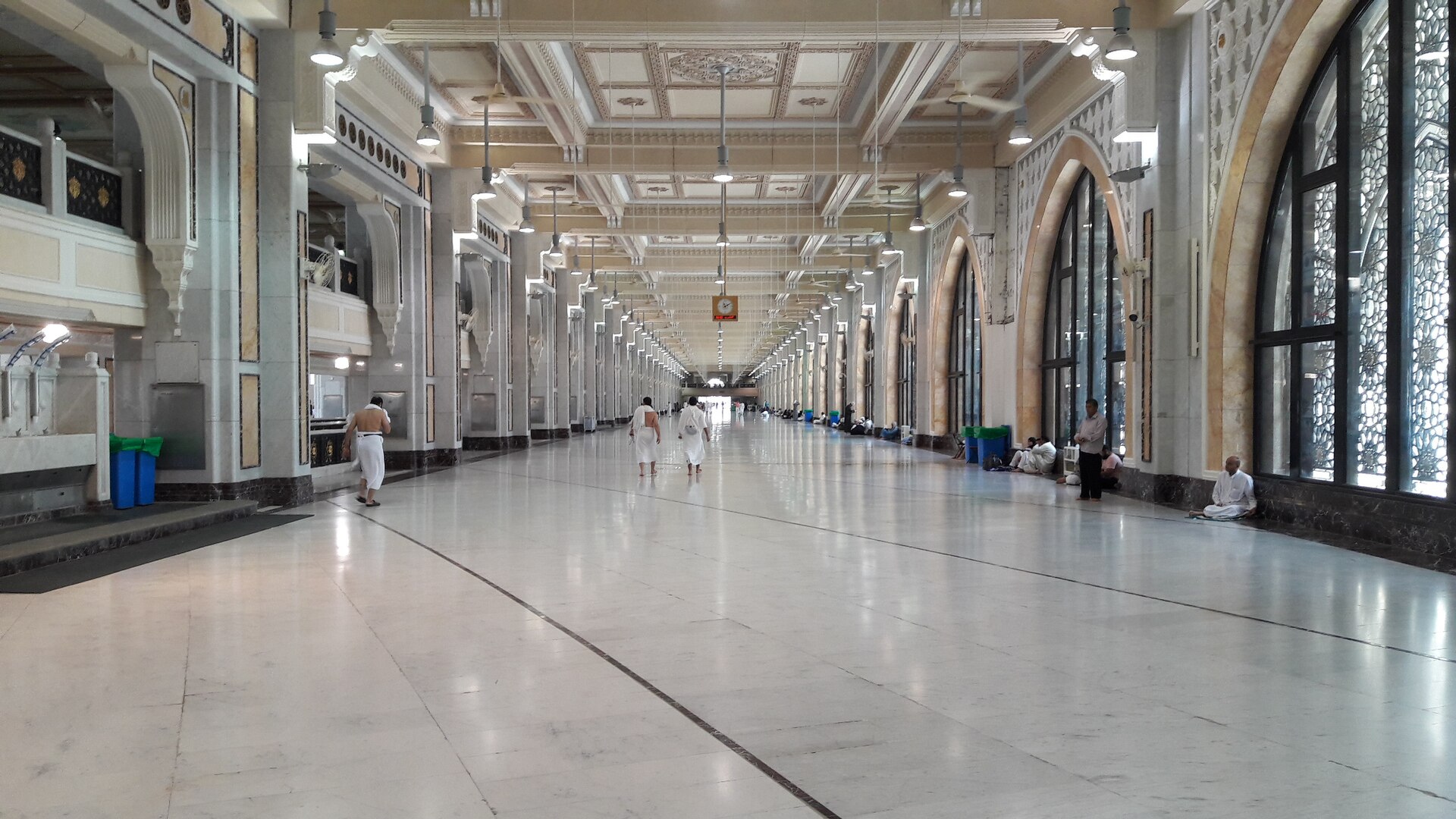
Safa and Marwah are two small hills within the Masjid al-Haram sanctuary in Mecca, Saudi Arabia. They form the endpoints of the sa'i ritual, a devotional walk performed by pilgrims during Umrah and Hajj. The distance between the hills is now enclosed within a multi-level marble-floored structure integrated into the mosque complex. The sa'i commemorates Hagar's search for water for her son Ishmael. The original outdoor path has been fully enclosed and climate-controlled since major mosque expansions. The site holds profound religious significance for Muslims worldwide and operates under the administration of the Saudi religious authorities. Sa'i between Safa and Marwah is a required component of both Umrah and Hajj rituals for those physically able. Omitting it without valid exemption renders the pilgrimage incomplete.
Checked 2026-08-26 · Source
The sa'i corridor between Safa and Marwah spans multiple levels with dedicated pedestrian flows. Green fluorescent markers indicate the section where running is prescribed for able pilgrims. The structure contains wheelchair-accessible routes and designated lanes for mobility-impaired visitors. Drinking water stations appear at intervals, though specific amenities vary by level. The hills themselves are marked with stone indicators at corridor endpoints. The enclosure connects directly to the main prayer halls and circumambulation areas. Climate control systems moderate interior temperatures. The space accommodates extremely high volumes of simultaneous pilgrims during peak seasons, with crowd management infrastructure integrated throughout.
Checked 2026-08-26 · Source
The sa'i ritual comprises seven lengths of the corridor between Safa and Marwah, totaling approximately fourteen individual traverses from one hill to the other and back. Duration depends heavily on crowd density, individual physical capacity, and whether one performs the recommended running segment. During congested periods, completion may extend considerably. Many pilgrims combine sa'i with other rites in sequence. The ritual follows specific supplications and starting procedures at Safa. Practitioners should anticipate variable timing and maintain awareness of surrounding pedestrian traffic throughout the devotional walk.
Checked 2026-08-26 · Source
The sa'i corridors operate in conjunction with Masjid al-Haram access, though specific scheduling for maintenance or capacity restrictions may apply independently. Pilgrims typically perform sa'i immediately following tawaf circumambulation as part of sequential Umrah or Hajj rites. Peak congestion occurs during Ramadan, Hajj season, and Friday prayer periods. Nighttime hours generally see reduced crowds. Seasonal temperature variations affect interior comfort despite climate control. Visitors should verify current access protocols through official Saudi channels before planning, as operational adjustments occur periodically without extensive advance notification.
Checked 2026-08-26 · Source
Access to Safa and Marwah for sa'i constitutes part of general Masjid al-Haram entry; no separate admission mechanism is publicly documented. The Saudi government oversees all sanctuary operations without commercial ticketing intermediaries. Services such as wheelchair assistance or guided support may involve third-party arrangements with unverified cost structures. Visitors should exercise caution regarding unofficial payment requests. Official sources should be consulted for any ancillary service fees. Financial transactions within the broader mosque complex for amenities remain distinct from ritual access itself.
Checked 2026-08-26 · Source
Safa and Marwah lie entirely within the Masjid al-Haram complex in central Mecca. The sa'i corridors connect to multiple mosque entrances and levels. The nearest access points depend on accommodation location and current construction configurations. The mosque complex receives pedestrian traffic from surrounding streets, with vehicle access restricted to perimeter zones. Mecca lacks public rail transit; taxis and buses serve the general area. Pilgrim accommodations typically cluster within walking distance. Signage in Arabic and English directs movement between tawaf areas and sa'i commencement points. Mobility assistance services may be arranged through official mosque administration channels.
Checked 2026-08-26 · Source
Extreme crowd density presents the primary safety consideration, with crushing hazards during peak periods. Pilgrims must maintain situational awareness and protect vulnerable companions. The prescribed running segment requires brief acceleration amid general walking traffic, demanding spatial alertness. Footwear should be secure and practical for prolonged marble-surface walking. Personal belongings require secure carriage due to congestion. Physical exhaustion affects many practitioners; hydration and pacing merit attention. The enclosed environment, while climate-controlled, still imposes demands during extended ritual performance. Visitors with medical conditions should prepare accordingly. Official guidance on emergency procedures and lost-person protocols should be reviewed beforehand.
Checked 2026-08-26 · Source
Photography regulations within the Masjid al-Haram complex, including the sa'i corridors, fall under Saudi religious authority jurisdiction with specific restrictions. Visitors should observe posted guidance and personnel instructions without assumption of permissibility. The devotional context demands respectful conduct prioritizing worship over documentation. Camera equipment may attract scrutiny or intervention. Mobile telephone use for non-ritual purposes may be discouraged in active worship zones. Visitors should defer to immediate official direction and refrain from photographing other individuals without clear authorization in this sensitive religious environment.
Checked 2026-08-26 · Source
Sa'i between Safa and Marwah is a required component of both Umrah and Hajj rituals for those physically able. Omitting it without valid exemption renders the pilgrimage incomplete.
The entire Masjid al-Haram sanctuary, including Safa and Marwah, is restricted to Muslims only under Saudi regulations. Non-Muslims are prohibited from entering Mecca's sacred precincts.
Multiple access points connect to the sa'i corridors from various mosque levels and exterior entrances. Specific routing depends on current construction and crowd management protocols.
Sequential performance of tawaf followed by sa'i is the standard and recommended practice, though scholars acknowledge certain flexibilities in timing based on individual circumstances.
Wheelchair-accessible routes and designated lanes exist within the sa'i structure. Mobility assistance services may be available through official channels, though specific arrangements require direct verification.
Pilgrims in ritual state (ihram) follow prescribed dress codes. Others should maintain modest Islamic attire appropriate for mosque worship, with practical footwear for extended walking on marble surfaces.
Loading the interactive map…
The interactive map could not be loaded.

Last updated:
Source: OpenStreetMap contributors ·