


6 min walk
Embassy Theater
- Notable
- Art and culture venue
Language · 1 published
Viewpoint · Athens
Λυκαβηττός

Mount Lycabettus is a limestone cone rising to 277 metres above the Kolonaki district, and it is the high point of central Athens. The official Athens city guide is careful about the superlative: it calls the summit the second highest viewpoint in the wider city, behind Tourkovounia, which is the honest way to put it. What the hill has that Tourkovounia does not is position. It stands roughly two kilometres northeast of the Acropolis with nothing in between, so the classical city, the modern grid and the port all line up from one parapet. Mythology explains the shape by saying Athena was carrying the rock to fortify the Acropolis and dropped it when a raven brought her bad news. The name is less settled. One account traces it to lykos, wolf, and the packs said to have lived here; another connects it to the sun rising over the ridge and spreading light across the city. The hill has been worked as well as admired: its stone was quarried for the neoclassical buildings that give central Athens its colour, and it held a bunker during the First World War. Today it is an open public hill with no gate and no ticket barrier, walkable from the street at any hour.
Checked 2026-08-26 · Source
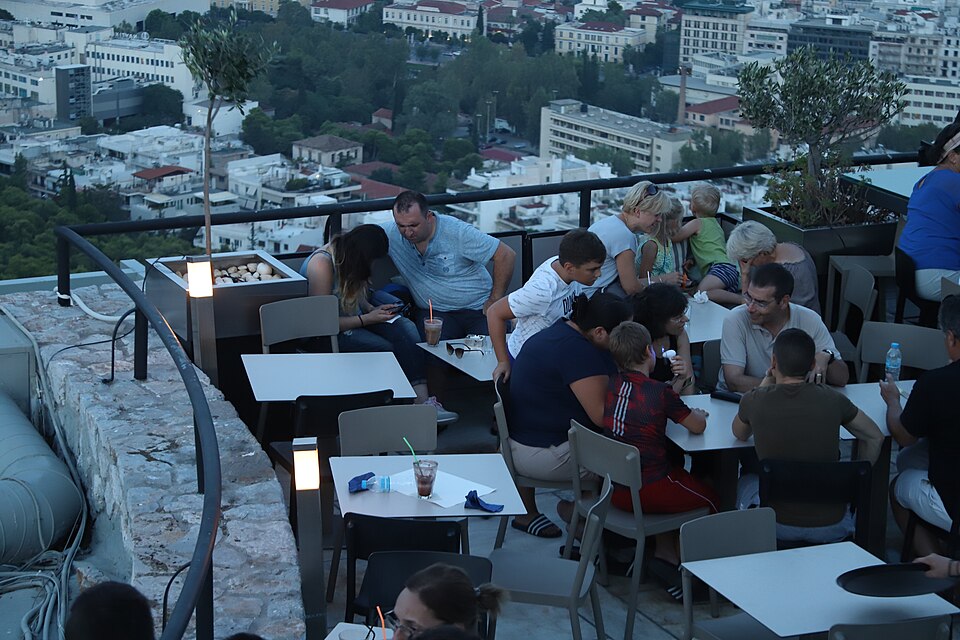
The summit is small and holds three things worth naming. The whitewashed chapel of Agios Georgios sits at the very top, built in the eighteenth century on a site that had already carried a Byzantine church and, before that, traces of a temple to Zeus. Its bell tower went up in 1902 on a donation from Nicholas Thon, a landowner in King Othon's court, and the large bell inside was cast in Russia and given by Queen Amalia. Beside it stands a nineteenth-century hermit's cell, built by a Cretan monk who founded the church and lived out his life next to it. Around the chapel runs the terrace, and off the terrace the Orizontes restaurant and its Skybar, which the operator lists as open daily from 12:30 to 00:30. Lower on the slope is the City of Athens Lycabettus Theatre, cut into the northeast face by the architect Takis Zenetos in the 1960s at the urging of the actress Anna Synodinou. It reopened after fifteen dark years with 3,950 new seats, a layout that can be extended to hold 6,000, new lighting and reinforced structure, and it runs a full summer concert season again. On the southwest flank, a small church of Saint Isidore is built into a cave.
Checked 2026-08-26 · Source
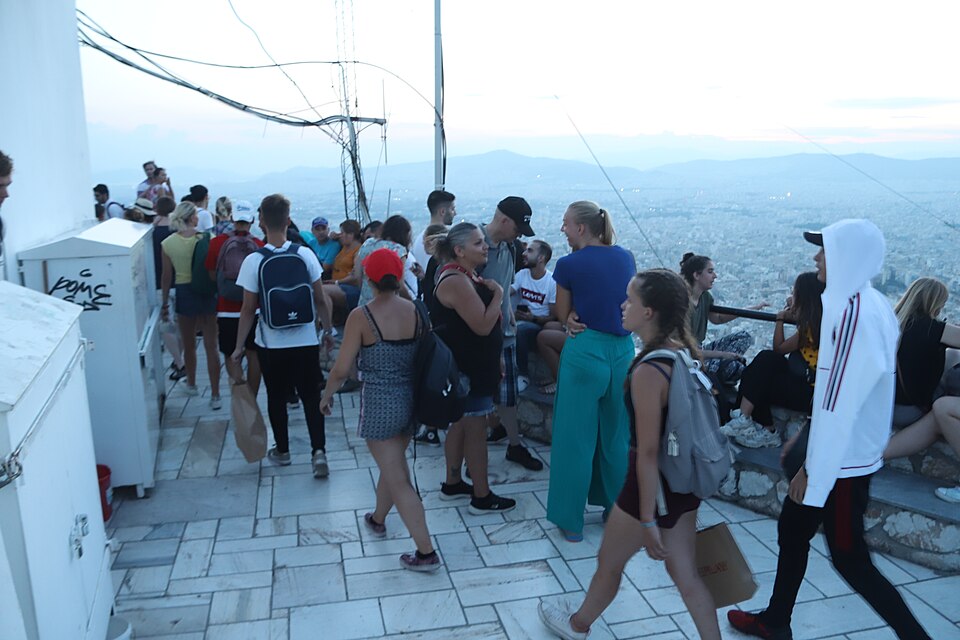
Ninety minutes covers the hill properly from the street and back to it, and that is the figure this guide plans against. The summit itself is compact: the chapel, the terrace, the parapet and the view take perhaps thirty to forty minutes at an unhurried pace, longer if the light is changing and you keep waiting for it. The rest of the ninety goes on getting up and down, and that is the part visitors underestimate. The funicular runs on a thirty-minute headway for most of the day, tightening to ten minutes when it is busy, so a badly timed arrival at the lower station can cost half an hour before you have moved at all. Each car takes thirty-four people, which means a sunset queue clears in cars rather than in seconds. On foot the operator puts the walk from the theatre parking to the summit at five to ten minutes, but that is the short path from a point already high on the hill; starting from the Kolonaki streets below adds a stiff twenty to thirty minutes of stepped climbing. If you intend to eat at the top, treat the meal as separate and add its own two hours.
Checked 2026-08-26
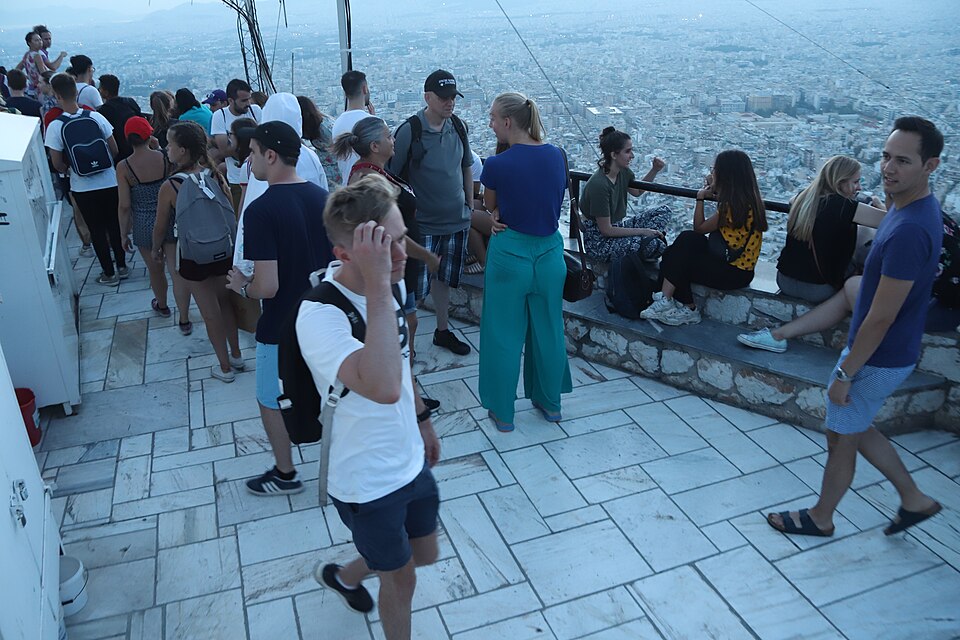
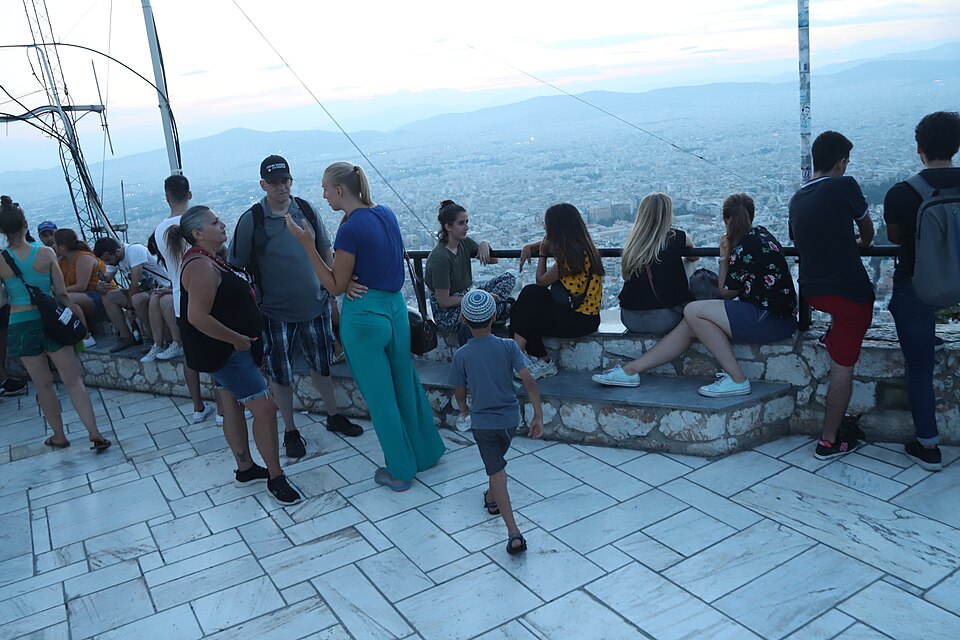
Late afternoon into dusk is the reason most people come, and it is the right instinct. Athens faces you from the west and southwest, so the sun sets behind the Acropolis and Piraeus rather than into your lens, and the twenty minutes after it drops give you the lit city and a sky that still holds colour. Arrive an hour before sunset if you want a place at the parapet rather than a place behind three rows of people at it. Midday in July and August is the worst call: the summit has almost no shade, the terrace stone holds heat, and the footpath is exposed the whole way. Winter is quieter and often clearer, and on a hard bright day after rain the view reaches furthest across the Saronic Gulf. Two dates change the character of the hill entirely. On Good Friday a candle-lit procession leaves the church of Agios Georgios and winds down the slope, which the city's own guide singles out as the thing to see here. On concert nights at the theatre below, the hill fills with several thousand people and the approach roads change their rules.
Checked 2026-08-26
There is no ticket for Mount Lycabettus. The hill is open ground, the summit terrace is open ground, and the chapel of Agios Georgios is a working church that charges nothing. The only thing you pay for is the ride. The funicular's operator publishes the fare as 13 euros per person for a return and 10 euros per person one way, and that is the number recorded on this page: it is a transport fare, not an admission charge, and walking up costs nothing at all. The one-way fare is worth thinking about rather than defaulting to the return. Riding up and walking down suits a visitor who wants the view at sunset but does not want to queue again with everyone else afterwards, and the descent on foot is easy in a way the ascent is not. The restaurant and the Skybar at the top are separate businesses with their own prices, and using them is not a condition of standing on the terrace. Concerts at the City of Athens Lycabettus Theatre are ticketed per event through the promoter, at prices that vary widely with the act; a 2026 date listed on the official city guide ran from 65 to 150 euros.
Checked 2026-08-26 · Source
No car is needed, and on many nights a car is a liability. The funicular's lower station is at Aristippou 1 in Kolonaki, where Aristippou meets the top of Ploutarchou, and the line runs in a tunnel through the hill to the summit. The station sits about a ten-minute uphill walk from Evangelismos on metro Line 3, which is the sensible way to arrive; the last stretch through Kolonaki is steep but paved and lit. Two cars work the line, thirty-four passengers each, leaving every thirty minutes and as often as every ten when demand is high. On foot there are two routes. The operator's own path starts at the Lycabettus Theatre parking area and reaches the summit in five to ten minutes depending on pace. The longer stepped path climbs from the Kolonaki side through pine and scrub and is pleasant in cool weather and punishing in August. On theatre event days the municipality restricts the parking area to disabled visitors and those over sixty, allows taxi drop-offs, and runs a free shuttle from Sarantapichou Street between 19:00 and 21:30. Everyone else walks.
Checked 2026-08-26 · Source
The operator's own website disagrees with itself about the funicular's hours, and this is the trap worth knowing before you plan an evening around it. The access page states services from 09:00 to 02:30, every thirty minutes and every ten at peak. The operator's page about the hill says that the funicular runs until midnight during the summer months to serve visitors. Those two are not the same claim, and neither is a misreading of the other. This guide prints both rather than splitting the difference, and the practical answer is to telephone the station on 210 7210701 on the day if the last car matters to you. Do not plan to be at the top late without a way down: the walk down in the dark is doable but unlit in stretches. The second thing to watch is the stale description still circulating that the theatre on the hill is no longer operational. It is operational and has been since its reopening; the city's own attraction page simply has not caught up. Third, the chapel is a working church, not a viewing platform, and dress and behaviour inside are expected to reflect that.
Checked 2026-08-26 · Source
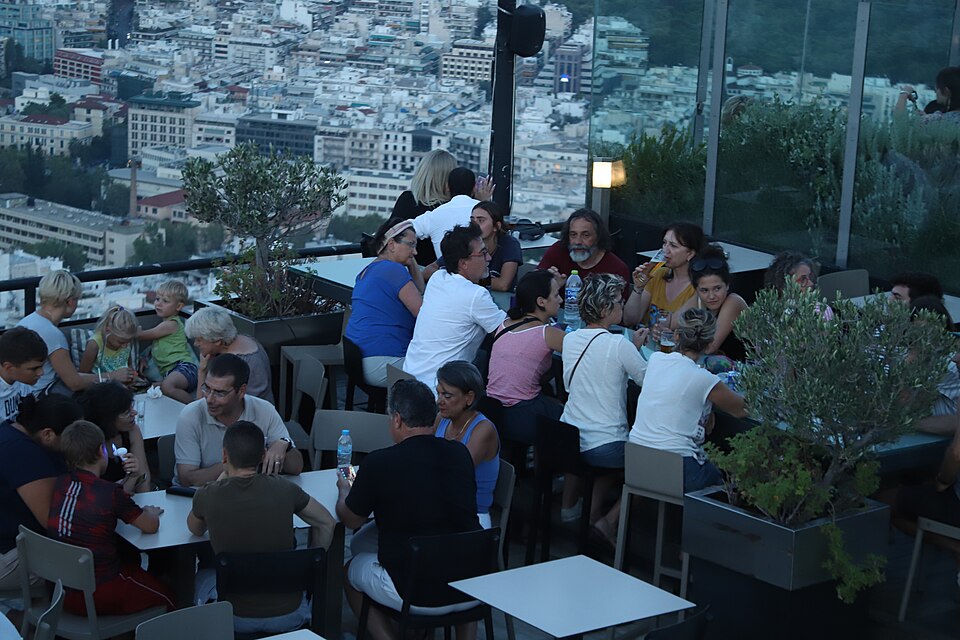
The picture almost everyone comes for is southwest: the Acropolis on its rock in the middle distance, the low sprawl of the city around it, Piraeus and the Saronic Gulf behind, and Aegina on the horizon when the air is clean enough. That composition wants a moderate telephoto rather than a wide lens, because the Acropolis is small at this distance and a wide frame turns it into a detail. Shoot it in the last hour of light, when the rock is warm and the city behind it is still separable, then wait: the twenty minutes after sunset, with the monuments floodlit and the sky not yet black, is when the frame works best and when most people have already left the parapet. The whitewashed chapel is the other subject, and it photographs best from below and slightly to the side, against sky rather than against the city, which means going early or going in winter when the light stays low. Two practical warnings. The parapet at the terrace is crowded and knocked into constantly, so a tripod is more trouble than it is worth at sunset. And it is windy at 277 metres in a way the streets below never suggest.
Checked 2026-08-26
The operator publishes the fare as 13 euros per person for a return trip and 10 euros per person for a single journey. That is a transport fare rather than an admission charge: the hill itself has no ticket gate, and walking up costs nothing. Riding up and walking down at 10 euros is a reasonable choice if you do not want to queue for the descent after sunset.
The operator's access page states that cars run from 09:00 to 02:30, every thirty minutes and as often as every ten minutes at peak times. The operator's own page about the hill says instead that the funicular runs until midnight during the summer months. The two pages disagree and this guide does not average them; if the last car down matters, telephone the station on 210 7210701 on the day.
No. The hill is open public ground with no gate, no closing time and no admission charge, and the chapel of Agios Georgios at the summit charges nothing to enter. The only cost is optional: the funicular fare, or whatever you spend at the restaurant and bar on the terrace. A visitor who walks up and back pays nothing at all.
Ninety minutes from the street and back to it. The summit itself absorbs thirty to forty minutes between the chapel, the terrace and the view, and the rest goes on the climb or on the funicular, which runs on a thirty-minute headway for much of the day. A meal at the top is a separate commitment and should be budgeted on its own.
Yes, and many people do. The operator describes a marked path from the Lycabettus Theatre parking area that reaches the summit in five to ten minutes. Starting lower, from the Kolonaki streets, means a stepped climb through pine and scrub of twenty to thirty minutes. Both are free. Neither is comfortable in the middle of a summer afternoon, when the slope has almost no shade.
The whitewashed eighteenth-century chapel of Agios Georgios with its 1902 bell tower and the hermit's cell beside it; the Orizontes restaurant and its Skybar, which the operator lists as open daily from 12:30 to 00:30; and, lower on the northeast face, the City of Athens Lycabettus Theatre, which reopened after fifteen years with 3,950 seats and runs a summer concert season.
Loading the interactive map…
The interactive map could not be loaded.
Last updated:
Source: OpenStreetMap contributors, Wikidata ·