


1 min walk · Paris 5e Arrondissement
Capitoline Wolf
- Notable
- Art and culture venue
Language · 1 published
Museum · Paris 5e Arrondissement, Paris
| Monday | Closed |
|---|---|
| Tuesday | 09:30 – 18:15 |
| Wednesday | 09:30 – 18:15 |
| Thursday | 09:30 – 18:15 |
| Friday | 09:30 – 18:15 |
| Saturday | 09:30 – 18:15 |
| Sunday | 09:30 – 18:15 |
Checked 2026-08-24 · Source
Read from the OpenStreetMap access tags; anything not listed has no tag recorded.
Set the group type to family in the planner and the day window contracts to about three quarters of a solo day.
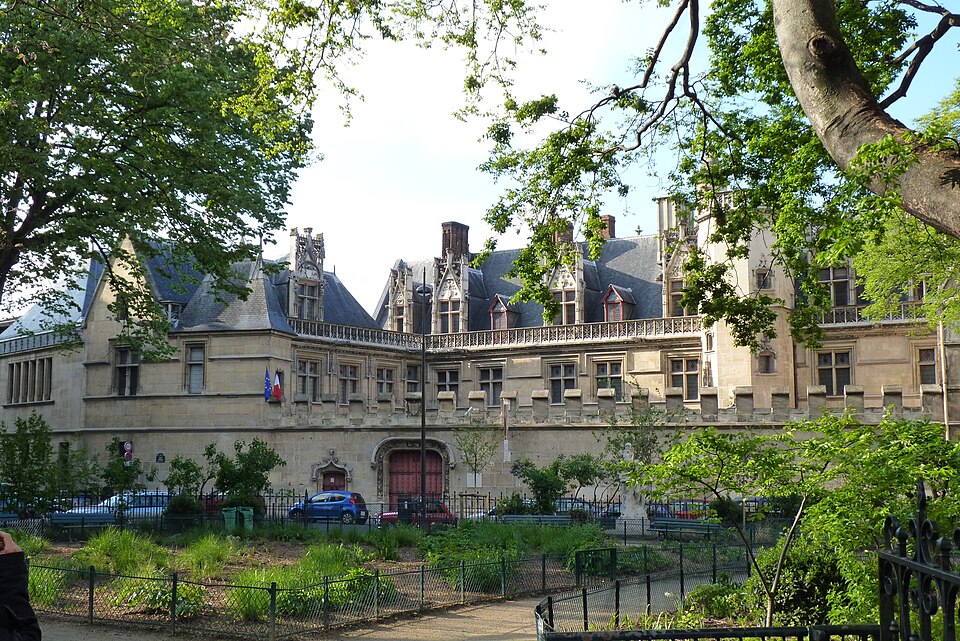
Musee de Cluny — formally the Musee national du Moyen Age — occupies the Hotel de Cluny, a late-15th-century mansion built around 1485-1500 for the Abbots of Cluny as their Paris residence, in the Latin Quarter.
The mansion stands directly against the ruins of Gallo-Roman public baths on the same site, among the best-preserved Roman remains in northern Europe; the frigidarium, the cold room of the baths, keeps its original vaulted ceiling intact after close to two thousand years.
The museum reopened in May 2022 after a long renovation that added a new glass-fronted entrance and reorganised the route through both the medieval mansion and the Roman ruins as a single circuit.
Checked 2026-08-24 · Source
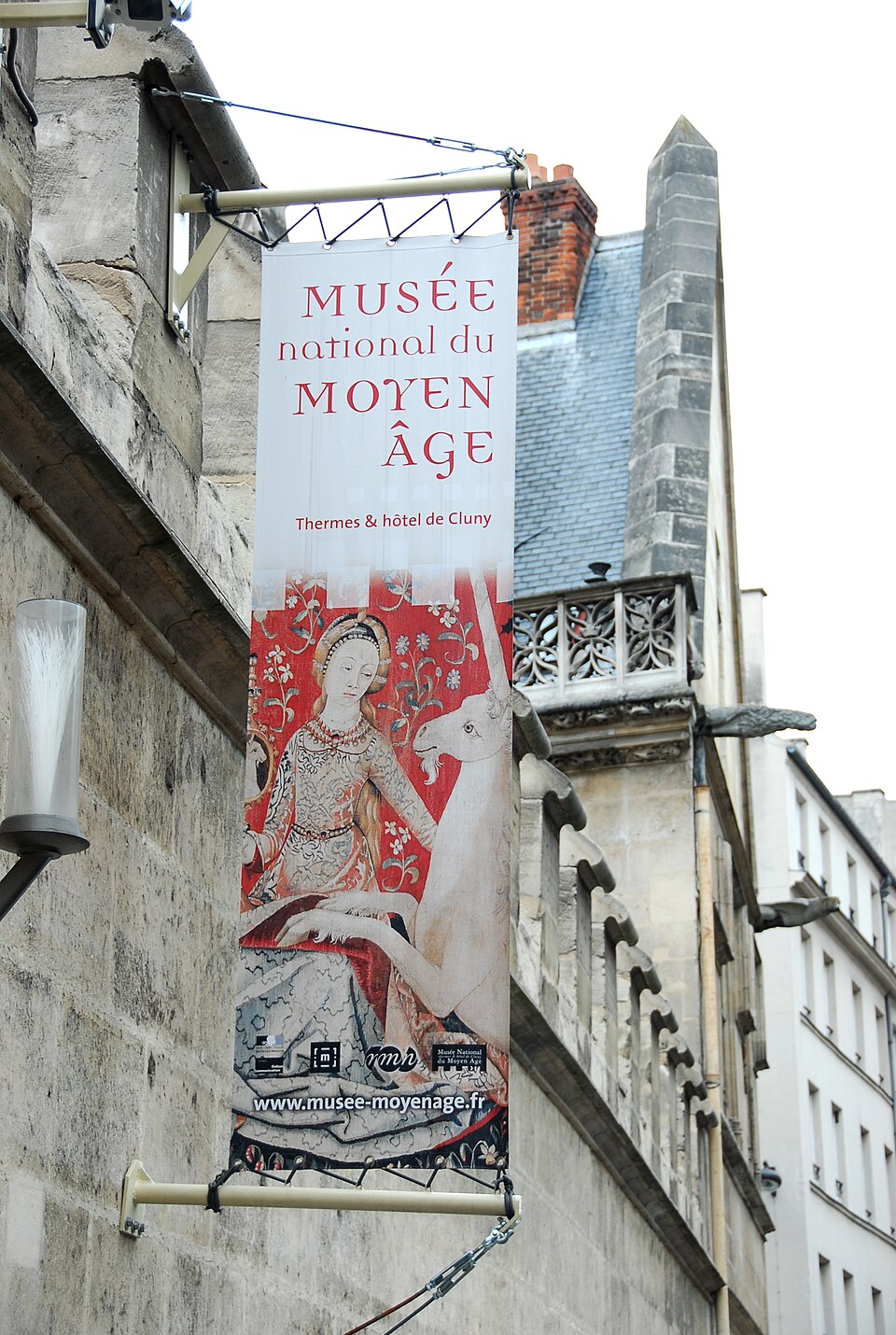
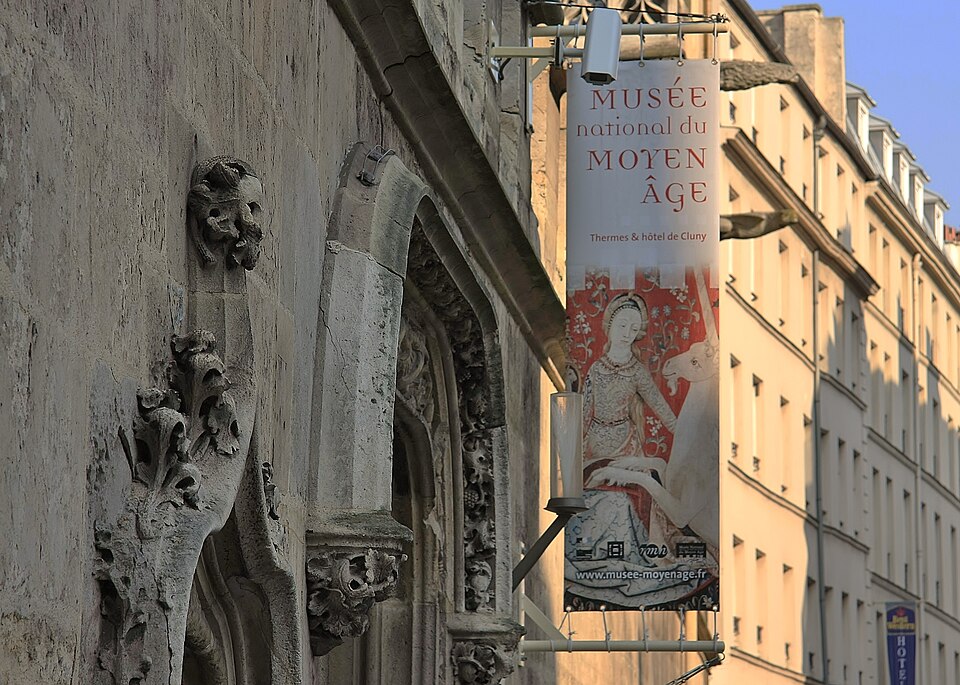
The Lady and the Unicorn (La Dame a la licorne), a cycle of six wool-and-silk tapestries woven around 1500, likely in a Brussels workshop, is the museum's best-known holding and hangs in a dedicated dimly lit rotunda built for the renovation.
The Gallo-Roman frigidarium, with its intact vaulted ceiling, gives the clearest sense in the city of what Roman-era Lutetia's public buildings actually looked like from the inside.
Stone heads from the Gallery of Kings on Notre-Dame's facade — defaced during the Revolution and buried, then rediscovered by chance in 1977 during construction work near Rue de la Chaussee-d'Antin — are displayed together, along with medieval stained glass, illuminated manuscripts and gold reliquaries.
A walled medieval garden on the museum's grounds, planted with species documented in period manuscripts and tapestries rather than a modern ornamental scheme, extends the visit outdoors and gives a sense of what a monastic garden of the period grew rather than only how its buildings looked.
Checked 2026-08-24 · Source

One and a half to two and a half hours covers the tapestry rotunda, the Roman baths and the main medieval galleries at a steady pace.
The tapestry room alone rewards a slower look — the six panels are dense with detail and are meant to be read individually rather than passed in a glance, and visitors with a specific interest in them often spend twenty minutes or more there on its own.
Checked 2026-08-24 · Source
Closed on Mondays. Being a national museum rather than a municipal one, it follows the Reunion des musees nationaux practice of free entry on the first Sunday of the month, October to March.
The tapestry rotunda is kept deliberately dim to protect the textiles, so the difference between a bright and an overcast day outside makes no difference to that room specifically.
Checked 2026-08-24 · Source
Paid entry for the permanent collection, standard for a French national museum, with free admission on the first Sunday of the month from October to March. Current adult and reduced prices are not reproduced on this page; they are set and published by the museum directly.
Checked 2026-08-24 · Source
Cluny-La Sorbonne station on Metro line 10 sits at the museum's door, on the corner of Boulevard Saint-Germain and Boulevard Saint-Michel. Saint-Michel-Notre-Dame, served by the RER B and C, is a short walk north towards the Seine.
The Sorbonne and the rest of the Latin Quarter's university district surround the museum on the south side, which makes it an easy stop to combine with a wider walk through the neighbourhood's older streets rather than a single-purpose detour.
Checked 2026-08-24 · Source

The tapestry rotunda is kept dark to protect the textiles, which makes photography difficult and reading the smaller details of the six panels slower than in a normally lit gallery.
The 2022 renovation added a new glass-fronted entrance that reads as a separate modern structure next to the medieval mansion — first-time visitors sometimes look for a more obviously historic doorway and pass the actual entrance by. School groups are common on weekday mornings and concentrate around the tapestry rotunda.
Checked 2026-08-24 · Source

The Gallo-Roman frigidarium's intact vaulted ceiling is the strongest architecture shot in the museum and is well lit compared with the tapestry rotunda.
Photography without flash is generally permitted around the Lady and the Unicorn tapestries specifically to avoid damaging light exposure on the textiles, which is the reason for the low light in that room rather than an aesthetic choice.
The medieval garden outdoors gives better conditions for a camera than the interior rooms generally allow, with natural light and none of the conservation restrictions that apply around the textile and manuscript collections inside.
Checked 2026-08-24 · Source
The Lady and the Unicorn tapestry cycle, six panels woven around 1500, and the Gallo-Roman baths beneath and beside the medieval mansion.
They date from the Gallo-Roman period, and the frigidarium keeps its original vaulted ceiling intact after close to two thousand years.
May 2022, with a new glass-fronted entrance and a reorganised route through the mansion and the Roman ruins together.
Not on a standard visit — paid entry applies, with free admission on the first Sunday of the month from October to March.
Stone heads from the Gallery of Kings on Notre-Dame's facade, defaced during the Revolution and buried, then rediscovered by chance in 1977 near Rue de la Chaussee-d'Antin.
One and a half to two and a half hours, longer with a specific interest in the tapestries.
Loading the interactive map…
The interactive map could not be loaded.
Last updated:
Source: OpenStreetMap contributors, Wikidata ·