
.png)
1 min walk · Paris 7e Arrondissement
Café Campana
- Notable
- Restaurant or café
Language · 1 published
Museum · Paris 7e Arrondissement, Paris
| Monday | Closed |
|---|---|
| Tuesday | 09:30 – 18:00 |
| Wednesday | 09:30 – 18:00 |
| Thursday | 09:30 – 21:45 |
| Friday | 09:30 – 18:00 |
| Saturday | 09:30 – 18:00 |
| Sunday | 09:30 – 18:00 |
Checked 2026-08-24 · Source
Read from the OpenStreetMap access tags; anything not listed has no tag recorded.
Set the group type to family in the planner and the day window contracts to about three quarters of a solo day.
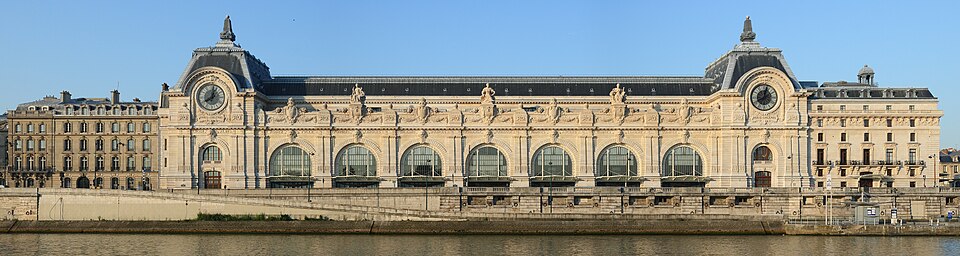
The Musée d'Orsay is a railway station that outlived its trains. The Gare d'Orsay was built between 1898 and 1900 on the Left Bank for the Exposition Universelle, by Lucien Magne, Émile Bénard and Victor Laloux, in full Beaux-Arts dress.
It became a museum in December 1986, opened by François Mitterrand, with the interior reorganised across three levels by the Italian architect Gae Aulenti.
The collection covers French art from 1848 to 1914 and holds the largest collection of Impressionist and post-Impressionist painting in the world. It took 3.9 million visitors in 2023, the second-most-visited art museum in France after the Louvre.
Checked 2026-08-23 · Source
Two thousand paintings and six hundred sculptures at opening, and the fifty-year window they cover is the reason the museum works.
Van Gogh, Manet, Monet, Degas, Courbet, Cézanne, Renoir and Gauguin are all here, and they are here together, in the decades when they were arguing with each other. A museum that stops in 1914 tells that story better than one that runs from antiquity.
Victor Laloux's great clock is the other exhibit. The glass face on the upper floor, with the city behind it, is the most photographed thing in the building that is not a painting.
The vaulted station nave itself holds the sculpture, at ground level, under the original glass roof.
Checked 2026-08-23 · Source
Three hours, and go to the top floor first.
The Impressionist galleries are on the fifth level and everyone arrives at them last, tired, at the busiest hour. Reversing the route is the single most useful thing anyone can do here.
The nave and the sculpture take forty minutes on the way down. The nineteenth-century decorative arts and the Art Nouveau rooms take another forty and are usually empty.
The building is smaller than the Louvre and can genuinely be seen in one visit, which the Louvre cannot.
Checked 2026-08-23 · Source
Late afternoon on a late-opening evening, or the first hour of a weekday.
The queue on the Quai Anatole France forms early and stays. Timed booking is the practical answer.
The museum closes one day a week and the crowds redistribute onto the days either side of it.
The upper-floor clock face is best in the late afternoon, when the light comes through it from the west rather than falling on it.
Checked 2026-08-23 · Source
The Musée d'Orsay is ticketed with timed entry. The figure shown on this page is the one currently published.
It is covered by the Paris Museum Pass. A combined ticket with the Musée de l'Orangerie across the river has been offered, and the two together make a coherent afternoon — the Orangerie holds Monet's Water Lilies in the rooms built for them.
There are separate entrances for booked tickets and for passes, and joining the wrong one costs an hour.
Checked 2026-08-23 · Source

The 7th arrondissement, on the Left Bank quay directly opposite the Tuileries.
Musée d'Orsay on RER C is underneath the building. Solférino on Métro line 12 is two minutes away. From the Right Bank, the Passerelle Léopold-Sédar-Senghor footbridge crosses from the Tuileries in five minutes.
The Métro runs 16 lines across 321 stations, with stations 548 m apart on average — a two-stop journey is usually faster walked.
Checked 2026-08-23 · Source
Book a time. The unbooked queue on the quay is exposed, long and slow in every season.
The museum closes one day a week; confirm before building a day around it.
The Impressionist floor is the crowded floor and it is at the top. Going there first is worth more than any other tactic.
Large bags are not admitted and the cloakroom fills by mid-morning.
Photography without flash is permitted in the permanent collection; temporary exhibitions often prohibit it and are signed.
The quay outside is a working road with fast traffic and no crossing directly at the entrance.
Checked 2026-08-23 · Source
The clock face on the upper floor, shot from inside with the Right Bank behind it, is the picture that belongs to this building alone. Late afternoon puts light through it.
The nave from the upper walkway, looking along the length of the old station under the glass roof, gives the scale that ground level hides.
In the Impressionist galleries the works are unglazed and evenly lit, which makes them unusually easy to photograph — and unusually pointless to, since the reproduction of a Monet is not what you came for.
Flash is prohibited and temporary exhibitions often ban photography entirely.
Checked 2026-08-23 · Source
A railway station. The Gare d'Orsay was built between 1898 and 1900 for the Exposition Universelle by Lucien Magne, Émile Bénard and Victor Laloux.
December 1986, opened by François Mitterrand, with the interior reorganised across three levels by Gae Aulenti.
French art from 1848 to 1914 — around 2,000 paintings and 600 sculptures at opening, and the largest collection of Impressionist and post-Impressionist work in the world.
3.9 million visitors in 2023, second in France only to the Louvre. Timed booking is the practical way in.
The top floor. The Impressionist galleries are on the fifth level and most visitors reach them last, tired, at the busiest hour.
Three hours. Unlike the Louvre, the Musée d'Orsay can honestly be seen in a single visit.
Loading the interactive map…
The interactive map could not be loaded.
Last updated:
Source: OpenStreetMap contributors, Wikidata ·