
.jpg)
1 min walk · Paris 5e Arrondissement
Jean-Jacques Rousseau
- High
- Historic monument
Language · 1 published
Historic monument · Paris 5e Arrondissement, Paris
| Monday | 10:00 – 18:30 |
|---|---|
| Tuesday | 10:00 – 18:30 |
| Wednesday | 10:00 – 18:30 |
| Thursday | 10:00 – 18:30 |
| Friday | 10:00 – 18:30 |
| Saturday | 10:00 – 18:30 |
| Sunday | 10:00 – 18:30 |
Checked 2026-08-24 · Source
Read from the OpenStreetMap access tags; anything not listed has no tag recorded.
Set the group type to family in the planner and the day window contracts to about three quarters of a solo day.
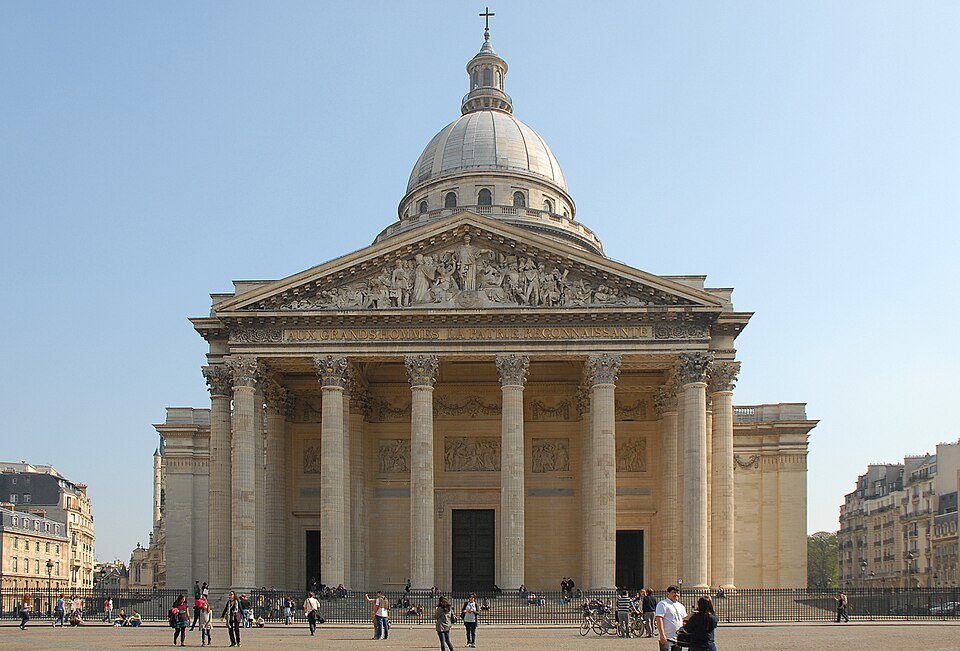
The Panthéon was built as a church and finished just in time to stop being one. Louis XV commissioned it in 1755, Jacques-Germain Soufflot designed it, the foundations were laid in 1758 and it was completed in 1790, a year after the Revolution began.
In April 1791 the National Constituent Assembly turned it into a national tomb and cut the inscription over the entrance: a grateful nation honours its great men.
It is 110 m long, 84 m wide and 83 m high, with a crypt of the same footprint underneath. It stands on the Montagne Sainte-Geneviève in the 5th arrondissement, which is why it can be seen from most of the Left Bank.
Checked 2026-08-23 · Source
A vast empty nave, a pendulum, and eighty-one people in the crypt.
As of December 2021 the remains of 81 people — 75 men and six women — had been transferred here. Voltaire came in 1791 and Rousseau in 1794, Victor Hugo in 1885, Marie Curie in 1995, Simone Veil in 2018 and Josephine Baker in 2021.
Léon Foucault hung a 67 m pendulum from the dome in 1851 and demonstrated the rotation of the Earth in front of an audience that could watch it happen. A replica hangs there now and it is the single most convincing object in the building.
The dome colonnade is climbable in season and gives a view across the Left Bank.
Checked 2026-08-23 · Source
An hour and a half, split between the nave and the crypt.
The nave is large, bright and largely empty, which is the point — it was stripped of its religious furniture and never filled with anything else. Half an hour there, including the pendulum.
The crypt is a grid of vaulted corridors and takes forty-five minutes if you read the inscriptions and fifteen if you do not.
The dome colonnade adds half an hour and a climb.
Checked 2026-08-23 · Source
Late morning, when the sun is high enough to come through the upper windows and reach the pendulum.
The Panthéon is one of the quieter major monuments in Paris — it is uphill, it has no famous single object, and the coach tours skip it. It is rarely uncomfortable at any hour.
The dome colonnade is seasonal and closes in winter and in bad weather.
The interior is unheated stone and is cold whenever the outside is.
Checked 2026-08-23 · Source
The Panthéon charges admission, and the dome colonnade is an extra when it is open. The figure shown on this page is the one currently published.
It is a national monument under the Centre des monuments nationaux and is covered by the Paris Museum Pass.
The Saint-Étienne-du-Mont church next door, which holds the shrine of Sainte Geneviève and the only surviving rood screen in Paris, is free and is fifty metres away.
Checked 2026-08-23 · Source
The 5th arrondissement, at the top of the Montagne Sainte-Geneviève in the Latin Quarter.
Cardinal Lemoine on Métro line 10 is the closest station and the climb up the Rue Clovis is short and steep. Luxembourg on RER B comes out by the Jardin du Luxembourg and the walk across is five minutes and level.
The Métro runs 16 lines across 321 stations, with stations 548 m apart on average — a two-stop journey is usually faster walked.
Checked 2026-08-23 · Source

The crypt is the reason to come and people run out of time before reaching it. Go down first if you are on a schedule.
The dome colonnade is seasonal, weather-dependent and closes at short notice; it involves a spiral climb with no lift.
The building is a mausoleum and the crypt is a burial place. Voices carry in it.
The nave is stone and unheated, and the hill outside is one of the steepest approaches to any monument in central Paris.
Photography is permitted without flash.
Checked 2026-08-23 · Source
The pendulum is the photograph and it needs a slow shutter to show that it is moving. Standing at the rail with the dome above and the bob at the bottom of its swing is the frame.
The nave's scale is hard to convey without a person in it; include one.
The crypt is dim, evenly lit and unflattering to flash. The long vaulted corridors with the name-plates receding are better than any single tomb.
From outside, the portico with its Corinthian columns faces the Place du Panthéon and takes afternoon light. The dome reads better from the Jardin du Luxembourg, several hundred metres away, than from the square at its foot.
Checked 2026-08-23
As of December 2021, 81 people — 75 men and six women. Voltaire (1791), Rousseau (1794), Victor Hugo (1885), Marie Curie (1995), Simone Veil (2018) and Josephine Baker (2021) among them.
No. Louis XV commissioned it as a church in 1755. It was completed in 1790 and the National Constituent Assembly converted it into a national tomb in April 1791.
A replica of the 67 m pendulum Léon Foucault hung from the dome in 1851 to demonstrate the rotation of the Earth.
110 m long, 84 m wide and 83 m high, with a crypt of the same footprint beneath it.
Yes, the colonnade is climbable, but it is seasonal and closes in winter and in bad weather. It is a spiral climb with no lift.
It is the quietest of the major Paris monuments and it is uphill. Allow ninety minutes, and go down to the crypt first if time is short.
Loading the interactive map…
The interactive map could not be loaded.
Last updated:
Source: OpenStreetMap contributors, Wikidata ·