The Centre Pompidou is a building turned inside out, and it is closed until 2030.
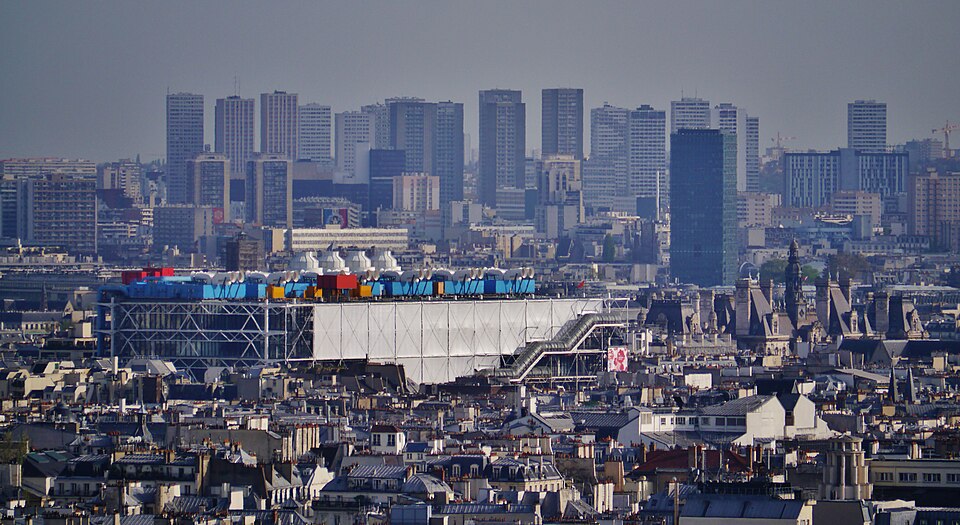
Richard Rogers, Renzo Piano and Gianfranco Franchini won the competition in 1971 against 681 entries, and the centre opened on 31 January 1977. Structure, services and circulation are all on the outside, which is what freed the interior into open floors, and the exposed elements were colour-coded: green for plumbing, blue for climate, yellow for electricity, red for safety.
It closed on 2 March 2025 for a renovation running to 2030 — asbestos removal and energy work, under Moreau Kusunoki with Frida Escobedo.
The square outside remains open and the building can still be seen.
The Musée National d'Art Moderne is the largest modern art museum in Europe. The Bibliothèque publique d'information is a free public library of about 367,000 books. IRCAM is a research institute for music and acoustics, and it is underground beside the building.
The centre was designed for 8,000 visitors a day and took more than 145 million in its first two decades. In 2017 it recorded about 3.37 million museum visitors and 1.37 million library users.
All of it is shut until 2030. Parts of the collection are being shown elsewhere while the building is closed.
Fifteen minutes, for as long as the closure lasts.
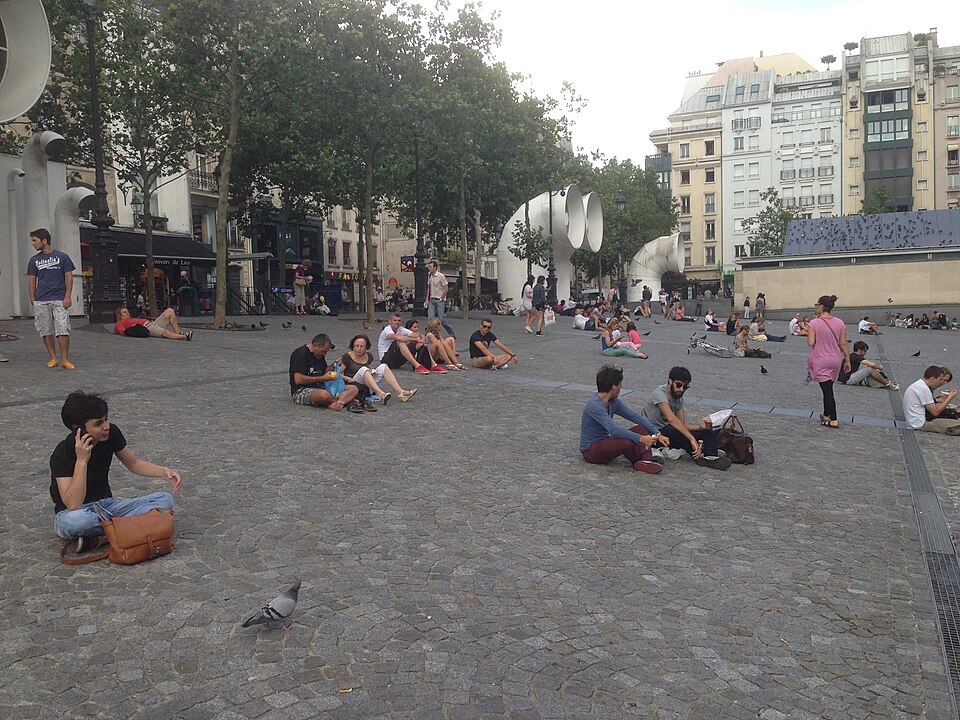
What is left to a visitor is the exterior and the Place Georges-Pompidou that slopes down in front of it, which was designed as public space and still works as one.
When the building reopens in 2030, the modern art collection alone is a three-hour museum and the top-floor view along the escalator tube was one of the better free-standing reasons to go up.
The Stravinsky Fountain on the south side, with its Niki de Saint Phalle and Jean Tinguely pieces, is two minutes away and is open.
Any time while it is closed; the exterior does not have opening hours.
Afternoon light hits the west front with the escalator tube on it, which is the face everyone photographs.
The sloping square in front fills with street performers and people sitting on the ground in good weather, which was the architects' intention and is the liveliest thing about the site at the moment.
The renovation runs to 2030, so anyone planning around a reopening should confirm before travelling.
Nothing is on sale. The centre is closed to the public until 2030.
Before the closure the museum was ticketed, the library was free and IRCAM was not generally open. Any rates from that period are obsolete and are not reproduced here.
The square, the fountain and the streets around are free and open.
It is closed. The single most important thing about the Centre Pompidou in 2026 is that it shut on 2 March 2025 and does not reopen until 2030, and a great deal of travel writing still describes visiting it.
Construction hoarding surrounds parts of the site and the escalator tube is not accessible.
Parts of the collection are being shown at other venues during the closure, which changes; check before planning a day around a particular work.
The area between here and Les Halles is busy at night and is one of the more persistent pickpocket zones in the centre.
The west front with the escalator tube running diagonally across it is the photograph, taken from the top of the sloping square in the afternoon.
The colour-coding — green plumbing, blue climate, yellow electrical, red safety — is easiest to read on the back and side elevations, on the Rue du Renard, and those faces are almost never photographed.
The Stravinsky Fountain beside the church of Saint-Merri gives colour and movement in a frame the grey building does not.
Construction hoarding is in shot from most angles until 2030.
No. It closed on 2 March 2025 for a renovation running until 2030, covering asbestos removal and energy work under Moreau Kusunoki with Frida Escobedo.
Who designed it?
Richard Rogers, Renzo Piano and Gianfranco Franchini, whose design won against 681 entries in 1971. It opened on 31 January 1977.
Why are the pipes on the outside?
The structure, services and circulation were deliberately put outside to free the interior into open floors. They were colour-coded: green plumbing, blue climate, yellow electricity, red safety.
What is inside it?
Three institutions: the Musée National d'Art Moderne, Europe's largest modern art museum; the Bibliothèque publique d'information, a free library of about 367,000 books; and IRCAM.
Can I still see anything?
The exterior and the sloping square in front are open, as is the Stravinsky Fountain beside it. Parts of the collection are being shown at other venues during the closure.
How many people used to visit?
It was designed for 8,000 a day and took more than 145 million in its first two decades. In 2017 it recorded 3.37 million museum visitors and 1.37 million library users.
Nothing non-essential is set before you choose, in regions where consent is required. If you decline, ads still appear but they are non-personalised, and analytics is switched off entirely.




.jpg)
