
_-_btv1b532739831.jpg)

.jpg)
.jpg)
.jpg)
3 min walk · Paris 5e Arrondissement
Le Renard Café
- Notable
- Restaurant or café
Language · 1 published
Historic monument · Paris 5e Arrondissement, Paris
Cavae des Arènes de Lutèce
| Monday | 08:00 – 21:30 |
|---|---|
| Tuesday | 08:00 – 21:30 |
| Wednesday | 08:00 – 21:30 |
| Thursday | 08:00 – 21:30 |
| Friday | 08:00 – 21:30 |
| Saturday | 09:00 – 21:30 |
| Sunday | 09:00 – 21:30 |
Checked 2026-08-24 · Source
Read from the OpenStreetMap access tags; anything not listed has no tag recorded.
Set the group type to family in the planner and the day window contracts to about three quarters of a solo day.
Arenes de Lutece is the surviving Roman amphitheatre of Lutetia, built in the 1st century AD on the slope of what is now the 5th arrondissement, and it once seated an estimated 15,000 people for gladiator contests and theatre.
The Barbarian invasions of the late 3rd century put it out of use, and Lutetia's inhabitants quarried its stone to build a defensive wall around the shrunken city on the Ile de la Cite. The site was built over and forgotten for more than 1,500 years.
It resurfaced in 1869, uncovered by workers cutting the Rue Monge for a new tram depot. Victor Hugo, already a national figure by then, led the public campaign that stopped the depot and got the ruin protected; the arena reopened as a public garden in 1896, laid out by the city architect Jean-Camille Formige.
Checked 2026-08-24 · Source
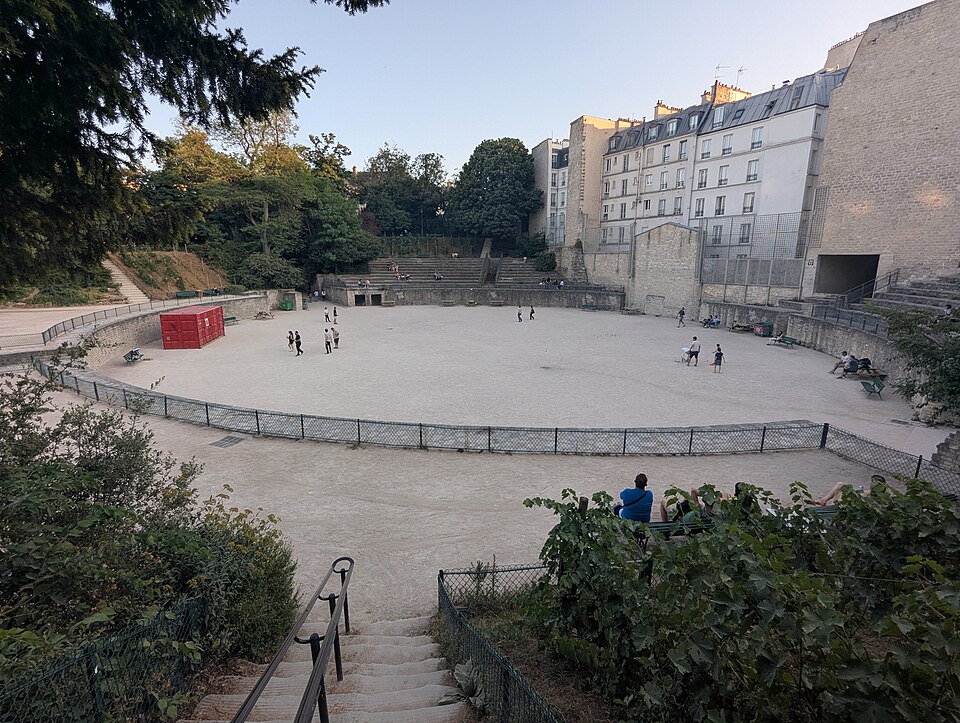
A sunken oval arena floor ringed by tiered stone seating, five rows of which survive on the northern side, cut into the natural slope the way Roman engineers built amphitheatres to save on masonry.
A low wall at the back of the arena marks where the stage building stood, used for theatrical performances as well as combat, which makes this arena a hybrid of the two Roman building types rather than a pure gladiatorial ring.
None of it is roped off. The arena floor is used today the way a neutral patch of Paris gravel gets used: pickup football, petanque on the flat ground near the seating, and picnics on the tiers themselves. A small sign at the Rue de Navarre entrance sets out the excavation history; there is no on-site museum or model.
Checked 2026-08-24 · Source

Twenty to thirty minutes covers it at a walking pace, longer if the arena floor is free for a game of petanque or the tiers are occupied for a sit-down.
There is no indoor content and no ticketed area, so the visit does not extend the way a museum stop does. Most visitors combine it with the Jardin des Plantes, a five-minute walk east, or the Rue Mouffetard market to the west, rather than treating it as a stand-alone destination.
Checked 2026-08-24 · Source

It is a city garden (jardin) and keeps a city garden's schedule: open through the day and locked at night, with the exact opening and closing times shifting by season. Not recorded here — check the gate itself, which posts the current hours, since the site has no dedicated official page of its own.
Weekday mornings are quiet. Saturday and Sunday afternoons bring local families and pickup games, which is also when the arena looks most like what it was built for.
Checked 2026-08-24 · Source
No ticket and no door. Arenes de Lutece is a municipal garden with three street entrances — Rue de Navarre, Rue des Arenes and Rue Lacepede — and free access during opening hours, the same as any other Paris square.
There is nothing to buy on site: no gift shop, no guided tour desk, no audio guide. A visit here costs nothing beyond the walk in.
Checked 2026-08-24 · Source

Place Monge on Metro line 7 is the closest station, a two-minute walk down Rue de Navarre to the main gate. Cardinal Lemoine on line 10 and Jussieu on lines 7 and 10 both reach it in about eight minutes on foot.
The Place Monge market runs Wednesday, Friday and Sunday mornings on the square directly above the arena, which is a reasonable way to arrive with a reason to linger afterwards.
Checked 2026-08-24 · Source

The gates lock outside opening hours, and those hours move with the season, so a late-evening visit can mean a closed gate rather than an empty ruin.
The stone tiers are original Roman construction, uneven and worn smooth in places — footing needs attention, especially with children or in wet weather. Pickup football and petanque share the arena floor with anyone walking through it, so the middle of the space is not always a place to stand still.
There is no fence around the seating and no supervision, which is part of what makes it feel like a real neighbourhood garden rather than a monument, but it also means nothing stops a ball, a dog or a bicycle from crossing the arena floor.
Checked 2026-08-24 · Source

The clearest shot of the amphitheatre shape is from the top of the surviving tiers looking down across the arena floor to the stage wall, which reads as a full oval only from that height.
Morning light comes in low across the seating from the east and picks out the worn edges of the stone steps. There are no photography restrictions — it is an open public garden — and no barriers to shoot around.
Checked 2026-08-24 · Source
Yes. It is a public garden with no ticket and three street entrances, open during the garden's daily hours.
It was built in the 1st century AD as Lutetia's Roman amphitheatre and went out of use after the Barbarian invasions of the late 3rd century.
Workers cutting the Rue Monge for a tram depot uncovered it in 1869. Victor Hugo led the campaign that stopped the depot and had the ruin protected; it reopened as a public garden in 1896.
An estimated 15,000, which made it large enough for both gladiator contests and theatrical performances.
Yes. It is used for pickup football and petanque rather than kept roped off, and the seating tiers are open to sit on.
Place Monge on line 7, about two minutes' walk from the Rue de Navarre entrance.
Loading the interactive map…
The interactive map could not be loaded.
Last updated:
Source: OpenStreetMap contributors, Wikidata ·