.jpg)

3 min walk
Bitexco Financial Tower and Saigon Skydeck
- Must see
- Viewpoint
Language · 11 published
Activity · Ho Chi Minh City
Phố đi bộ Nguyễn Huệ
Reviewed by Elena Voss · SSMTour Travel Editor
Read from the OpenStreetMap access tags; anything not listed has no tag recorded.
Set the group type to family in the planner and the day window contracts to about three quarters of a solo day.
Nguyen Hue Walking Street is Ho Chi Minh City’s central civic promenade, joining a public walking route with the formal space in front of the city administration. Nguyen Hue was upgraded as a pedestrian street while the new Ho Chi Minh monument and its surrounding park were being developed. The two projects were designed as one architectural composition rather than unrelated roadside works.
The monument occupies the park before the headquarters of the People’s Council and People’s Committee. This position brings landscape, architecture, culture and history into an open, dignified space close to the public. The monument’s placement was chosen as part of the city’s administrative centre rather than as a detached object elsewhere in the urban area.
The project grew from a wider plan for the existing central district. The administrative centre was being organised around Le Thanh Ton, Pasteur, Ly Tu Trong and Dong Khoi, while Nguyen Hue was rebuilt to create a coherent pedestrian axis beside it. Today’s visit therefore combines an urban walk, a working government frontage and a public monument landscape. The result is a city-centre sequence in which the pedestrian route and the formal civic setting are read together.
Checked 2026-09-06 · Source
The main experience is a broad urban route framed by central-city architecture and commerce. Nguyen Hue runs from City Hall at its northern end south to Bach Dang Wharf. High-rises, restaurants, commercial arcades and boutiques line the edges, so the promenade’s character comes from the contrast between its open middle and the active building fronts on both sides.
City Hall provides the formal landmark at the northern end. It is the administrative post of the Ho Chi Minh City People’s Committee and is not open to the public, so the building is viewed from the civic space outside. The southern direction leads toward Bach Dang Wharf and the riverfront, giving the street a clear end-to-end orientation rather than the loop of a conventional park.
The route changes as surrounding businesses open and close and as people gather in the central space. Restaurants, arcades and boutiques create a changing commercial edge rather than a fixed collection of exhibits. Treat the street itself as the attraction: look along the full axis, use the endpoints to stay oriented, and choose any commercial stop separately. The defining elements are the walking route, its civic endpoint, the movement toward the wharf and the dense line of city-centre activity along both sides.
Checked 2026-09-06 · Source
There is no single prescribed visit length because Nguyen Hue is a linear public street rather than a timed interior attraction. The most direct version is an end-to-end walk between City Hall and Bach Dang Wharf. A longer visit develops naturally when the walk includes the restaurants, commercial arcades or boutiques along the street, or when the promenade is folded into a wider central Ho Chi Minh City route.
Use the two endpoints to shape the visit. Starting at City Hall gives an immediate view of the civic frontage before the route moves toward the river. Starting at Bach Dang Wharf reverses that sequence and finishes at the city administration. Either direction preserves the same main sightline, so there is no required circuit or mandatory order of rooms.
An afternoon stroll can lead into sundown, when the street is liveliest. That makes the amount of stopping more important than the distance alone: a continuous walk is a compact city-centre segment, while meals, shopping and pauses in the public space turn it into a larger outing. Keep adjacent venues outside the street’s own time estimate, since each business has its own schedule and the City Hall interior is not open to visitors.
Checked 2026-09-06 · Source
Check the dated city event notice before choosing a time, because Nguyen Hue’s usable layout can change even when the street remains a public space. A June 2026 programme shows how substantial those changes can be. Construction and installation work occupied the walking street before the event; rehearsals and performances then used a stage at the Ngo Duc Ke intersection, while displays, exhibitions and public activities ran on the section between Le Loi and Ngo Duc Ke.
For the main gala, the entire Nguyen Hue route was used for exhibition, activity and stage areas. Nearby sections of Le Loi and Ngo Duc Ke became emergency corridors where vehicle movement, stopping and parking were prohibited and crowding was restricted. Traffic police advised people travelling through the city centre to use Pasteur, Dong Khoi, Ton Duc Thang or Ham Nghi instead during the busiest programme dates.
Those June dates are a past example, not a recurring weekly timetable. The event added performances and displays but also introduced construction zones, controlled corridors and altered approaches on specified dates. Base the visit on the current notice for the actual date, especially around civic celebrations and large public events. Do not assume fixed pedestrian-only hours or unrestricted access along every section, and do not reuse the June 2026 traffic plan for a later programme.
Checked 2026-09-06 · Source
General use of Nguyen Hue Walking Street is free. The free access applies to the public walking-street experience: strolling through the landscaped space, seeing the decorative lighting and sculptures, and encountering outdoor activities or street-art exhibitions when they are present. It does not create a pass for every business or building along the route.
Restaurants and food outlets beside the promenade are separate commercial venues, and purchases there are personal expenses. The same separation applies to shops and any independently operated attraction in the surrounding buildings. Decide on those stops individually instead of treating the street as a ticket that bundles them together.
The walking street lies near Le Thanh Ton in the central area. Nguyen Hue is an outdoor public-space visit, while surrounding interiors have their own access conditions. Free use of the promenade covers the shared landscaped route, decorative features and public activity space. Food, shopping and access to independently managed interiors remain separate decisions. This distinction is useful when planning the visit: no general street ticket needs to be purchased, but the free listing does not set the prices, booking rules or access conditions of neighbouring venues.
Checked 2026-09-06 · Source
Opera House Station on Metro Line 1 provides a direct public-transport approach to central Nguyen Hue. Passage number 4 connects the station with level B2 of Union Square. The connection lets passengers leave the underground railway for the shopping and dining complex without first returning to street level outside.
For Nguyen Hue, remember that passage 4 ends inside Union Square rather than on the surface of the promenade. Follow the centre’s signs upward, then orient yourself toward Nguyen Hue. People working on Nguyen Hue described the link as removing the need to return to ground level and walk around the outside of the centre before reaching the street.
The station-to-centre link was Ho Chi Minh City’s first connection of this kind and forms an example of transit-oriented development. Union Square therefore works as both an arrival point and an indoor transition between the metro and the surrounding commercial district. The station passage does not replace the final navigation through the shopping centre to the street. Follow the live signs inside Opera House Station and Union Square. Passage 4 is the specific connection named for the B2 route; other station exits should not be assumed to provide the same direct indoor link.
Checked 2026-09-06 · Source
Street crossings deserve attention even though Nguyen Hue is known as a walking street. During a 2015 accessibility visit, shallow kerbs and gentle ramps allowed wheelchair users to move through much of the promenade with limited assistance. Pedestrian-priority buttons at crossings emitted a signal that helped blind pedestrians judge the crossing phase, but participants said the period of roughly twenty seconds could be too short for some wheelchair users.
The fountain area was open and step-free during that visit. An underground public toilet had a shallow entrance, a gentle ramp and an attendant who could assist visitors. These features supported access, but participants also identified missing raised or tactile markings around lifts, pavements and crossing buttons. A route that works for one wheelchair user may therefore remain difficult for a blind visitor or for someone who needs more crossing time.
Kerbs, signals, lifts and toilet access can change, so inspect the current route rather than treating the 2015 conditions as permanent. Check the crossing signal before entering the carriageway, allow extra time at intersections and do not assume that the central paved area eliminates vehicle conflicts at every junction. Visitors who need a particular accessible route should follow current on-site signs and ask attendants about the underground facilities rather than depending on a fixed map.
Checked 2026-09-06 · Source
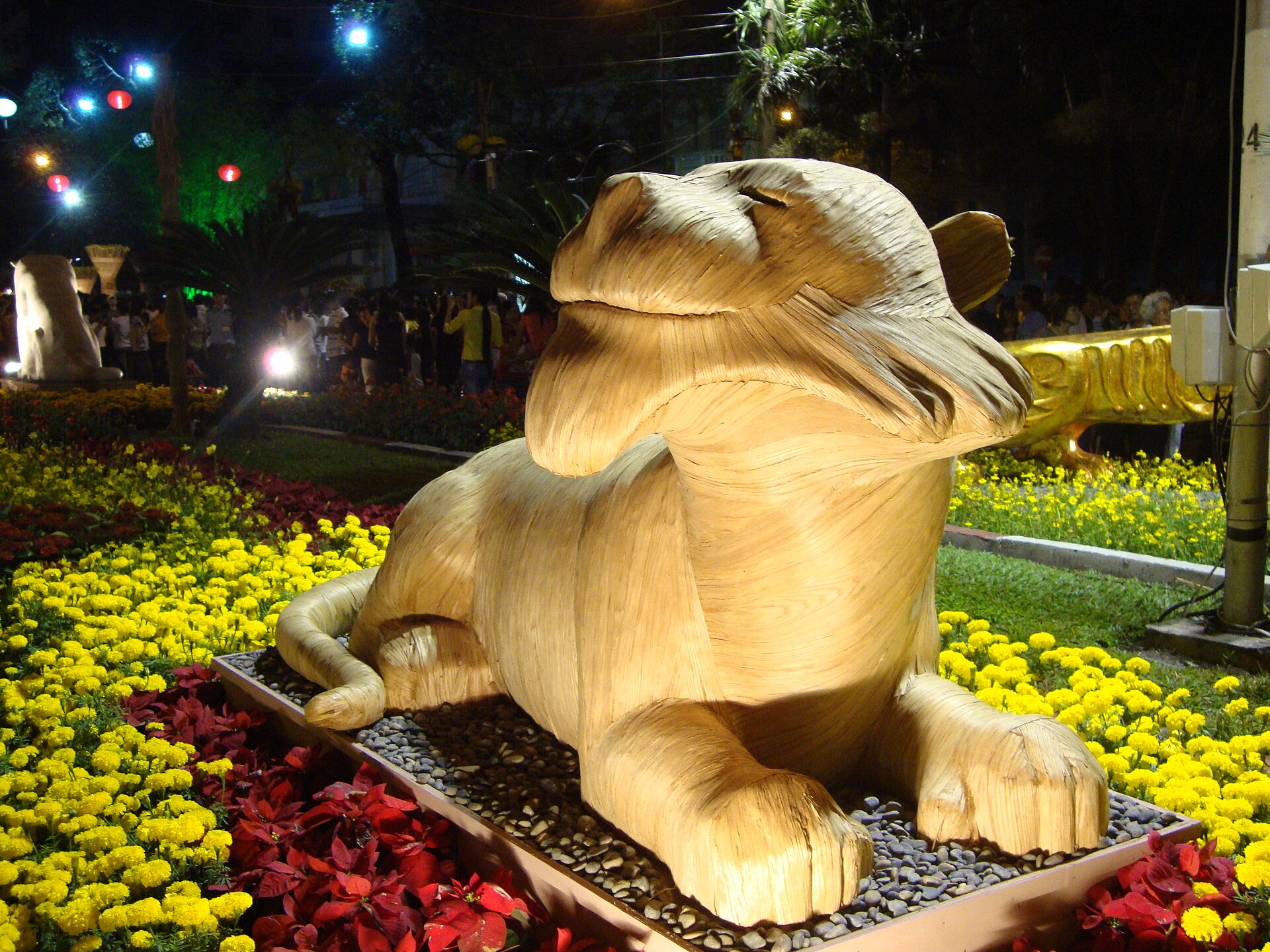
Nguyen Hue’s strongest photographic feature is its ability to become a city-scale display space. The 2026 Tet flower street turned the full route into a continuous cultural journey rather than a set of isolated decorations. Major scenes interpreted the Saint Giong horse, the southern Vietnamese Ly Ngua O musical tradition, the nine-red-maned horse and the Vinh quy bai to homecoming motif through contemporary art. Projection mapping added five programmes based on the five elements, while an augmented-reality horse experience extended parts of the display into a digital format.
That programme demonstrates the range of subjects the promenade can hold: monumental gateways, layered installations, performance light, crowds and long axial views. It also shows why dated context matters. The 2026 flower street closed in February, although its entrance and final gate were retained until a stated March date. The structures were temporary and should not be expected outside their published display period.
During a named installation, include the programme and date in captions so temporary art is not mistaken for the everyday streetscape. Use the sequence of large scenes to show how the route was designed as one cultural narrative, and distinguish physical installations from the mapping projections and augmented-reality layer. Follow posted camera, tripod or drone restrictions, security directions and any event-specific notices visible on the day. Do not expect a past festival’s lighting, gateways or structures to remain after the programme ends.
Checked 2026-09-06 · Source
The promenade is public, but no stable all-day access schedule is recorded here. Official city notices show that events and traffic plans can change access to sections, so check dated notices before visiting.
No. General access to the public promenade is free.
The promenade is more than 670 metres long and 64 metres wide.
Yes, with limitations. The paved promenade has shallow curb transitions and ramps, but some crossing phases are short and tactile identification is incomplete.
Yes. An underground public toilet is reached by a shallow ramp and a dedicated wheelchair lift, with an attendant available.
Opera House Station on Metro Line 1 serves the northern end; Exit 4 connects directly to Union Square on Nguyen Hue.
Loading the interactive map…
The interactive map could not be loaded.

Last updated:
Source: OpenStreetMap contributors ·