


.jpg)
2 min walk · เขตพระนคร
Wat Ratchapradit
- Must see · Heritage site
- Historic monument
Language · 1 published
Historic monument · เขตพระนคร, Bangkok
สวนสราญรมย์

| Monday | 04:00 – 21:00 |
|---|---|
| Tuesday | 04:00 – 21:00 |
| Wednesday | 04:00 – 21:00 |
| Thursday | 04:00 – 21:00 |
| Friday | 04:00 – 21:00 |
| Saturday | 04:00 – 21:00 |
| Sunday | 04:00 – 21:00 |
Checked 2026-08-25 · Source
Saranrom Park, or Saranrom Royal Park, is a 23-rai public park directly east of the Grand Palace, run by the Bangkok Metropolitan Administration, and one of the few green spaces in Rattanakosin that a visitor can simply walk into and sit down in. It began as the pleasure garden of Saranrom Palace, which King Mongkut ordered built in 1866, and was laid out early in King Chulalongkorn's reign, around 1874, on the advice of Henry Alabaster, who designed and built it as a botanical garden after foreign models with Phraya Aphirak Ratcha-uthayan supervising the works. It was used to receive foreign royal guests. After the 1932 revolution King Prajadhipok granted it to the government and it became the ground of the People's Party; the cabinet handed it to Bangkok as a public park in 1960. What is left is a Rattanakosin-period Thai garden shaped by Western ideas, now one of the city's steadier exercise grounds.
Checked 2026-08-25 · Source
The park is a garden with monuments standing in it. The memorial to Queen Sunandha Kumariratana was ordered by King Chulalongkorn in 1883 as a monument of love and mourning for the queen and their daughter, Princess Kannabhorn Bejaratana, who died when a royal barge capsized, and it was placed where the queen had liked to spend her time; it is white marble with a prang finial, ringed by frangipani trees, and carries an inscription on four faces — prose on the first, verse on the second and fourth, and English in Roman letters on the third. Crown Prince Maha Vajirunhis pulled the cord that unveiled it on 28 June 1883. The Glass Pavilion is a single-storey glass-roofed hall with carved woodwork that housed the Thawi Panya Club and its theatre from 1904, a Western-style club for nobles and senior officials; it later held the Bangkok Tree School from 1999 and is currently unused. The Trumpet Pavilion, built when King Vajiravudh was still Crown Prince, was where naval brass bands played at garden parties. There is also an octagonal resting pavilion in the style popular under King Chulalongkorn, the Chinese Takian Thong shrine that dates from the garden's making, a floral-patterned doorway with an archway registered by the Fine Arts Department, and a European metal-tray fountain over a hundred years old. A champaka, Pterospermum acerifolium, a rare and protected Thai species, grows beside the glasshouse and flowers around January and February.
Checked 2026-08-25 · Source
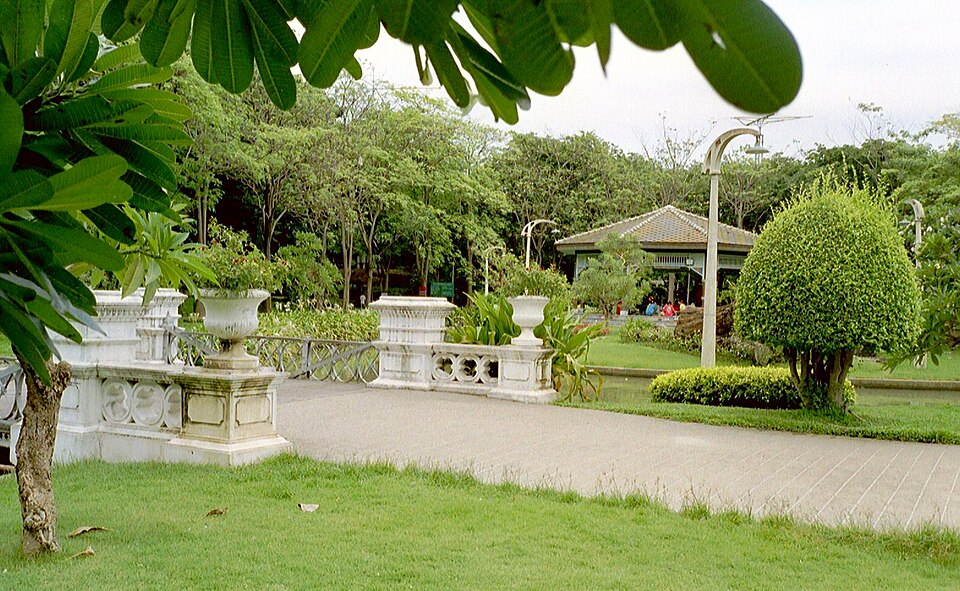
An hour is the honest figure. Saranrom is not large — 23 rai is a garden rather than a park in the Lumphini sense — but its interest is spread out in small objects that each need a minute or two: the Sunandha memorial and its inscriptions, the fountain, the shrine, the two pavilions, the neglected glasshouse. Walking the paths without stopping takes twenty minutes. Anyone treating the park as a rest stop between the Grand Palace and Wat Ratchabophit can do it in half an hour and still see the monuments; anyone who reads the inscriptions and sits down afterwards will use ninety minutes without noticing. Add time in the early morning, when the park's real function — exercise ground — is on show.
Checked 2026-08-25

Saranrom opens at four in the morning and the first hours are the ones that show what the park is for. Bangkok's own listing names Chinese boxing, sword and stick dancing, aerobics, walking and running, a health court with exercise equipment, and musical performance among the activities here, and those happen at the cool end of the day rather than in the middle of it. From late morning the park empties into shade and becomes a quiet place to sit between two hot sightseeing stops, which is its other use. Evening brings a second exercise crowd before the nine o'clock close. For the champaka beside the glasshouse, January and February are the months, when its fragrant flowers open. The monuments are outdoors and unroofed, so a wet-season afternoon downpour ends a visit rather than interrupting it.
Checked 2026-08-25 · Source
Entry is free. The Bangkok Metropolitan Administration's own park page states the admission fee as free and gives the opening and closing times as daily 04.00–21.00, with a contact number of 02-221-0195. No ticket office exists and no charge is made for the monuments inside. The only published fee attached to Saranrom is a use fee rather than an admission: the city's public-space booking platform lists commercial film production in the park at 6,000 baht per day, which is a permit matter for production companies and has nothing to do with an ordinary visitor carrying a camera.
Checked 2026-08-25 · Source
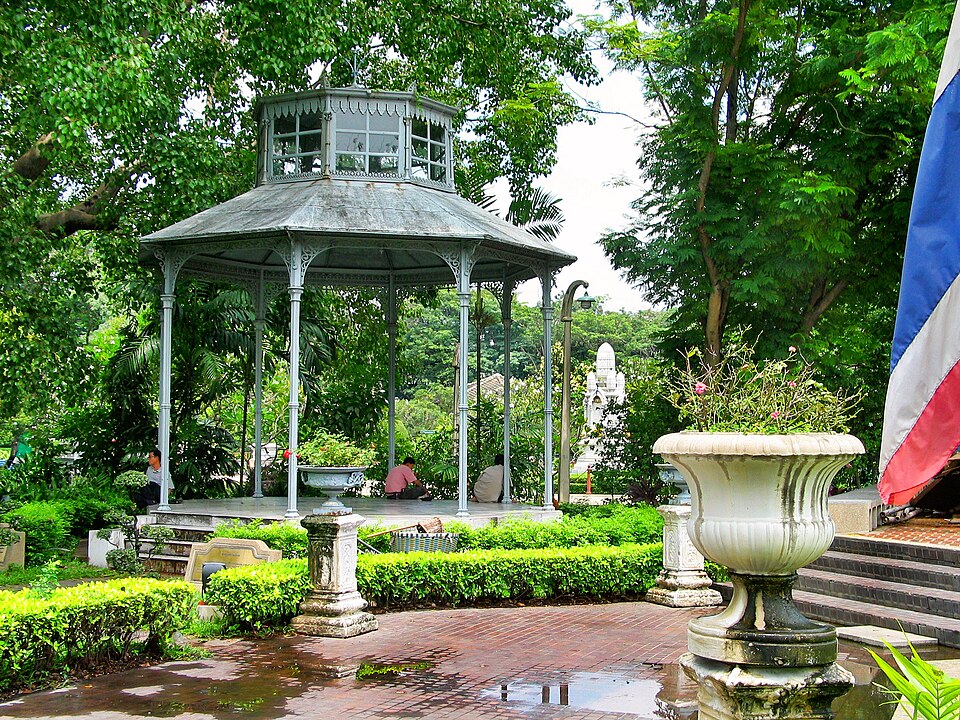
The park is on Charoen Krung Road in Phra Borom Maha Ratchawang subdistrict, Phra Nakhon, directly opposite the Grand Palace on its east side, which makes walking the obvious approach: anyone finishing at the palace is already at the gate. The Thai Wikipedia entry gives the address from the other frontage, 678–681 Ratchini Road, because the block faces two streets. Bangkok's own park page routes drivers along Charoen Krung and lists city buses on the same road. Wat Ratchabophit and its royal cemetery are a short walk east across the old city moat, and Wat Pho is a similar distance south, so Saranrom slots between them rather than needing a journey of its own.
Checked 2026-08-25 · Source
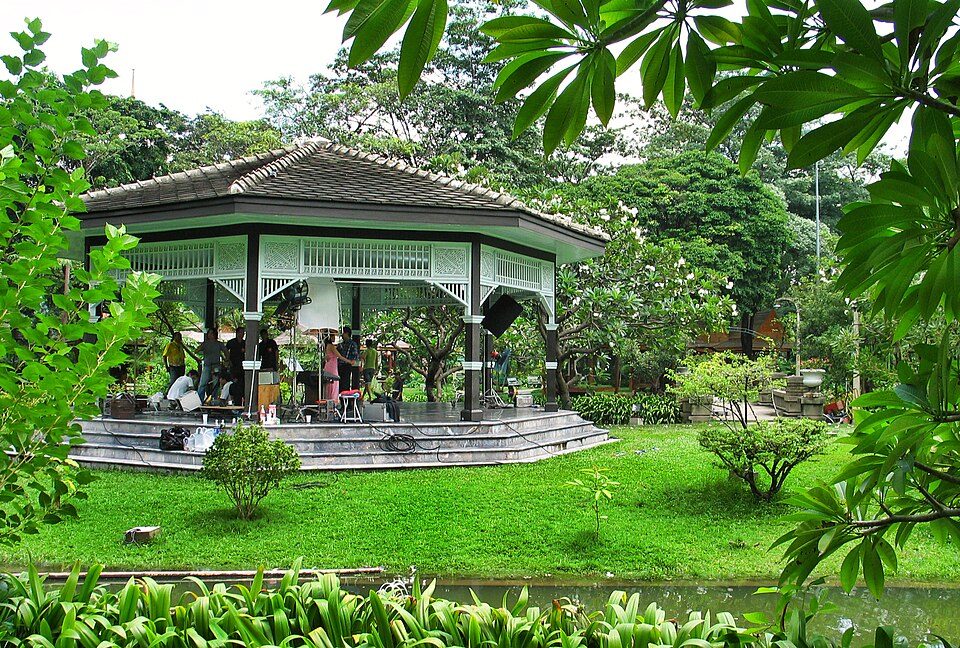
The posted rules are stricter than most visitors expect and they are enforced: no pets in the park, no cycling or motorcycles inside it, no drone flying, no smoking, no alcohol, no sleeping, no gambling, no littering, and no football, volleyball or takraw on the park roads or in areas where the park has posted a prohibition. Certified guide dogs for disabled visitors are the one exception to the pets rule. Published hours disagree between sources and the difference matters at dawn: Bangkok's own park page gives 04.00–21.00 daily, while the Thai Wikipedia article's infobox gives 05.00–21.00, and this page records the city's figure because the city runs the park. Some of the heritage buildings are in poor condition — the Glass Pavilion is described by the city as currently unused, and the Thai Wikipedia article says it is badly neglected and used for park storage — so expect to see them from the outside only. The Thai article also notes that the streets around the park have a reputation as a place where sex workers wait for customers at night, which is a reason to treat the surrounding blocks after dark as an ordinary city-centre area rather than as a continuation of the park.
Checked 2026-08-25 · Source

Saranrom is a morning park for a camera. The trees are mature and the paths narrow, so at midday the contrast between canopy shade and open lawn is unmanageable, while at six in the morning the light comes in low and level and the exercise groups give the frame something to be about. The Sunandha memorial is white marble and burns out easily; expose for the stone and let the frangipani around it go dark. The cast-iron entrance gateway and the metal-tray fountain are the two objects that reward a close, graphic frame rather than a wide one. The Glass Pavilion is a harder subject than it looks, because its glass roof reads as glare from outside and the building cannot be entered. Drone flying is prohibited in the park, so the aerial view is not available; commercial film production needs a permit and a fee.
Checked 2026-08-25
The Bangkok Metropolitan Administration's park page gives the hours as daily 04.00–21.00 and states the admission fee as free. The park's contact number is 02-221-0195. The Thai Wikipedia article's infobox gives 05.00–21.00 instead; this page follows the city, which operates the park.
It is the memorial to Queen Sunandha Kumariratana, ordered by King Chulalongkorn in 1883 as a monument of love and mourning for the queen and their daughter, Princess Kannabhorn Bejaratana, who died in a royal barge capsizing, and built where she had enjoyed the garden in her lifetime. It is white marble with a prang finial and inscriptions on four faces, one of them in English, and it was unveiled on 28 June 1883.
It was the pleasure garden of Saranrom Palace, built under King Mongkut in 1866, and was laid out around 1874 on Henry Alabaster's advice as a botanical garden. After the 1932 revolution King Prajadhipok granted it to the government and it served the People's Party, which held Constitution Day celebrations there each 10 December and ran the first Miss Siam contest in the park. The cabinet transferred it to Bangkok as a public park in 1960.
No. The city's park page lists pets and cycling or motorcycles inside the park among the prohibitions, along with drones, smoking, alcohol, sleeping, gambling and ball games on the park roads. Disabled visitors are permitted to bring certified guide dogs.
About an hour. Walking the paths without stopping takes around twenty minutes; the extra time goes on the Sunandha memorial and its inscriptions, the fountain, the Takian Thong shrine and the pavilions. Visitors slotting the park between the Grand Palace and Wat Ratchabophit can do it in half an hour.
The champaka beside the glasshouse — Pterospermum acerifolium, a rare Thai species preserved and planted there — has fragrant flowers that bloom around January and February. Otherwise the park's rhythm is daily rather than seasonal, with exercise groups in the early morning and again in the evening.
Loading the interactive map…
The interactive map could not be loaded.
Last updated:
Source: OpenStreetMap contributors, Wikidata ·