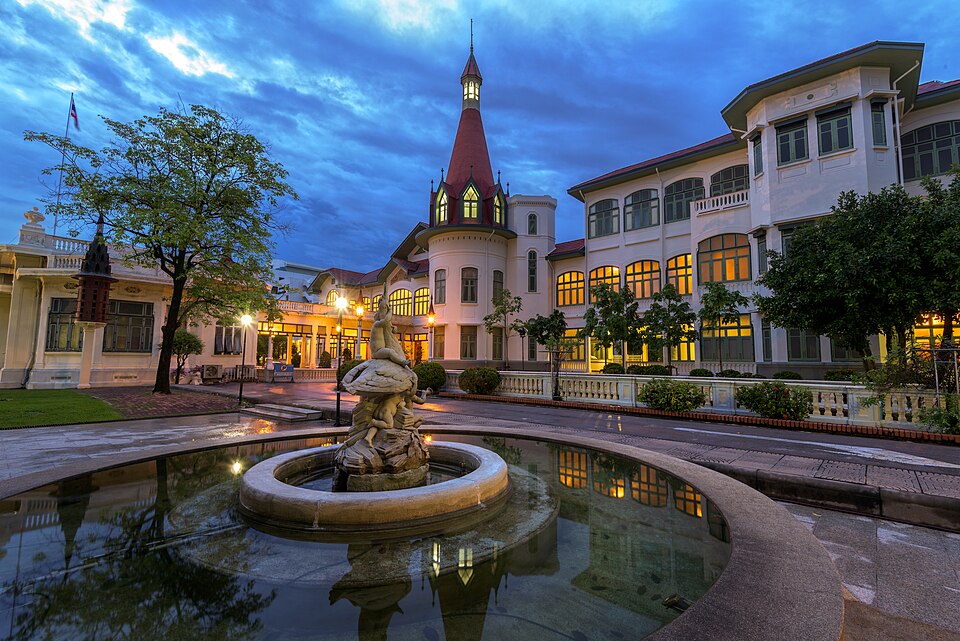
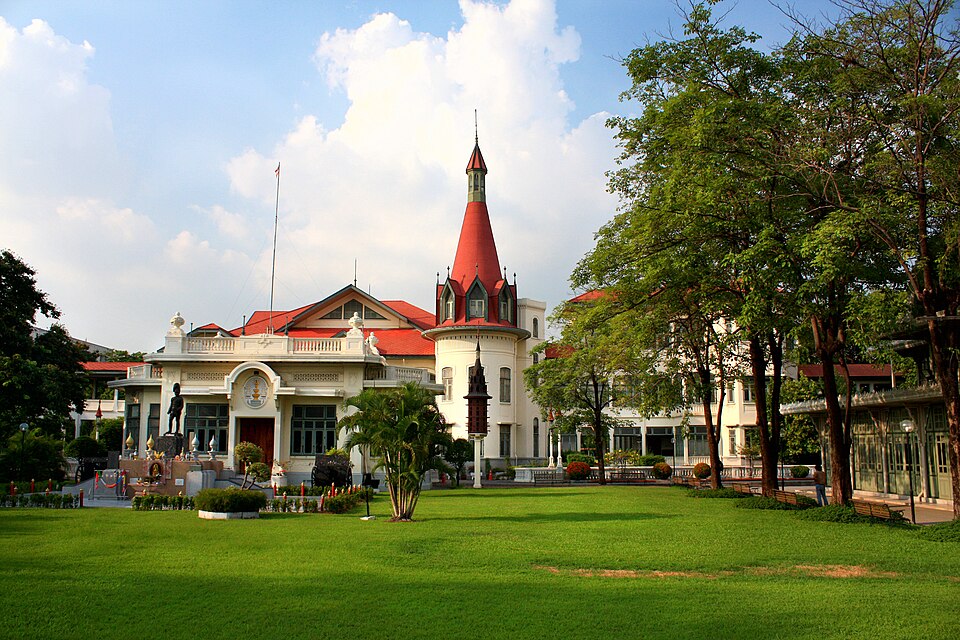
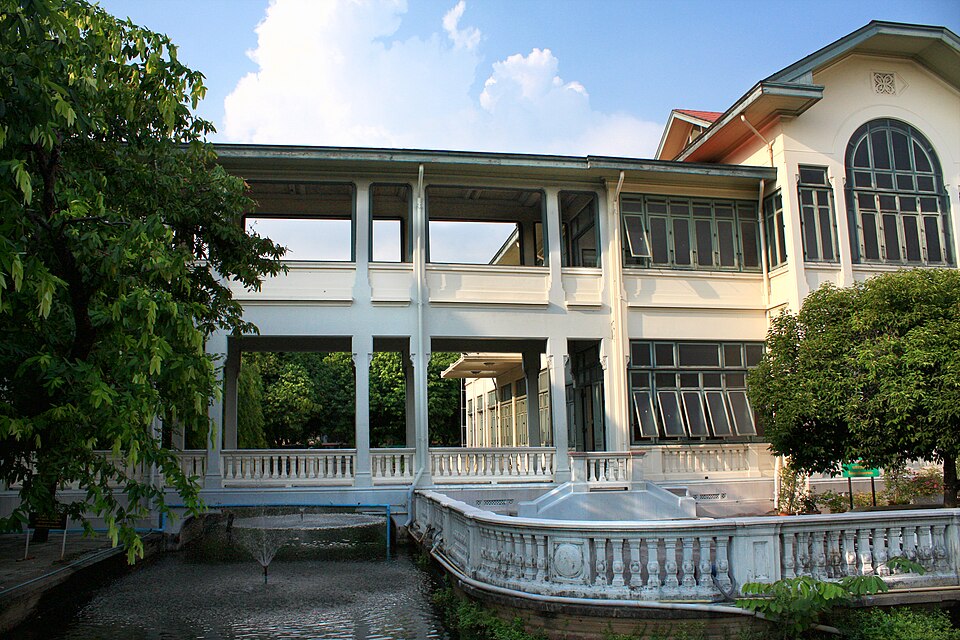
Phaya Thai Palace is a group of early twentieth-century royal halls at 315 Ratchawithi Road in Ratchathewi, standing inside the walls of a working army hospital rather than behind a ticket office. The ground began as farmland. King Chulalongkorn bought a little over one hundred rai from the market gardeners along Khlong Samsen, put up a royal farm he named Rong Na Luang Khlong Phaya Thai, and moved the Royal Ploughing Ceremony there from Thung Phra Men, the field now called Sanam Luang. The residence itself was built in B.E. 2452, and the king came to it often in the last year of his life; his final visit fell on 16 October B.E. 2453, a week before his death. His widow, Queen Saovabha Phongsri, then lived here with a household said to have numbered no fewer than five hundred people. After her death in B.E. 2462 King Vajiravudh pulled down her residence, raised the estate from a wang to a phra ratchawang in his parents' honour, and built in its place a group of three throne halls with a geometric garden the court called the Roman Garden. Phaya Thai Palace is the result: a Siamese king's European house, kept by a foundation, inside a hospital compound.
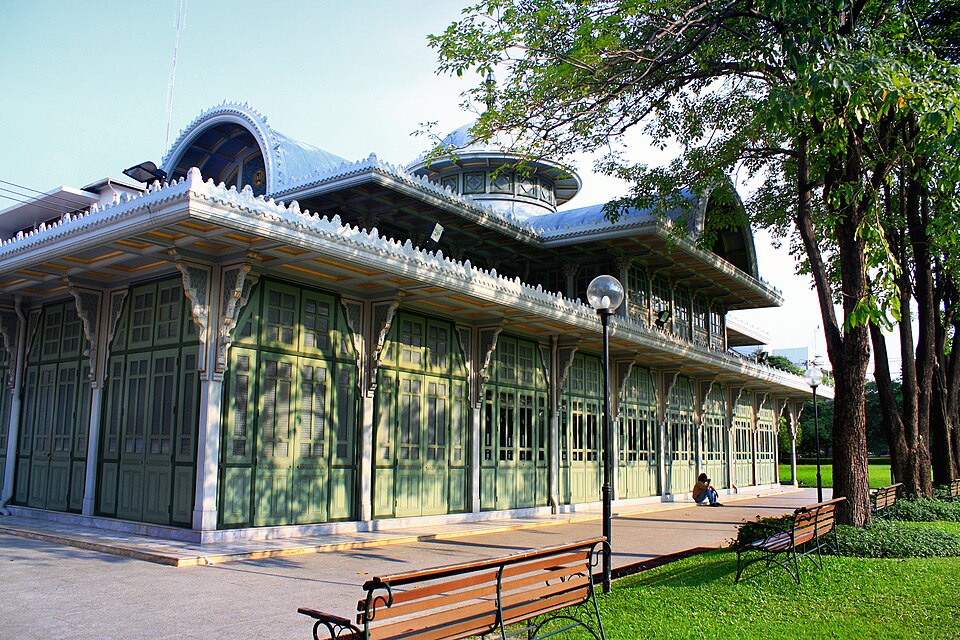
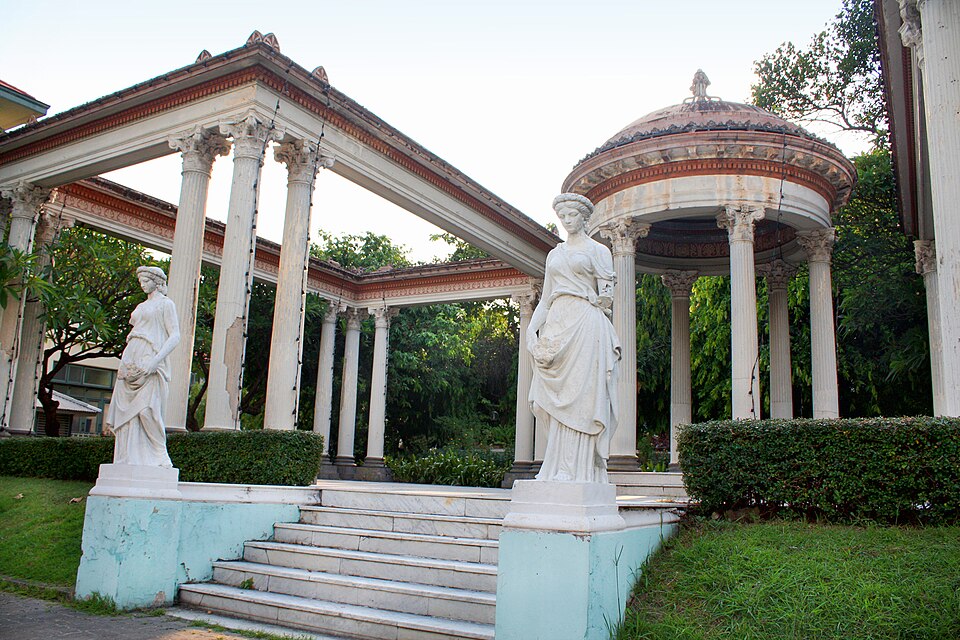
The palace is five throne halls and a scatter of smaller buildings. Phra Thinang Phiman Chakri is the principal hall, two storeys of brick and stucco that mix Romanesque with Gothic and carry the tower from which the Royal Standard, the Garuda flag, was raised whenever the king was in residence. Its ceilings and upper walls are painted in fresco secco, and its doors are carved teak gilded in a Victorian manner with the cipher of Rama VI set above them. The ground floor holds the dining room used with the inner court, a reception room and a pantry; the private apartments are upstairs, among them an audience room whose fireplace stands beneath the king's portrait framed in the Chakri emblem, a bedroom whose ceiling carries Buddhist scripture painted on palm leaf together with a dragon, and a room whose cornice is painted with peacock tails for Queen Indrasakdi Sachi. Beneath the dome a spiral stair climbs past white and gold bookcases to a statue of the king. Phra Thinang Vaikunthathephayasathan stands to the east and is Romanesque; Phra Thinang Sri Sudhanivas is English Gothic under a small dome; Phra Thinang Thewarat Sapharom is the older throne hall left standing from Queen Saovabha's household; Phra Thinang Udom Wanaphon occupies the site of what was known as the treasury block. Behind them sits Phra Tamnak Mekhala Ruchi, a two-storey teak house roofed in terracotta tile with bird paintings inside and a bathing pool, and a Neoclassical carriage porch added after the palace was finished. In the grounds are the Roman Garden and the bronze shrine of Thao Hiran Phanasun, the guardian spirit Rama VI adopted on his northern tour of B.E. 2449 and later had cast in bronze with an antique Thai headdress and a staff of rank.
Allow ninety minutes. Phaya Thai Palace is a sequence of interiors rather than a walk-through site, and the ceilings are the reason to be there: a room that takes thirty seconds at a glance takes five minutes if the painted cornice is actually being read. Ninety minutes covers Phiman Chakri and the halls beside it at that pace and still leaves time for the Roman Garden and the Thao Hiran Phanasun shrine in the grounds. Add half an hour when the visit is led, because the palace's story is told building by building rather than in one introduction at the door. This is a half-morning, not a day, and it sits comfortably beside something else in Ratchathewi.
There is no schedule to plan around, because Phaya Thai Palace does not publish one. Its own website carries a history of the estate, a description of every hall, an account of the conservation foundation, and a footer giving the address at 315 Ratchawithi Road together with the telephone numbers 02 354 7987 and 087 708 1015 — and no visiting days, no session times and no closed day. The site's own contact page returns an error rather than a page. Anyone who wants a firm answer should ring those numbers before travelling rather than trust a timetable copied onto a booking site, since the timetables that circulate do not agree with one another. What can be said about timing is structural rather than seasonal: the palace stands inside Phramongkutklao Hospital, whose gates carry ambulances and outpatients all day, so an arrival away from the morning outpatient rush is easier on everyone.
No admission figure is recorded for Phaya Thai Palace, because admission is not stated anywhere the palace itself publishes. The website of the Phyathai Palace Conservation Foundation was read in full on 25 August 2026 — the front page, the history section and its five articles, the halls section, the foundation section and the footer — and none of it carries a price, a concession or a booking route; the contact page it links to returns a not-found error. Numbers do circulate on booking platforms and travel blogs, they disagree with each other, and none of them is printed here. The foundation's own account of its Palace Lovers Club records that members may ask for honorary guides to show them the palace for a sum towards the cost, which establishes that some charge exists without fixing what it is. The telephone numbers in the site footer are the way to settle it before travelling.
The address is 315 Ratchawithi Road, Thung Phaya Thai, Ratchathewi, Bangkok 10400, and the way in is through the grounds of Phramongkutklao Hospital rather than a gate of the palace's own. The nearest elevated station is Victory Monument on the BTS Sukhumvit line, and Ratchawithi Road runs west from it past the hospital; taxis and motorcycle taxis use the same road, and a driver who does not recognise the palace by name will recognise the hospital. Arriving by car means arriving at a hospital car park, which fills with patients rather than with visitors, so public transport is the easier approach. Once through the gate the palace is the group of domed halls standing apart from the modern hospital blocks. Asking staff for wang phaya thai works better than asking for a museum, because that is the name the hospital uses for it.
The first trap is treating Phaya Thai Palace as a museum with fixed hours; it publishes none, and a visitor arriving on spec can find nothing open. The second is the setting. The palace sits inside a working military hospital, and the route to it passes wards, ambulance bays and people waiting to be seen, so keeping out of vehicle lanes, keeping voices down, and photographing neither patients nor hospital signage is the minimum courtesy. The third is conduct. This is a royal residence that the Fine Arts Department registered as a national ancient monument on 12 January B.E. 2522, published in the Royal Gazette volume 96 part 15 of 6 February B.E. 2522, and it holds a shrine at which offerings are still made to Thao Hiran Phanasun; covered shoulders and knees, shoes off where asked, no climbing on furniture and no stepping over an offering tray. The fourth is the fabric itself. The interiors are painted plaster and gilded teak, so bags go on the back rather than the shoulder, walls are not for leaning on, and a flash comes out only if whoever opened the door says it may.
The palace publishes no photography rule of its own, so the working rule is whatever the person who opened the door says, and the first frame comes after asking rather than before. What this building rewards is interiors, not a facade shot. The fresco secco ceilings of Phiman Chakri are the subject worth carrying a fast lens for: they are high, they are painted in flat matte colour that a direct flash simply erases, and they are lit by whatever the windows let in, so a camera that copes with dim indirect light beats a bright one. The gilded door carving and the cipher above it repay a close frame more than a wide one. Outside, the Roman Garden reads best from its own axis rather than from the hall steps, since the geometry is the point of it, and the domes separate more cleanly against bright overcast than against a hard blue sky. Nobody in a hospital compound wants a tripod in a vehicle lane.
Checked 2026-08-25
Common questions
Is Phaya Thai Palace open to visitors?
The palace does not publish visiting days or session times on its own website, which carries its history, its buildings and a contact footer and nothing about a timetable, and its contact page returns an error. Schedules circulate on third-party sites and disagree with one another, so the honest answer is that access is arranged rather than advertised: ring 02 354 7987 or 087 708 1015, the numbers the palace itself publishes, before travelling.
How much does it cost to visit Phaya Thai Palace?
No admission figure is recorded here, because the fee is not stated on any page the palace publishes. Its foundation does record that members of its Palace Lovers Club may ask for honorary guides in exchange for a sum towards the cost, so a charge of some kind exists; what it is now can only be had from the palace by telephone.
Where exactly is Phaya Thai Palace?
At 315 Ratchawithi Road, Thung Phaya Thai, Ratchathewi, Bangkok 10400, inside the grounds of Phramongkutklao Hospital. There is no separate palace entrance; visitors go in through the hospital compound and walk to the group of domed halls standing apart from the modern hospital blocks.
Which king built Phaya Thai Palace, and why?
Two of them. King Chulalongkorn bought the land and built a farmhouse residence there in B.E. 2452 so that he could watch the rice fields he was experimenting on. King Vajiravudh, after his mother Queen Saovabha Phongsri died there in B.E. 2462, demolished her residence, raised the estate to the rank of a royal palace in his parents' honour, and built the domed throne halls that stand today.
Is it true the palace was once a hotel?
Yes. King Prajadhipok had the Royal State Railways convert it into a first-class hotel, the Phya Thai Palace Hotel, and opened it on 18 February B.E. 2468. It ran a twenty-piece orchestra drawn from the army band for weekend dancing, hosted the founding meeting of the Rotary Club of Bangkok on 17 September B.E. 2473, and housed the Bangkok radio transmitter in Vaikunthathephayasathan Hall that carried Thailand's first radio broadcast on 25 February B.E. 2473. The hotel lost money after the 1932 change of government and was closed.
How long should be allowed for a visit?
Ninety minutes for the halls, the Roman Garden and the Thao Hiran Phanasun shrine at a pace that lets the painted ceilings be looked at rather than passed. Add half an hour when the visit is guided, because the account is given building by building.
Nothing non-essential is set before you choose, in regions where consent is required. If you decline, ads still appear but they are non-personalised, and analytics is switched off entirely.