

3 min walk · Stari Grad
Gallery "Artget"
- High
- Art and culture venue
Language · 1 published
Historic monument · Градска општина Стари град, Belgrade
Београдска синагога Сукат Шалом
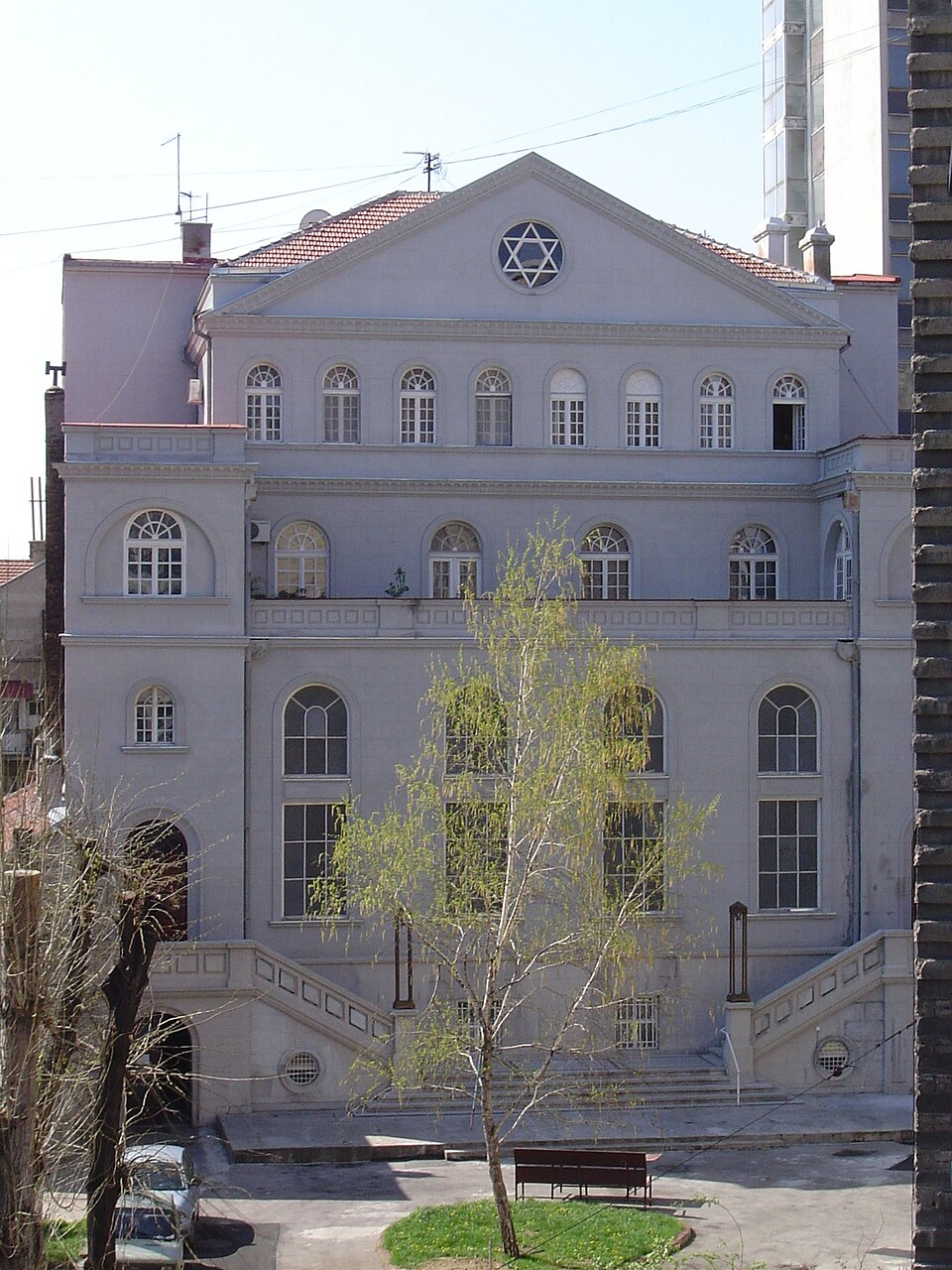
The Belgrade Synagogue, known as Sukkat Shalom, is the only functioning synagogue in Serbia today and the religious centre of Belgrade's Ashkenazi Jewish community. It stands on Maršala Birjuzova Street, with groundbreaking on 15 June 1924 and completion on 27 November 1929, built to designs by the architect Franjo Urban with Milan Šlan. The building is brick-built in a Neoclassical idiom with predominant neo-Renaissance elements, and was declared a Serbian national heritage site on 31 May 2013.
Jewish settlement in Belgrade goes back to the Sephardic community that arrived after the Ottoman conquest of the city in 1521; the Ashkenazi community that this synagogue serves was formally established later, on 1 October 1869. Before the Second World War, Belgrade counted roughly 12,000 Jews, about 80 percent Sephardic and 20 percent Ashkenazi, so this building represents the smaller of the two prewar congregations rather than the city's larger Sephardic one.
Checked 2026-08-23 · Source
The synagogue rises through a semi-basement, a ground floor, a gallery level and two further upper floors. The central prayer hall, the hekhal, runs east-west and is flanked by two rows of eight-sided columns, under a coffered ceiling edged with a floral border. A three-flight central staircase, drawing on French neoclassical models, leads up through the building.
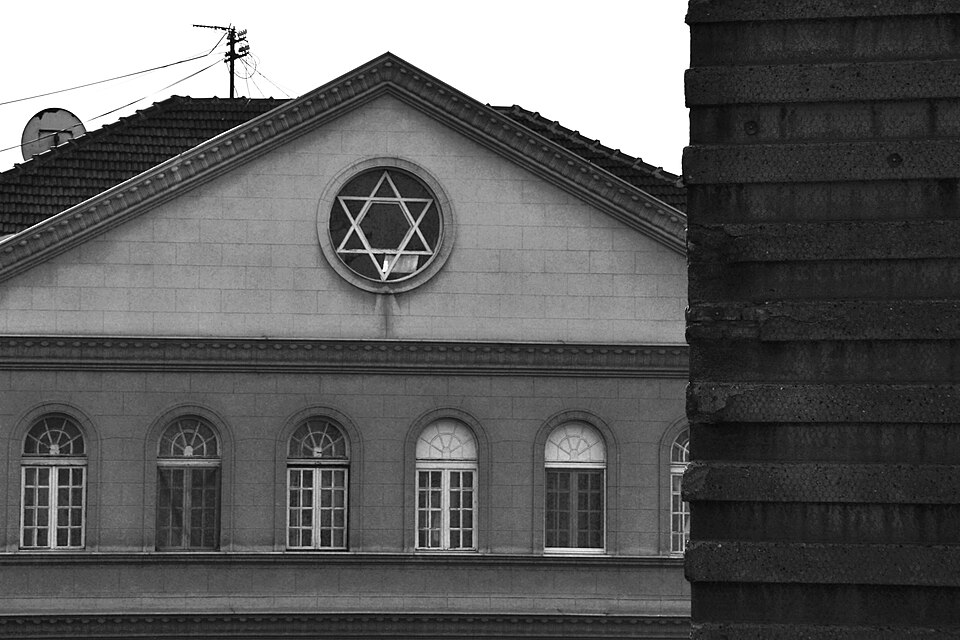
On the façade, a symmetrical composition is capped by a Star of David set in an oculus above the gable, with four tall round-arched windows lighting the ground floor and gallery. Twin towers flank the entrance front, their arched openings referencing Jachin and Boaz, the two named bronze pillars that stood at the entrance to the Temple of Solomon — a detail that ties this 1920s building directly back to biblical temple architecture rather than to any local Serbian precedent.
Checked 2026-08-23 · Source
Twenty minutes is enough to take in the prayer hall and the building's exterior detail; this is a working synagogue serving a small congregation rather than a large museum space, so there is less floor area to cover than at Belgrade's Orthodox cathedrals.
Visitors with a specific interest in the history of Belgrade's Jewish community can extend this by pairing the visit with the nearby Jewish Historical Museum, a short walk away, which supplies the historical context the synagogue building itself does not display in situ.
Checked 2026-08-23
As an active synagogue with a small congregation, opening to visitors is generally more limited than at Belgrade's larger Orthodox churches, and can depend on service times and the Jewish calendar rather than a fixed daily pattern; this makes checking ahead more important here than at a church that is open throughout the day.
Jewish holidays, including the High Holy Days in autumn and Passover in spring, are the periods when the building is most actively in liturgical use and least available for casual sightseeing.
Checked 2026-08-23
Current admission arrangements, whether entry is free, by donation, or requires prior contact with the Jewish community of Belgrade, are not published on the sources this page uses and are not reproduced here. Unlike Belgrade's Orthodox churches, which stand open to walk-in visitors through the day, an active synagogue serving a small community more commonly asks visitors to arrange a visit in advance, so confirming access before arriving is worth the extra step.
Checked 2026-08-23
The synagogue is on Maršala Birjuzova 19, in central Belgrade within easy walking distance of Republic Square and Knez Mihailova, roughly ten minutes on foot. The street sits between the old town and the Dorćol district, so the synagogue can be combined with a walk that also takes in St. Alexander Nevsky Church.
Belgrade has no metro; several tram and bus lines serve the surrounding streets, with stops within a short walk of Maršala Birjuzova. Given the central location, arriving on foot from Republic Square is the simplest route for most visitors.
Checked 2026-08-23
Jewish custom expects head covering for men inside the prayer hall; a kippah is normally offered at the entrance for visitors who do not have one. Modest dress applies as it would at any place of worship, and photography, phone use and casual movement around the hall are inappropriate during services.
Security at the synagogue is typically tighter than at Belgrade's Orthodox churches, reflecting both the building's small congregation and the wider pattern of security around European synagogues; visitors should expect to identify themselves or explain their visit at the door rather than simply walking in unannounced. There is no queue or crowding issue here — the opposite is closer to true, since the building is not set up for high visitor volumes the way Belgrade's larger churches are.
Checked 2026-08-23
Photography inside the prayer hall should not be assumed to be permitted by default, given the building's active religious use and its tighter security posture; asking at the entrance before raising a camera is the safer approach here, more so than at an Orthodox church that stands open to casual sightseeing.
Exterior photography of the façade, with its twin towers and Star of David oculus, is straightforward from across Maršala Birjuzova Street, which is narrow enough that a slight angle gives a cleaner view of the towers than shooting straight on.
Checked 2026-08-23
Groundbreaking took place on 15 June 1924 and the building was completed on 27 November 1929.
The architect Franjo Urban led the design, working with Milan Šlan, in a Neoclassical style with predominant neo-Renaissance elements.
Yes. It is the only functioning synagogue in Serbia and serves the city's Ashkenazi Jewish community. It was re-consecrated after the Second World War, having been desecrated and used as a brothel during the Nazi occupation from 1941 to 1944.
Of an estimated 12,000 Jews living in Belgrade before the war, only 1,115 survived; the synagogue building itself was desecrated during the German occupation before being re-consecrated afterward.
Yes. It was declared a national heritage site of Serbia on 31 May 2013.
The towers' arched openings reference Jachin and Boaz, the two named bronze pillars that stood at the entrance to the Temple of Solomon.
Loading the interactive map…
The interactive map could not be loaded.
Last updated:
Source: OpenStreetMap contributors, Wikidata ·