Ponte Vecchio
Ponte Vecchio is the oldest surviving bridge over the Arno and the only one in Florence still built up with shops. A crossing has stood on this spot since Roman Florentia.
- Must see
- Historic monument
Language · 11 published
City guide · Italy
Florence has a compact, largely pedestrian historic centre on both sides of the Arno. The Duomo, Piazza della Signoria, Uffizi and Santa Croce form the main north-bank cluster; the Oltrarno begins across the river around Santo Spirito and Palazzo Pitti. Santa Maria Novella station lies northwest of the centre, while hilltop viewpoints and Fiesole require a separate climb or transport leg.
Set your days, your pace and the hours you actually want to be out. The planner works around closing days and travel time, and leaves room to eat.
Ranked by importance — sitelinks, pageviews and heritage status, not editor preference.
100 places match
Category
Typical visit duration
Interests
Ponte Vecchio is the oldest surviving bridge over the Arno and the only one in Florence still built up with shops. A crossing has stood on this spot since Roman Florentia.
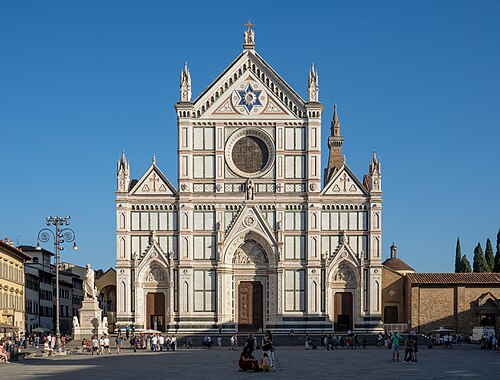
Santa Croce is the Franciscan mother church of Florence and the largest Franciscan church in the world.
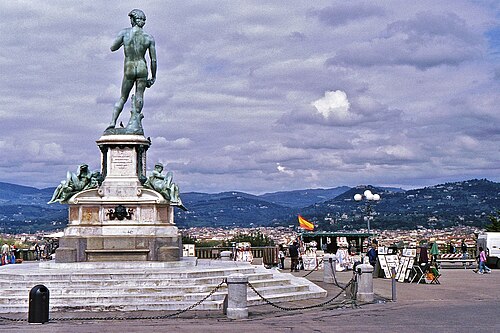
Piazzale Michelangelo is a panoramic square overlooking Florence from the south bank of the Arno River. It was designed by architect Giuseppe Poggi in 1869 as part of Florence's brief period as capital of the Kingdom of Italy.
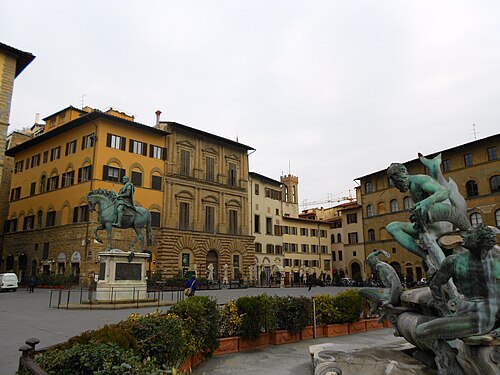
Piazza della Signoria is Florence's principal civic square and the historic heart of the city's political life.
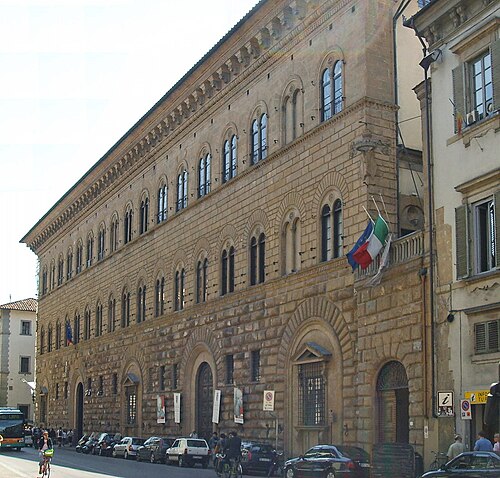
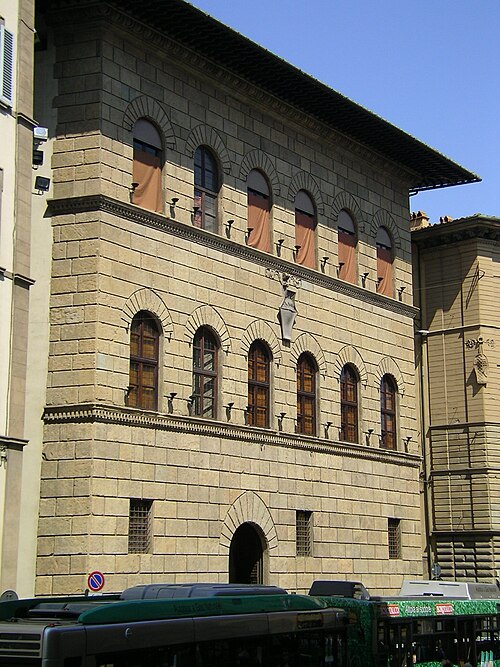
Palazzo Medici Riccardi is a Renaissance palace in Florence, Italy. It was commissioned by Cosimo de' Medici and designed by Michelozzo di Bartolomeo in the fifteenth century.
Santo Spirito is a major basilica in Florence's Oltrarno district, formally named Basilica di Santa Maria del Santo Spirito. The church stands as one of the most significant Renaissance religious structures in the city, designed by Filippo Brunelleschi.
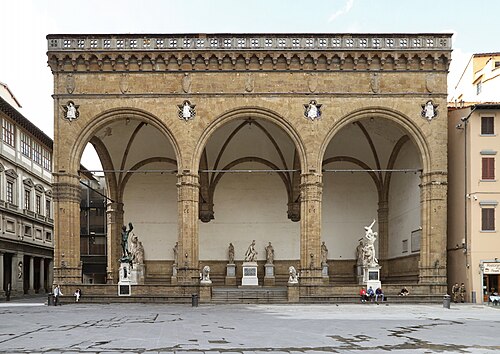
The Loggia dei Lanzi is an open-air sculpture gallery located on the southeast corner of Piazza della Signoria in Florence. Built between 1376 and 1382, this Gothic-style loggia was originally designed to host public ceremonies of the Florentine Republic.
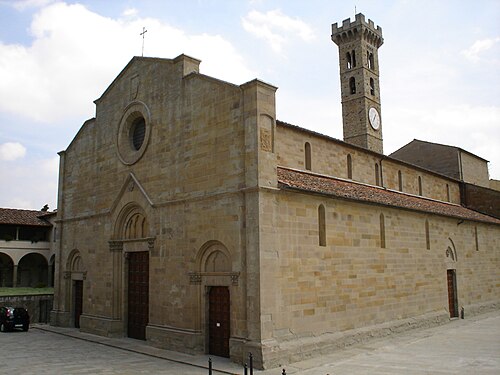
Fiesole Cathedral, known locally as Cattedrale di San Romolo, stands in the hill town of Fiesole overlooking Florence. This historic cathedral serves as the seat of the Diocese of Fiesole and represents a significant religious landmark in the Tuscany region.
The Basilica della Santissima Annunziata is a major Renaissance church in Florence, Italy. Founded in 1250 by the Servite order and rebuilt in the fifteenth and seventeenth centuries, it stands as one of the city's most architecturally significant religious complexes.
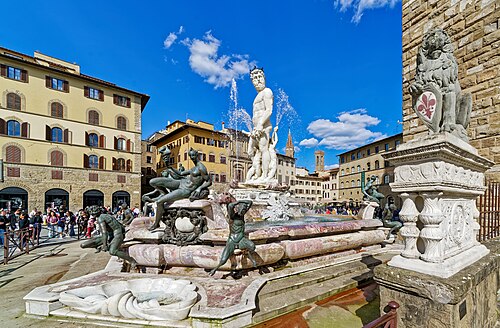
The Fountain of Neptune is a monumental fountain located in the Piazza della Signoria, Florence's central civic square.
Ponte Vecchio is a medieval stone bridge spanning the Arno River in Florence, Italy. The structure dates to Roman times, though the current bridge was rebuilt in 1345 after a flood destroyed its predecessor.
Giotto's Campanile is the freestanding bell tower of Florence Cathedral, designed by the painter and architect Giotto di Bondone. Construction began in 1334. The tower stands adjacent to the cathedral in Piazza del Duomo.
Piazza Santo Spirito is a public square in the Oltrarno district of Florence, Italy. It takes its name from the Basilica di Santo Spirito, the Renaissance church designed by Filippo Brunelleschi that dominates its eastern side.
The Palazzina della Meridiana is a historic building within the Boboli Gardens in Florence, Italy. It forms part of the extensive formal garden complex associated with the Pitti Palace.
Palazzo Strozzi is a prominent Renaissance palace in central Florence, Italy. Commissioned by the wealthy Strozzi family, its construction began in 1489 and exemplifies the grand scale of Florentine civic architecture.
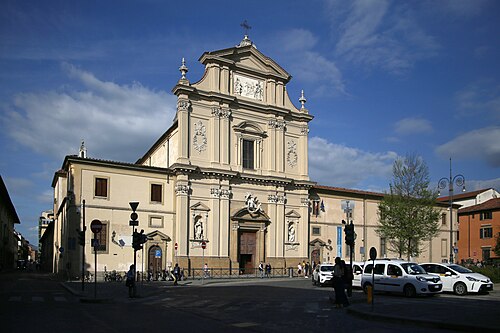
The Museum of San Marco occupies a former Dominican convent in central Florence. Its Wikidata entry identifies it as a museum and former religious building.
Villa Medici is a historic estate in Florence, Italy, associated with the influential Medici family. The property represents Renaissance architectural and garden heritage. Located within the city, it stands as a testament to the cultural patronage that defined Florentine history.
Villa La Petraia is a Medici villa located in Florence, Italy. It stands as one of the historic villas associated with the powerful Medici family, who played a central role in Florentine and Tuscan political and cultural life.
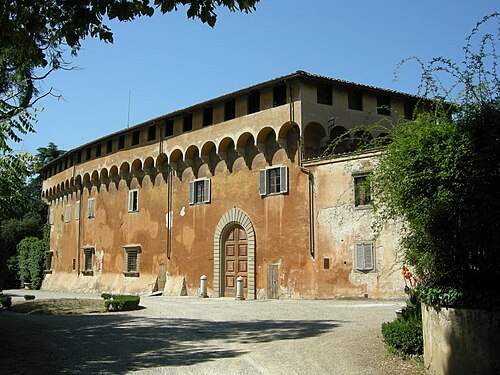
Villa Medici at Careggi is a historic Medici villa located in the northern suburbs of Florence, Italy. It served as one of the primary country residences for the powerful Medici family, who dominated Florentine politics and patronage during the Renaissance.
Villa Medicea del Poggio Imperiale is a historic Medici villa located in Florence, Italy. It stands on the Arcetri hill south of the city center.
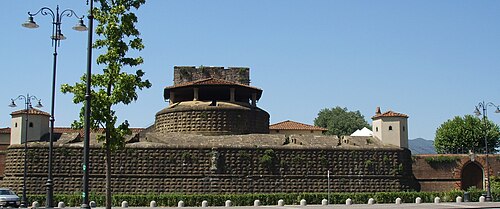
Fortezza da Basso is a historic fortress in Florence, Italy. Constructed between 1534 and 1537 under Alessandro de' Medici, Duke of Florence, it represents a significant example of Renaissance military architecture.
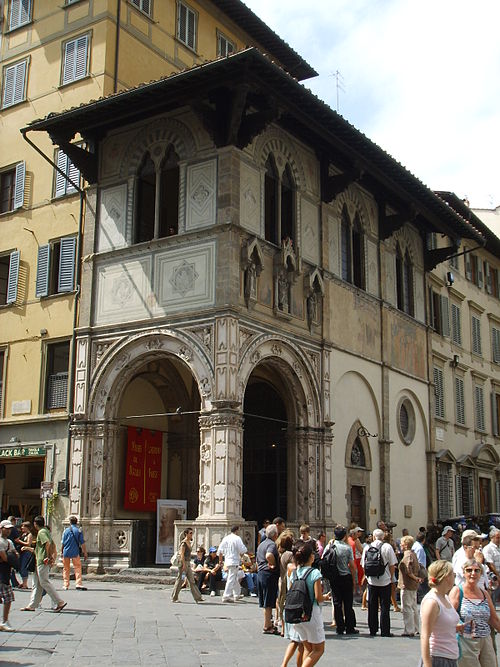
The Loggia del Bigallo is a historic loggia in Florence, Italy, located near the Florence Cathedral. It was originally built as a shelter for pilgrims and the poor by the Compagnia della Misericordia, a charitable confraternity.
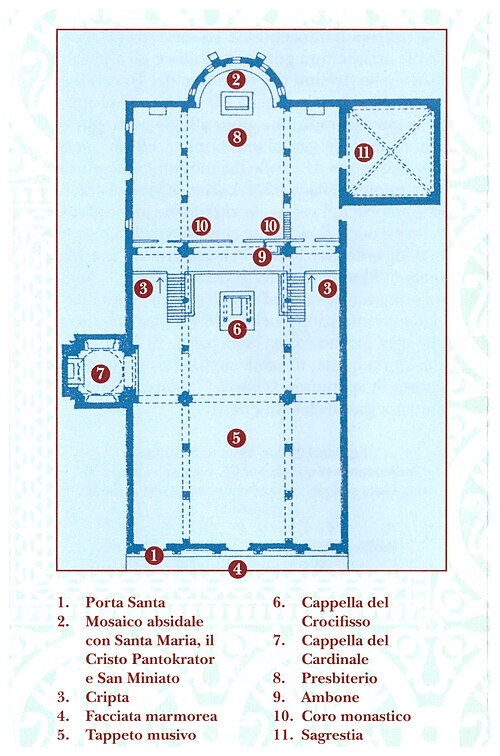
San Miniato al Monte is a basilica standing atop one of Florence's highest hills, offering commanding views across the city and surrounding Tuscan landscape. The church is dedicated to Saint Minias, Florence's first martyr according to tradition.
Chiesa di Santa Maria Maggiore is a church in Florence, Italy. It stands as one of the city's numerous historic religious structures, contributing to the dense architectural heritage that characterizes the urban landscape.
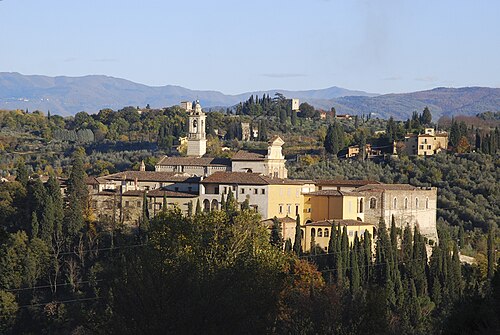
Florence Charterhouse, known locally as Certosa del Galluzzo, is a Carthusian monastery situated on a hillside south of central Florence. Founded in 1341 by Niccolò Acciaiuoli, a prominent Florentine statesman, the complex served as a contemplative religious community for centuries.
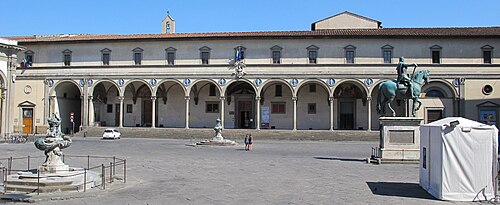
The Hospital of Innocents, known locally as Spedale degli Innocenti, stands as a historic building in Florence. Designed by Filippo Brunelleschi, it represents an early Renaissance architectural landmark.
Brunelleschi's Dome, known locally as Cupola del Brunelleschi, crowns Florence Cathedral. This architectural landmark represents a defining achievement of Renaissance engineering. Filippo Brunelleschi devised innovative construction methods to span the vast octagonal space without traditional supporting framework.
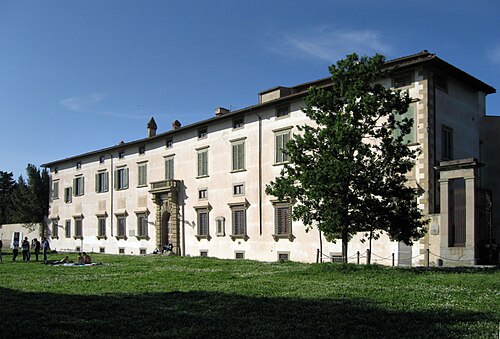
Villa Castello, locally known as Villa medicea di Castello, stands as a significant Medici villa on the outskirts of Florence. The estate represents an important example of Renaissance villa architecture and garden design.
Fonte della Fata Morgana is a decorative fountain located in Florence, Italy. The structure carries the name referencing the legendary enchantress Morgan le Fay from Arthurian tradition, suggesting a romantic or fantastical character in its naming.
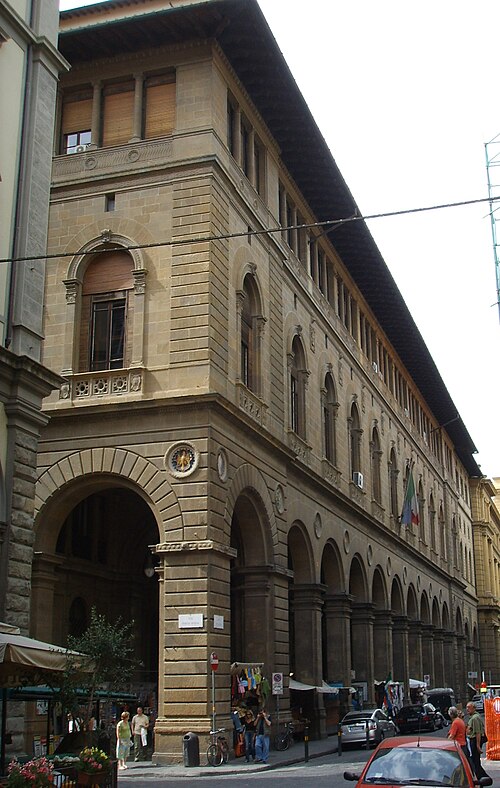
Palazzo delle Poste is the main post office building in Florence, Italy. Located in the city centre near Piazza della Repubblica, it serves as the central postal facility for the city.
Palazzo Martelli is a historic palace in Florence, Italy. The building holds significance as a preserved noble residence that offers insight into the domestic life of Florentine aristocracy.
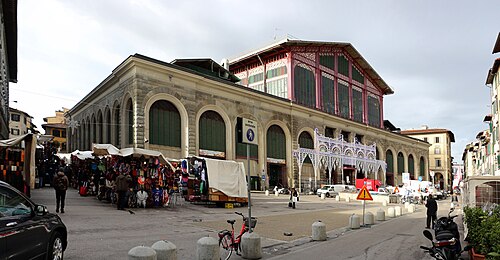
Mercato Centrale, locally known as Mercato di San Lorenzo, is a historic indoor market located in Florence, Italy. The building dates to the late nineteenth century and serves as a major commercial hub in the San Lorenzo district.
Palazzo Spini Feroni stands as a historic palace in Florence, Italy. The building carries notable architectural significance within the urban fabric of the city. Its medieval origins reflect the wealth and power of the Spini family, prominent Florentine merchants.
Palazzo Antinori is a historic palace in Florence, Italy, associated with the prominent Antinori family, renowned wine producers with centuries of Tuscan heritage. The building exemplifies Renaissance palazzo architecture in central Florence.
Sant'Ambrogio is a church in Florence, Italy, known locally as Sant'Ambrogio. The building is recorded in OpenStreetMap under identifier way/599901040 and holds a Wikidata entry at Q3672358.
Palazzo Uguccioni is a Renaissance palace on Piazza della Signoria in Florence. Its facade, attributed to design influences from Michelangelo or Raffaello, features classical elements including rusticated stonework and sculpted window surrounds.
San Frediano in Cestello is a Baroque church in Florence's Oltrarno district, standing on the south bank of the Arno River. The present structure largely dates to the late seventeenth and early eighteenth centuries, replacing an earlier Carmelite convent.
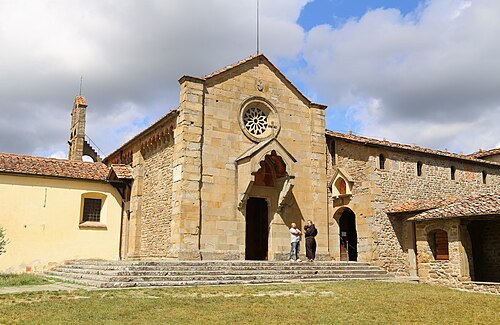
San Francesco Convent, locally Convento di San Francesco, is a religious complex in Florence mapped as OpenStreetMap relation 2322455 and catalogued on Wikidata Q3689538. Its precise historical foundation date, architectural period, and current denominational status remain Not recorded.
The Tomba della Mula is an Etruscan tomb located in the Florence area of Italy. Its local name, Tomba etrusca della Mula, identifies it as an archaeological site from the Etruscan civilization that flourished in central Italy before Roman dominance.
Villa La Quiete is a historic villa located in Florence, Italy. The property is identified in OpenStreetMap data under relation 4078940 and holds a Wikidata entry at Q3558626.
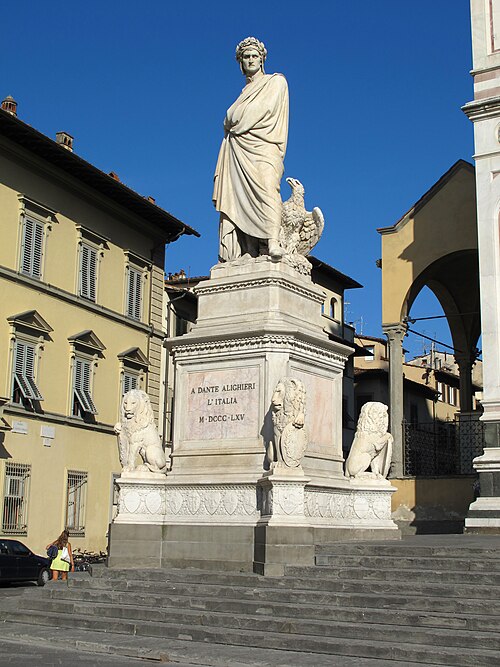
The Monument to Dante is an outdoor statue honouring Dante Alighieri, the medieval Florentine poet whose Divine Comedy shaped Italian literature. Located in a public square in Florence, the monument commemorates a figure of profound cultural significance to the city.
Palazzo Bartolini Salimbeni is a historic palace in Florence, Italy. The building stands as a notable example of Renaissance civic architecture in the city centre.
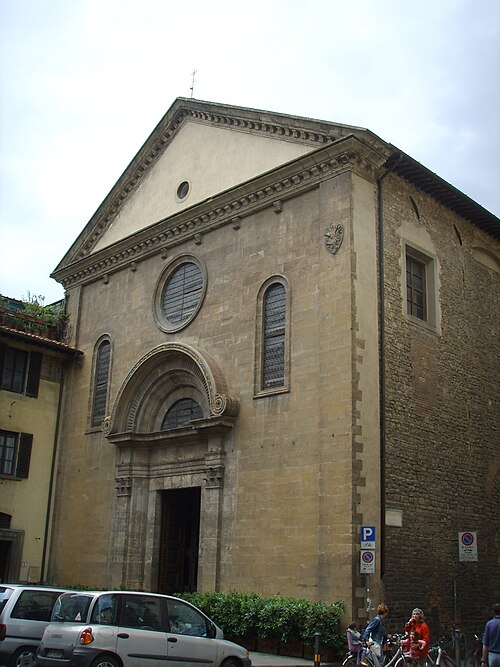
San Felice is a Catholic church in Florence's Oltrarno district, located in Piazza San Felice. The building stands as a historic place of worship with architectural significance in a city renowned for Renaissance and Baroque religious structures.
The Triumphal Arch of the Lorraine, known locally as Arco di Trionfo, stands in Florence as a commemorative monument.
Source: OpenStreetMap contributors, Wikidata ·
The cathedral is the clearest central landmark. Piazza della Signoria and the Uffizi lie south toward the Arno, Santa Croce lies east, and Santa Maria Novella lies west near the main station. Cross Ponte Vecchio for the Oltrarno, Palazzo Pitti and the Boboli Gardens. Piazzale Michelangelo sits above the river and should be treated as a separate uphill destination rather than part of a flat centre walk.
Checked 2026-08-26
Walk for most journeys inside the historic centre. Visit Tuscany describes Florence as relatively small and largely pedestrianised, with buses and trams serving places beyond the walking core. The tram also connects selected outer districts and the airport corridor. Restricted traffic zones make driving impractical for many visitors, so use public transport for outlying stops and keep central days on foot.
Checked 2026-08-26
A fixed duration is not recorded. Plan by clusters: the cathedral and civic centre, Santa Croce, Santa Maria Novella, the Oltrarno and any hilltop or day-trip destination.
Yes. The historic centre is compact and largely pedestrianised. Most major central sights can be linked on foot, while outer districts and uphill destinations may need transport.
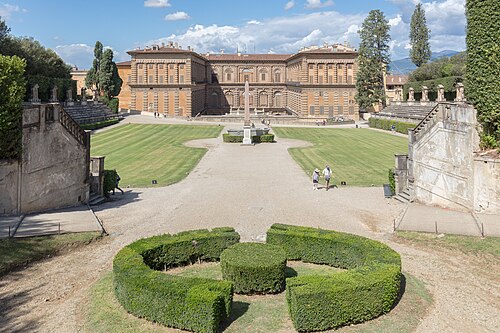
The Oltrarno contains Palazzo Pitti, the Boboli Gardens and Santo Spirito. Reach it across the central bridges and treat it as a separate neighbourhood cluster.
Yes. Florence uses buses and a tram network for journeys outside the pedestrian core, including selected outer districts and the airport corridor.
Public transport and walking are usually more practical. The historic centre has restricted traffic areas, narrow streets and a layout designed for short pedestrian journeys.