


1 min walk
Gallery of Photography
- High
- Art and culture venue
Language · 1 published
Historic monument · Dublin
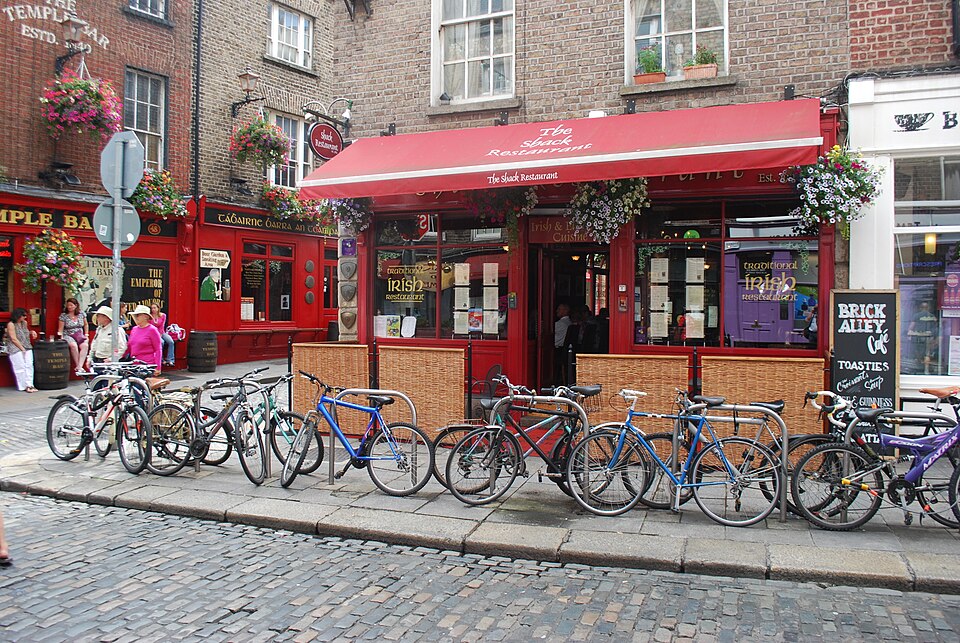
Temple Bar is a neighbourhood rather than a building: about a dozen cobbled streets on the south bank of the River Liffey, bounded by the river to the north, Dame Street to the south, Westmoreland Street to the east and Fishamble Street to the west, inside the Dublin 2 postal district. Nothing is ticketed at the edge, because there is no edge to ticket. A visitor simply walks in off Dame Street or across the river and is in it. The land itself is made ground. Until the 17th century the Liffey shoreline ran along the line of Essex Street, Temple Bar and Fleet Street, and the marsh on the river side of that line was walled in and reclaimed house by house, with backyards running down to the water until Wellington Quay replaced them in 1812. The street called Temple Bar first appears on Bernard de Gomme's 1673 map of Dublin. The name is usually traced to Sir William Temple, who built a house and gardens there in the early 1600s and served as provost of Trinity College from 1609 until his death in 1627, and also to the Temple Bar district of London, whose neighbouring Essex Street and Fleet Street repeat in the same relative positions here.
Checked 2026-08-26 · Source
The quarter holds more institutions than its reputation suggests. The Irish Film Institute is one of only two arthouse cinemas in Dublin and houses the Irish Film Archive, from which free lunchtime screenings are drawn. Photo Museum Ireland shows rotating photography over two floors on a quiet square, with the National Photographic Archive, holding the National Library of Ireland's photographic collection, directly across from it. Temple Bar Gallery + Studios has been an artists' studio complex and contemporary gallery since 1983 and states that it is free for everybody. Smock Alley Theatre was the city's first custom-built theatre and is classified as a heritage site; the New Theatre programmes new writers and directors; the Project Arts Centre runs two theatre spaces and free exhibitions. For music there is the Button Factory, the Workman's Club with its Main Room and its seventies-wallpapered Vintage Room, and the 3Olympia Theatre on Dame Street, in a house dating from 1879. Street-level attractions cost nothing at all: the Icon Walk, a community art project on the lanes behind Fleet Street, divided into ten themed laneways; and Love Lane in Crampton Court, whose mosaic walls were painted by Anna Doran in 2014 for Dublin City Council and the Temple Bar Company. Vintage shops, Cow's Lane at the Christ Church end and the Gutter Bookshop fill the gaps between.
Checked 2026-08-26 · Source
Allow two and a half hours. Visit Dublin publishes suggested visit durations for individual venues inside Temple Bar — Temple Bar Gallery + Studios is given as one to two hours — but publishes none for the quarter itself, so two and a half hours is this guide's judgement rather than a figure read off an official page. It is built from the shape of the place. The whole district is roughly ten minutes' walk end to end, from Fishamble Street to Westmoreland Street, so the walking is not what consumes the time; stopping is. Two and a half hours covers a full circuit of the lanes, the Icon Walk and Love Lane, one indoor stop of gallery or museum length, and a drink or a coffee sitting down. Strip out the indoor stop and forty-five minutes will do — that is genuinely enough to see the streets, the shopfronts and the two squares. Add the Irish Film Institute or a theatre booking and the visit stops being a walk and becomes an evening. Visitors intending to eat at the Saturday food market and then browse Cow's Lane should budget closer to four hours, because both are unhurried by design and the square fills up around lunchtime.
Checked 2026-08-26
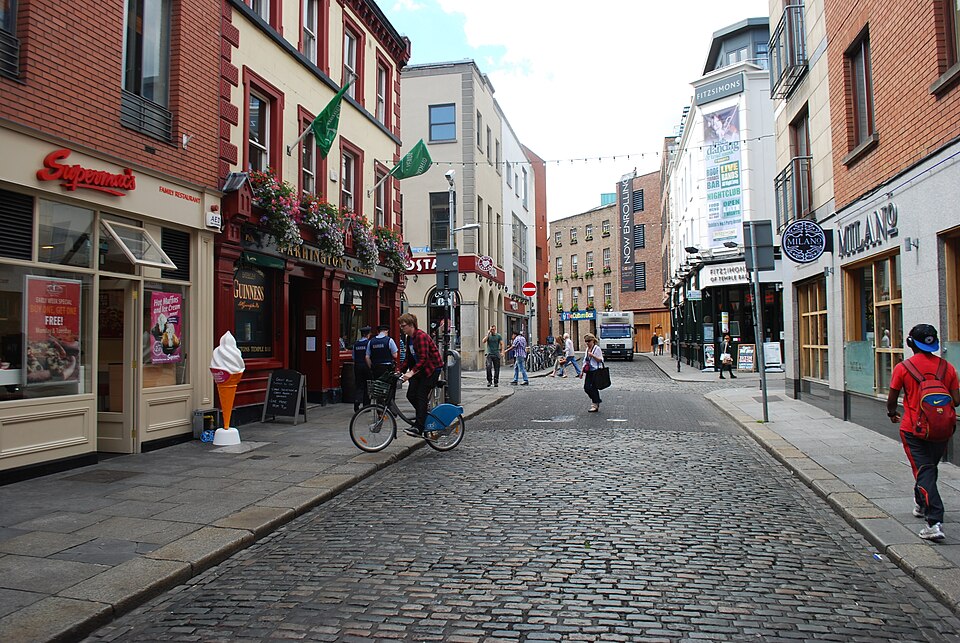
Saturday is the fullest day. Meeting House Square is taken over every Saturday by the Temple Bar Food Market, which Visit Dublin describes as one of Dublin's oldest and longest-running outdoor food markets, established in 1997 by a group of Irish farmers and producers and still trading with many of its original stallholders. Saturday is also when Cow's Lane holds its fashion and design market and when the weekend brunch places at the eastern end are at their busiest. For the streets themselves rather than the markets, morning is the better half of the day. Traditional music drifts out of the pubs from mid-morning on, and live music at the Temple Bar pub starts at 10.30am, so the sound the quarter is famous for is already available hours before the crowds that usually come with it. By early evening the balance changes: the lanes are dense, the pub prices are at their highest and the district is working as a nightlife destination rather than a cultural one. In the summer months Meeting House Square is used for outdoor film screenings. A visitor who wants photographs, shops and galleries should come before noon; a visitor who wants a trad session and a crowd should come after nine.
Checked 2026-08-26 · Source
There is no admission charge for Temple Bar, because there is nothing to charge admission to: the quarter is a network of public streets and two public squares, and every route through it is open to anyone on foot. What costs money is what a visitor chooses to go into, and those prices are set venue by venue rather than by the district. Several of the things worth stopping for are themselves free. Temple Bar Gallery + Studios states plainly that it is free, for everybody. The Project Arts Centre hosts free art exhibitions alongside its ticketed theatre programme. The Irish Film Institute draws free lunchtime screenings from the Irish Film Archive, though its regular releases are ticketed. The Icon Walk and the painted walls of Love Lane are simply outdoors and cost nothing to look at. Against that, the pubs on the central lanes are among the most expensive in Dublin, and a round bought at 10pm on a Saturday on Temple Bar street is not a fair sample of what drink costs in the city. No single ticket, pass or combination covers the quarter's venues, and none is sold. Visitors should budget per venue and per drink, not per district.
Checked 2026-08-26 · Source
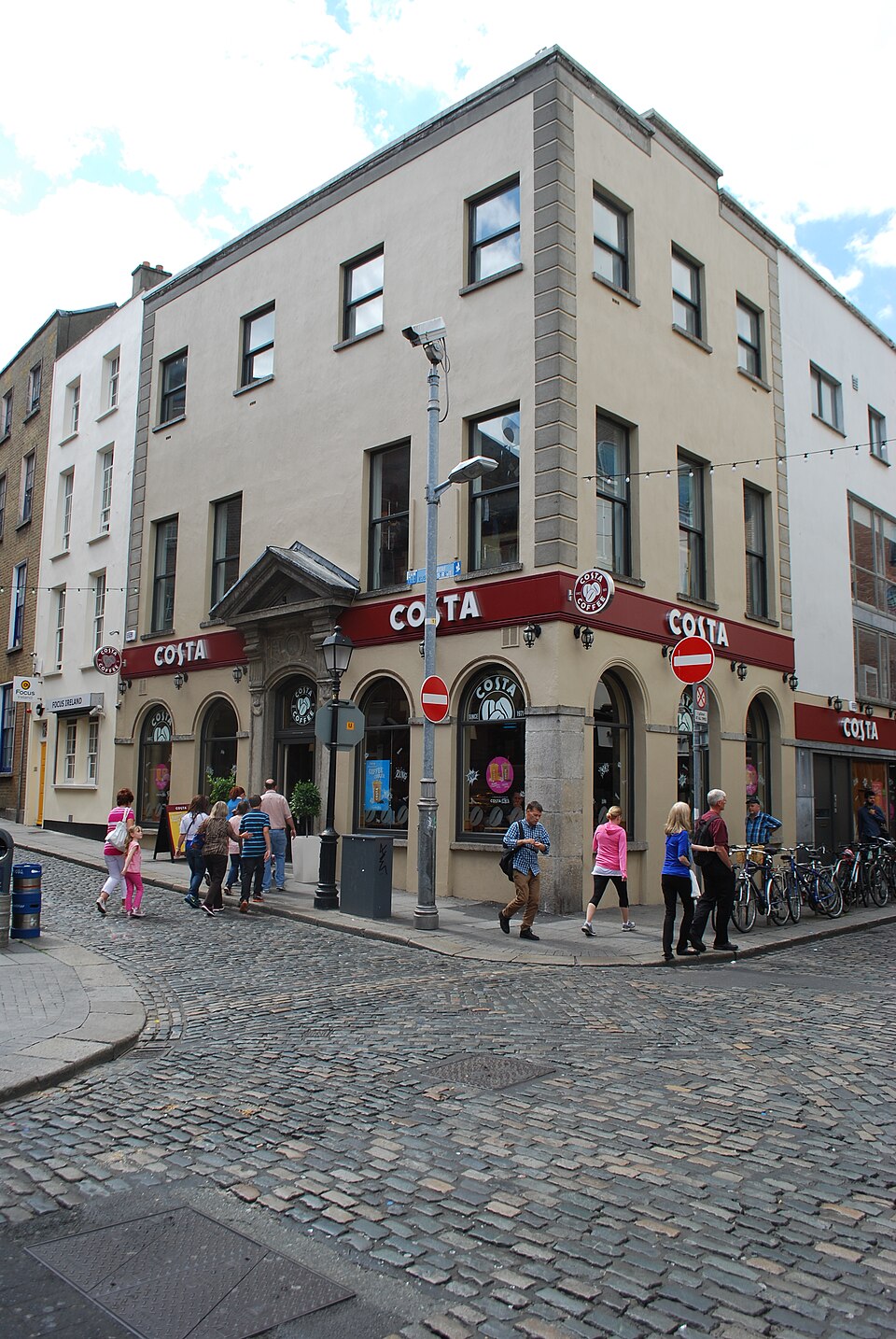
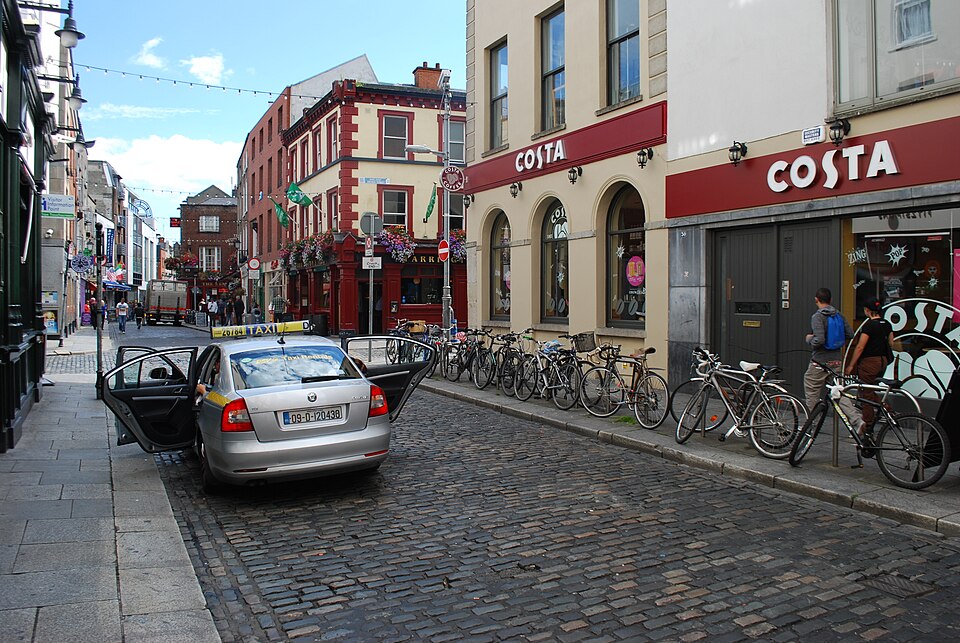
Temple Bar is reached on foot, and effectively only on foot. The quarter sits immediately south of the Liffey in the centre of Dublin, and its own streets are cobbled with narrow footpaths, low traffic volumes and low speeds — conditions that make walking pleasant and driving pointless. No car is needed, and a car brought here is a problem rather than a help: there is no visitor parking inside the quarter and the lanes are not laid out for it. From the north side, the pedestrian crossings of the Liffey land directly in it, Merchants' Arch delivering walkers into the middle of the district. From the south, Dame Street runs along its entire southern boundary, and from the east Westmoreland Street brings walkers down from College Green. Visit Dublin's own transport guidance for the city centre points at the TFI Leap Card for bus, tram and rail fares, the TFI Journey Planner app for live bus, rail and Luas times, and the TFI 90 Minute Fare, which lets Leap Card holders transfer between services at no extra cost within ninety minutes — the useful ticket for a visitor combining Temple Bar with something further out on the same afternoon.
Checked 2026-08-26 · Source
The surface is the first thing to plan for. The quarter is primarily cobbled, with narrow footpaths and steps in some places, and buildings that are generally older, smaller and likely to have an entrance step of their own. The steps can usually be bypassed and traffic is light and slow, which helps, but wheelchair access across the district is recorded as limited rather than full, and cobbles in rain are genuinely slippery. Flat shoes with grip, not heels, and not smooth soles. The second thing is the gap between the quarter's billing and its evenings. Temple Bar is promoted as Dublin's cultural quarter, and by day, with its galleries, archives, theatres and markets, that description holds. After dark it functions mainly as a nightlife district aimed at visitors, dense and loud, and drink prices on the central lanes reflect that. Meeting House Square has been gated since 1997 and is closed at night, so a route planned around it will not work late. Noise and late-night behaviour have been a live local issue for years, with residents pressing Dublin City Council and An Bord Pleanála on amplified music and licensing. None of that makes the district unsafe; it makes the hour of arrival the single decision that most changes the visit.
Checked 2026-08-26 · Source
The pictures here are made in lanes, which means the light is narrow and directional and the subject is usually a wall. Love Lane in Crampton Court is the most photographed spot after the pub frontages: a deconstructed heart mosaic with quotes and song lyrics, in an alley that is shaded almost all day, so it wants a still hand or a raised sensitivity rather than a flash, which flattens the mosaic completely. The Icon Walk panels sit between graffiti and fire escapes on the lanes behind Fleet Street and are easy to walk past, so they reward looking up as well as ahead. The pub frontages draped in fairy lights and hanging baskets are the postcard, and they photograph better wet at dusk than dry at noon, when the crowd in front of them is thickest and the light is flattest. Merchants' Arch frames the north-side view neatly and works as a silhouette. Two practical points. The lanes are busy from late morning, so anything wanting an empty street needs an early hour, before about nine. And these are working pubs, shops and studios rather than exhibits — pointing a camera through a doorway at people drinking is worth asking about first, and inside galleries the house rule applies rather than the street one.
Checked 2026-08-26
No. Temple Bar is a district of public streets and two public squares on the south bank of the Liffey, not a ticketed attraction, so walking in costs nothing at any hour. The venues inside it price themselves individually: Temple Bar Gallery + Studios states it is free for everybody, the Project Arts Centre runs free exhibitions, and the Irish Film Institute shows free lunchtime screenings from the Irish Film Archive, while its regular cinema programme, the theatres and the pubs all charge their own prices. No pass covers the quarter.
The quarter has none, and none is published. Temple Bar is an open street network with no gate and no operator that sets hours for it, so the honest answer is that the streets are always walkable and the individual venues each keep their own times. Two anchors are published: live music at the Temple Bar pub starts at 10.30am, and the Temple Bar Food Market runs on Saturdays in Meeting House Square. Meeting House Square itself has been gated since 1997 and is closed at night.
Two and a half hours is this guide's judgement, not an official figure — Visit Dublin publishes visit durations for venues inside the quarter, such as one to two hours for Temple Bar Gallery + Studios, but none for the district. Two and a half hours covers a circuit of the lanes, the Icon Walk and Love Lane, one indoor stop and a sit-down drink. Forty-five minutes is enough to see only the streets. A Saturday built around the food market and Cow's Lane runs closer to four hours.
Three, and all of them are weekend markets. The Temple Bar Food Market is held on Saturdays in Meeting House Square. The Temple Bar Book Market is held on Saturdays and Sundays in Temple Bar Square. The Cow's Lane Market, a fashion and design market, takes place on Cow's Lane on Saturdays. Meeting House Square, named for the nearby Quaker meeting house, also hosts outdoor film screenings in the summer months and has been home to the Speaker's Square public-speaking project since summer 2004.
No car is needed, and one is a hindrance: the quarter is central, small enough to cross on foot in about ten minutes, and has no visitor parking of its own. On accessibility, the streets are recorded as primarily cobbled with narrow footpaths, low traffic levels and low speeds; steps appear in some areas but can usually be bypassed, and the older, smaller buildings often have an entrance step. Wheelchair access across the district is limited rather than full. Cobbles are slippery in rain, so flat shoes with grip are the practical choice.
Both descriptions are true at different hours, and the hour is the decision. By day the quarter earns its cultural-quarter billing: the Irish Film Institute and its archive, Photo Museum Ireland and the National Photographic Archive, Temple Bar Gallery + Studios, Smock Alley Theatre, the Project Arts Centre and the weekend markets are all real and mostly cheap or free. After dark it works as a visitor-facing nightlife district, dense, loud and expensive by Dublin standards, and drink prices on the central lanes are not representative of the city. Come before noon for the first version.
Loading the interactive map…
The interactive map could not be loaded.
Last updated:
Source: OpenStreetMap contributors, Wikidata ·