


1 min walk
National Gallery of Ireland
- Must see
- Art and culture venue
Language · 1 published
Historic monument · Dublin
| Monday | 11:00 – 17:30 |
|---|---|
| Tuesday | 09:15 – 17:30 |
| Wednesday | 09:15 – 17:30 |
| Thursday | 09:15 – 20:30 |
| Friday | 09:15 – 17:30 |
| Saturday | 09:15 – 17:30 |
| Sunday | 11:00 – 17:30 |
Checked 2026-08-26 · Source
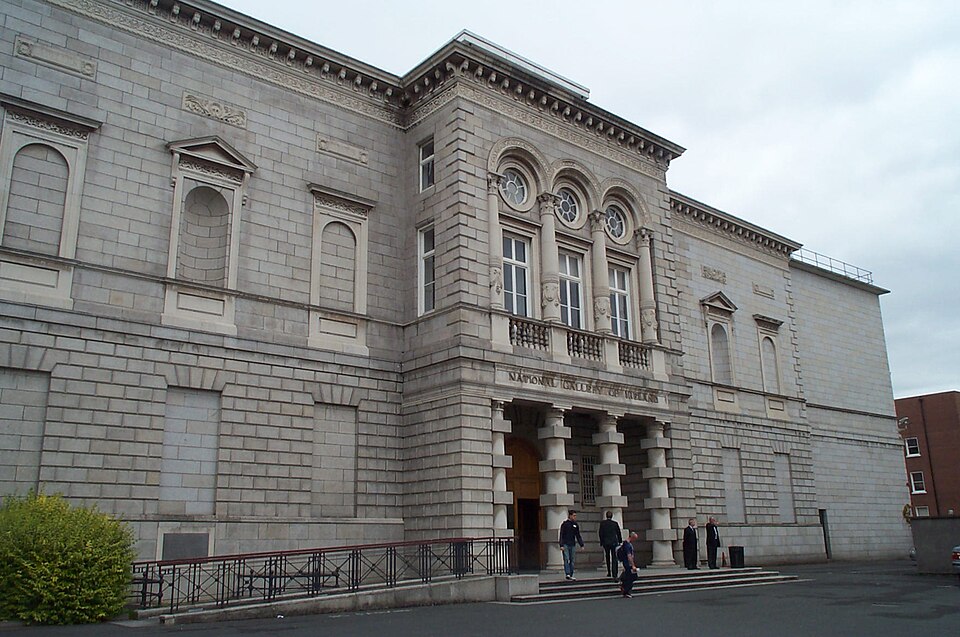
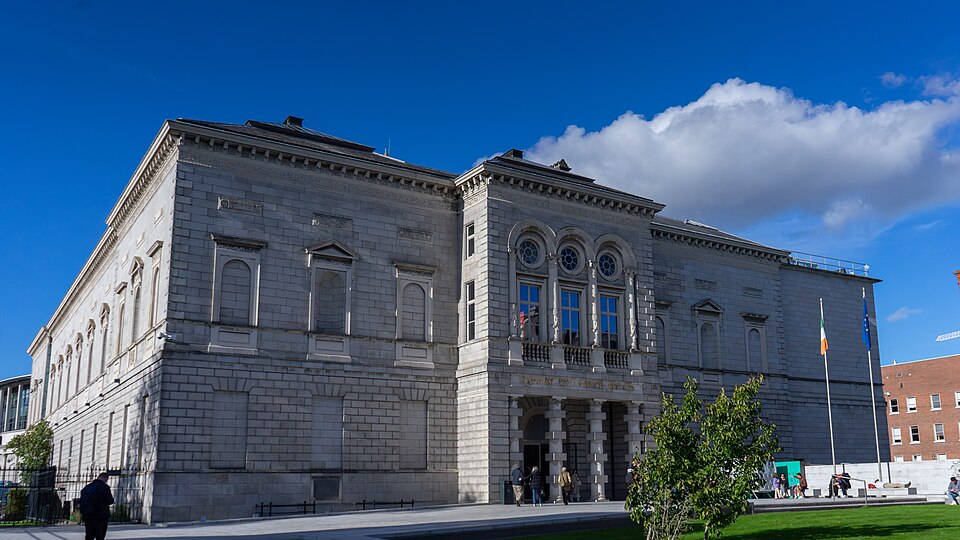
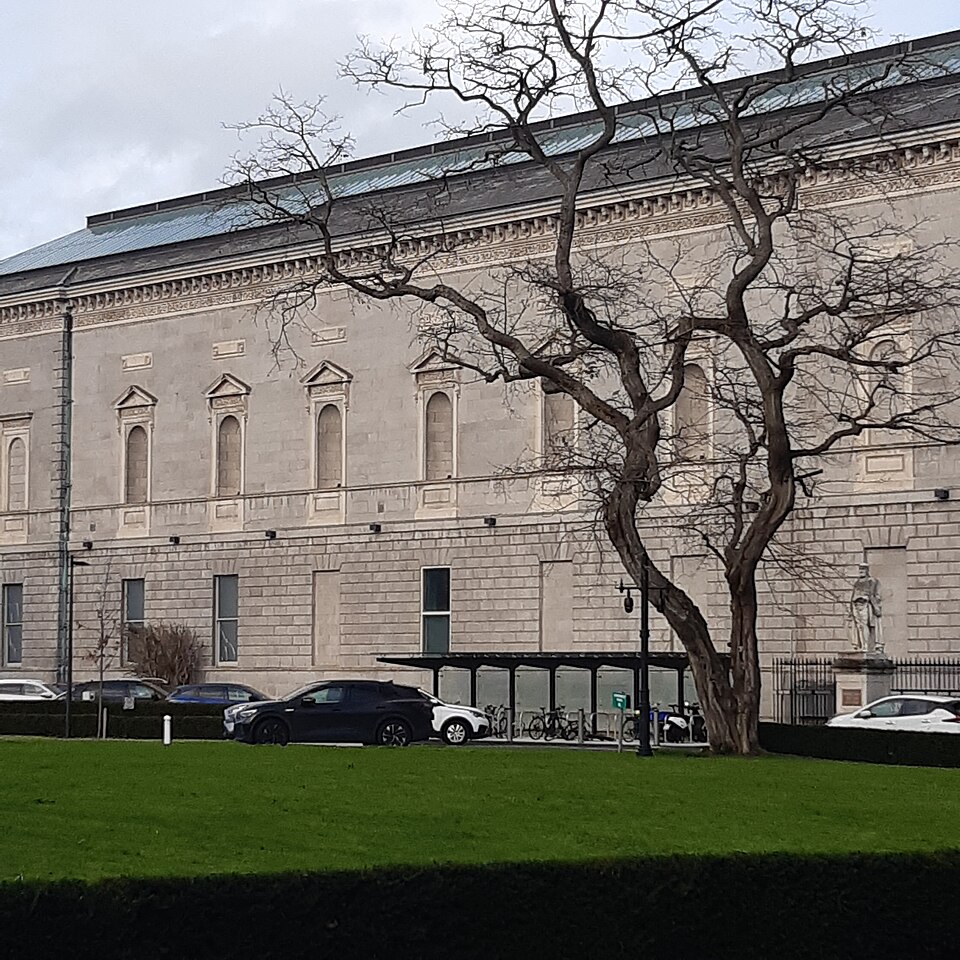
The National Gallery of Ireland holds the national collection of European and Irish art in a block on the west side of Merrion Square, Dublin 2. It opened to the public on 30 January 1864 with 112 pictures, thirty-nine of them bought in Rome in 1856 and thirty of them on loan. Everything after that arrived by purchase, bequest and gift. The Countess of Milltown gave over 200 pictures in 1901, a gift large enough that a new wing was built to hold it. Sir Alfred and Lady Clementine Beit gave seventeen old master paintings in 1987, and the 1968 extension carries their name. In 1993 Caravaggio's The Taking of Christ, long thought lost, was identified in a Jesuit house of studies in Dublin; it hangs here still, on indefinite loan from the Jesuit fathers. The building is four joined wings rather than one hall: the original Dargan Wing designed by Francis Fowke, the Milltown Wing, the Beit Wing, and the Millennium Wing of 2002, which added the second public entrance on Clare Street. Between 2011 and 2017 the two historic wings were rebuilt around an underground energy centre, and a courtyard was opened in the void between them. Admission to the permanent collection is free.
Checked 2026-08-26 · Source
Two collections share the building. One is European, running from the Italian and Spanish schools through the Dutch and French to the early twentieth century; the other is Irish, and the Gallery describes it as the most comprehensive collection of Irish art anywhere. The single painting most visitors come for is Caravaggio's The Taking of Christ. Around it the Gallery's own highlights list names Vermeer's Woman Writing a Letter, with her Maid, Velázquez's Kitchen Maid with the Supper at Emmaus, Rembrandt's Landscape with the Rest on the Flight into Egypt, Goya's Doña Antonia Zárate, Monet's Argenteuil Basin with a Single Sailboat, Turner's A Ship against the Mewstone, Degas, Picasso, Juan Gris, Berthe Morisot and Sofonisba Anguissola. The Irish rooms carry Jack B. Yeats's The Liffey Swim, Daniel Maclise's The Marriage of Strongbow and Aoife, Frederic William Burton's The Meeting on the Turret Stairs, William John Leech's A Convent Garden, Brittany, Mainie Jellett's Decoration and Harry Clarke's The Elf-hill. Prints and drawings and the National Portrait Collection are held as separate departments. Temporary exhibitions occupy their own rooms and change several times a year, so what is on the walls beyond the highlights is worth checking before a visit rather than assumed.
Checked 2026-08-26 · Source
Allow two hours. The Gallery publishes no suggested visit length of its own, so that figure is this guide's judgement rather than a number read off its site, and it is built from what the Gallery does publish. A private guided tour of the permanent collection is scheduled at fifty minutes, which is the institution's own estimate of how long a curated run through the best of it takes. Two hours is that tour walked at a visitor's pace, with the Irish rooms added and time left for one temporary exhibition. Ninety minutes is enough for the Caravaggio, the Dutch and Spanish rooms and the Yeats paintings if the route is chosen in advance rather than wandered into. Three hours is only worth booking on a Thursday, when the building stays open until 20.30. Two hard limits shape the end of any visit: entry to the galleries stops fifteen minutes before closing, and the Gallery begins closing at 16.50 every day, or 19.50 on Thursdays, starting with the upper floors. A visitor who arrives at 16.30 on a Tuesday has less than half an hour of full access, not the hour the closing time suggests.
Checked 2026-08-26 · Source
The Gallery opens seven days a week, and the useful distinction is the opening time rather than the closing one. Monday and Sunday start late, at 11.00. Tuesday through Saturday start at 09.15, which buys nearly two extra hours and is the quietest stretch of any day. Closing is 17.30 on six days; Thursday is the exception, running to 20.30, and it is the only evening in the week when the collection can be seen after dark in winter. The Gallery closes on 24, 25 and 26 December and on Good Friday, and opens 11.00 to 17.30 on 1 January. Those are the only annual closures it publishes. Group traffic is the other thing worth timing around: every group must book a time slot, a group is up to fifteen people plus a leader, and three groups can share one slot, so mid-morning on a weekday can put close to fifty people through an entrance at once. Between 1 and 31 July the Gallery states it cannot facilitate any group that has not booked in advance, which is a fair indication of how busy that month runs. Free guided tours for younger visitors run at 12.30 on Sundays.
Checked 2026-08-26 · Source
Entry to the permanent collection is free and no booking is required. Many temporary exhibitions are free too, and the Gallery's accessibility page states that two exhibitions a year carry an admission charge. Where a charge applies it is published per exhibition rather than as a standing gallery price: the Hilma af Klint exhibition running 15 October 2026 to 7 February 2027 is listed at tickets from 0 to 16 euro. Exhibitions are free for members. Carers accompanying someone in their care are admitted free to the ticketed exhibitions on production of valid identification, and the Gallery recommends booking that free ticket in advance. Groups visiting the permanent collection and the free exhibitions pay nothing but must book a time slot, choosing Clare Street or Merrion Square as their check-in point; a group is ten to fifteen people plus one leader, and there is no time limit on the visit once inside. A bespoke private guided tour of the permanent collection costs 100 euro in total including VAT, covers up to fifteen people, runs fifty minutes and must be booked at least two weeks ahead. Family Packs and drawing kits are lent free from the information desks.
Checked 2026-08-26 · Source
No car is needed, and driving is the worst of the options. The Gallery sits in the middle of Georgian Dublin with two entrances, one on Merrion Square West and one on Clare Street, and either can be used. On foot it is about ten minutes from St Stephen's Green, Grafton Street or Trinity College, which covers most of where a visitor to central Dublin is likely to be staying or standing. Pearse DART station is a five-minute walk. On the Luas Green Line, Dawson Street is the stop, six minutes away; the Red Line is not convenient, with Abbey Street about twenty minutes off. Dublin Bus routes 4, 7 and 8 stop at Merrion Square North and Clare Street, and the 39a stops at Merrion Row. Two dublinbikes stations sit beside the building, at Clare Street and at Merrion Square West. Drivers get metered parking on Merrion Square itself and four disabled parking spaces outside the Merrion Square entrance, and nothing else. Electric scooters and bicycles must be parked in the bike storage area at the Merrion Square forecourt and cannot be brought inside. All galleries and facilities are wheelchair and buggy accessible.
Checked 2026-08-26 · Source
Luggage is the usual problem. There are self-service lockers at Merrion Square, they measure 45 by 37 by 45 centimetres, and visitors are asked to put all handheld and backpack-sized items into them. The Gallery offers no storage beyond that and does not permit suitcases larger than a handheld bag or a regular backpack that fits a locker, so arriving from a train or a hotel checkout with a case is a wasted journey. Nothing may be left overnight. The second trap is the closing sequence: the Gallery starts closing at 16.50 daily, or 19.50 on Thursdays, and it starts with the upper floors, so the rooms furthest from the door are the first to be lost. Entry to the galleries ceases fifteen minutes before closing time. Individual rooms are closed from time to time without notice, which the Gallery states plainly rather than hides. Inside the galleries there is no touching of any artwork including sculpture, and no eating or drinking. Practical help that is easy to miss: wheelchairs can be borrowed from the information desks, large-print artwork booklets are placed throughout the permanent-collection galleries, assistance dogs are welcome, and the Changing Places toilet key is obtained by calling 087 117 0880.
Checked 2026-08-26 · Source
The Gallery publishes a Public Photography Policy, and it is more permissive than most. Casual still photography and video for personal, non-commercial use is allowed, as is photographing the architecture inside and outside the building, and photographing collection works that are out of copyright. The limits are specific. No flash, tripods, monopods or supplementary lighting in exhibition areas. No selfie sticks. Works that are in copyright or on long-term loan may not be photographed, and the Gallery marks those with a symbol printed on the display label, so the label rather than the painting is the thing to read first. That rule catches the modern Irish rooms more often than the old master ones. Staged photography in the Gallery's spaces, including engagement and wedding pictures and large posed groups, is prohibited without prior permission from the Executive Leadership Team, and the Gallery says it does not in practice facilitate wedding or engagement requests. Security staff will ask a visitor to stop if camera or phone use is undermining other people's visit. Commercial photographers, film crews, media and students all need to arrange permission with the relevant department in advance. High-quality digital images of collection works can be downloaded free where a Creative Commons attribution applies.
Checked 2026-08-26 · Source
Yes. Admission to the permanent collection is free and no booking is required, and many temporary exhibitions are free as well. The Gallery's accessibility page states that two of its temporary exhibitions each year carry an admission charge; those are priced per exhibition, and the Hilma af Klint exhibition of 15 October 2026 to 7 February 2027 is listed at tickets from 0 to 16 euro. Exhibitions are free for members, and carers accompanying someone in their care are admitted free with valid identification.
The Gallery opens every day. Monday 11.00 to 17.30, Tuesday and Wednesday 09.15 to 17.30, Thursday 09.15 to 20.30, Friday and Saturday 09.15 to 17.30, and Sunday 11.00 to 17.30. There is no midday break. Entry to the galleries stops fifteen minutes before closing, and the building begins closing at 16.50 daily, or 19.50 on Thursdays, starting with the upper floors.
Allow two hours. The Gallery publishes no suggested visit length, so this is the guide's judgement, built from the fifty minutes it schedules for a private guided tour of the permanent collection. Ninety minutes covers the Caravaggio, the Dutch and Spanish rooms and the Jack B. Yeats paintings if the route is planned first. Three hours is realistic only on a Thursday, when the Gallery stays open until 20.30.
No. The Gallery is on Merrion Square in central Dublin, roughly ten minutes on foot from St Stephen's Green, Grafton Street or Trinity College. Pearse DART station is five minutes away and the Luas Green Line stop at Dawson Street is six; the Red Line at Abbey Street is about twenty minutes off. Bus routes 4, 7 and 8 stop at Merrion Square North and Clare Street, and the 39a at Merrion Row. Drivers have metered parking on Merrion Square and four disabled spaces outside the Merrion Square entrance.
Casual still photography and video for personal, non-commercial use is permitted, along with photography of the building's architecture and of collection works that are out of copyright. Flash, tripods, monopods, supplementary lighting and selfie sticks are not permitted in exhibition areas. Works in copyright or on long-term loan cannot be photographed and are marked with a symbol on the display label, so the label is what to check. Staged photography, including wedding and engagement pictures, requires prior permission and is generally not facilitated.
The Gallery closes on 24, 25 and 26 December inclusive and on Good Friday. Those are the only annual closures it publishes; there is no weekly closing day. On 1 January it opens 11.00 to 17.30. Individual rooms and galleries may be closed temporarily at other times without advance notice.
Loading the interactive map…
The interactive map could not be loaded.
Last updated:
Source: OpenStreetMap contributors ·