1 min walk
Philopappou
- High
- Viewpoint
Language · 11 published
Historic monument · Athens
Μνημείο Φιλοπάππου
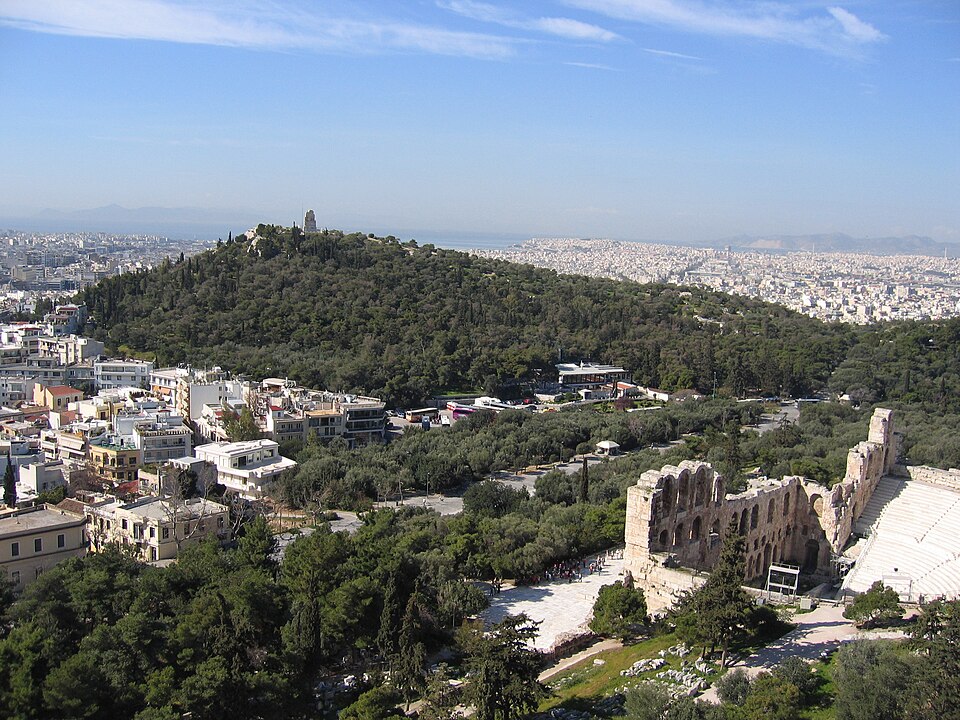
The Philopappos Monument is an ancient funerary monument situated on Mouseion Hill, southwest of the Athenian Acropolis. It was erected in honor of Gaius Julius Antiochus Epiphanes Philopappos, a prince of the Kingdom of Commagene who held Athenian citizenship and served as a Roman consul. The structure combines Greek and Roman architectural elements in its surviving marble fragments. The monument stands as a significant testament to the cultural integration of eastern royalty within Roman-era Athens. Its elevated position offers commanding views across the city toward the Saronic Gulf.
Checked 2026-08-26
The monument survives as a substantial ruin rather than an enclosed structure with an interior. Visitors encounter the remaining marble facade and architectural fragments that once formed the tomb's superstructure. The structure originally featured a seated statue of Philopappos in the central niche, flanked by statues of his royal ancestors. These sculptural elements are no longer present at the site. The archaeological remains permit examination of Roman imperial construction techniques and commemorative practices. The open-air setting allows unrestricted circulation around the monument base and along the preserved wall sections.
Checked 2026-08-26
A visit to the Philopappos Monument typically requires between thirty minutes and one hour for most visitors. This duration allows adequate time to approach the structure from the surrounding parkland, examine the architectural remains, and appreciate the panoramic views across Athens. The timing varies considerably based on individual interest in archaeological detail and the extent of walking undertaken across Mouseion Hill. Many visitors incorporate the monument into a longer itinerary including the nearby Pnyx, Hill of the Nymphs, and other archaeological points of interest within the Philopappos Hill park area.
Checked 2026-08-26
The Philopappos Monument occupies an open-air archaeological site within public parkland. Operator-confirmed hours are Not recorded pending review. The hilltop exposure suggests morning and late afternoon visits may offer more comfortable conditions during warmer months, particularly given the absence of shade at the monument itself. Sunset viewing attracts numerous visitors seeking photographic opportunities with the Acropolis illuminated in evening light. Seasonal weather patterns in Athens should inform visitor preparation, as the marble surfaces become slippery when wet and offer no shelter from rain or intense sun.
Checked 2026-08-26
The Philopappos Monument stands within freely accessible public parkland. No entrance fee is required to approach or view the archaeological remains. Operator-confirmed prices are Not recorded pending review. Visitors should verify whether any changes to access arrangements have occurred. The absence of controlled entry means no advance booking is necessary. This unrestricted access contrasts with ticketed archaeological sites elsewhere in central Athens. Visitors bear personal responsibility for appropriate conduct around the ancient structure, as no on-site supervisory staff are consistently present to monitor behavior or enforce protective regulations.
Checked 2026-08-26
The monument is reached on foot from multiple directions through the Philopappos Hill park. Common approaches originate near the Acropolis Museum, the Pnyx entrance, or the Dionysiou Areopagitou pedestrian promenade. The terrain involves uneven pathways and moderate inclines unsuitable for wheeled vehicles or mobility-impaired visitors without assistance. No public transportation delivers directly to the monument. The nearest metro station is Akropoli, requiring subsequent walking. Signage within the park indicates directions toward the archaeological points of interest. Comfortable footwear is essential given the unpaved and occasionally rocky trail surfaces throughout the hill area.
Checked 2026-08-26
The marble and stone surfaces present significant slip hazards, particularly following rainfall or morning dew. No protective barriers separate visitors from the ancient fabric, requiring careful movement to prevent accidental damage or personal injury. The exposed hilltop location offers no shade, water sources, or emergency facilities. Summer temperatures demand adequate hydration and sun protection carried by visitors. The isolated setting suggests visiting in groups or during periods when other visitors are present. Mobile telephone coverage may be inconsistent. Wildlife including snakes inhabits the rocky terrain, warranting attentive foot placement and avoidance of concealed spaces beneath stone fragments.
Checked 2026-08-26
The monument offers exceptional photographic prospects encompassing both the ancient structure and its dramatic topographical relationship with the Acropolis and modern Athens. The optimal light for photography occurs during early morning and the hour preceding sunset, when directional illumination enhances the marble textures and extends shadows across the architectural forms. The unrestricted access permits tripod use and extended composition time without crowd pressure typical of ticketed sites. Wide-angle lenses accommodate the monument's scale against its urban backdrop. The elevated position captures layered depth from foreground archaeological detail through middle-distance cityscape to distant mountains and sea horizon.
Checked 2026-08-26
No. The Philopappos Monument stands on separate Mouseion Hill, southwest of the Acropolis. While visible from the Acropolis and offering views toward it, these are distinct archaeological sites with separate historical significance and geographical locations.
The monument survives as an open-air ruin without enclosed interior spaces. Visitors circulate around the exterior remains and base structure. There are no doors, chambers, or roofed areas permitting or requiring entry.
No formal guided tour infrastructure operates specifically at the Philopappos Monument. The site lacks ticket offices, visitor centers, or scheduled programming. Visitors may encounter independent guides leading walking tours through the broader park area.
The approach paths involve uneven terrain, moderate inclines, and unpaved surfaces that present substantial difficulties for wheelchairs and strollers. The site is not designed with accessibility accommodations. Cautious visitor judgment is advised.
No restroom facilities are located at the monument itself. The surrounding parkland similarly lacks permanent amenity infrastructure. Visitors should plan accordingly before ascending the hill from surrounding urban areas where facilities may be found.
The visible remains represent ancient fabric in ruined condition. The extent of modern conservation intervention, anastylosis, or reconstruction is not recorded in available sources. Visitors observe archaeological remains rather than a fully reconstructed ancient monument.
Loading the interactive map…
The interactive map could not be loaded.

Last updated:
Source: OpenStreetMap contributors, Wikidata ·