_Sinti_und_Roma.jpg)


2 min walk
Reichstag
- Must see · Heritage site
- Historic monument
Language · 1 published
Historic monument · Berlin
Denkmal für die im Nationalsozialismus ermordeten Sinti und Roma Europas
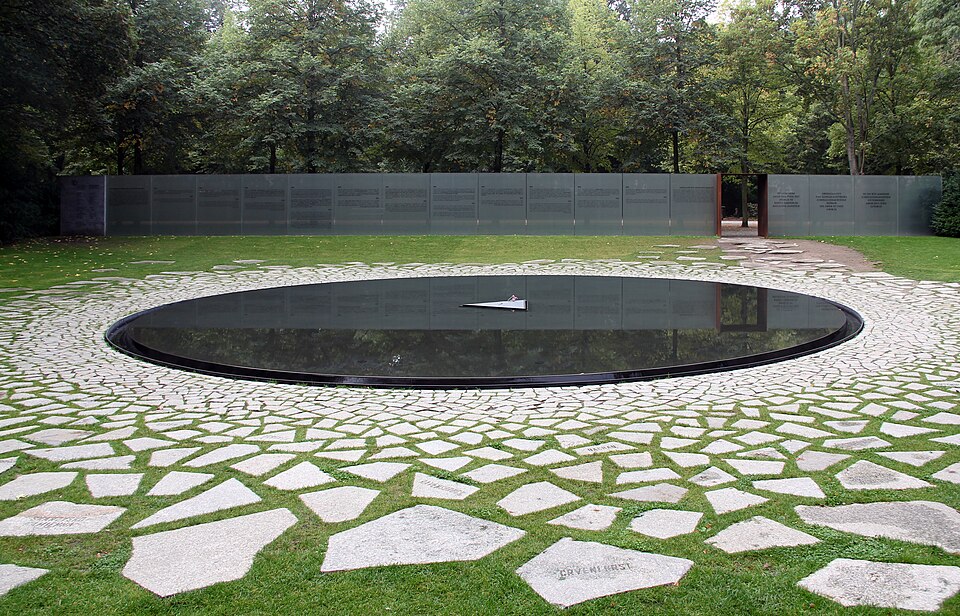
The Memorial to the Sinti and Roma victims of National Socialism is a Berlin monument dedicated to European Sinti and Roma murdered under Nazi rule. Located near the Reichstag, it was designed by artist Dani Karavan and opened in 2012 after prolonged political debate. The dark circular pool features a triangular stone that rises and sinks daily, bearing a fresh flower. A poem by Italian Roma survivor Santino Spinelli encircles the rim. This memorial addresses historical exclusion, as Sinti and Roma persecution was long marginalized in German remembrance culture.
Checked 2026-08-26
The memorial consists of an open-air installation on Tiergarten parkland. Its central element is a black water basin with the disappearing stone. Surrounding information panels document Nazi persecution of Sinti and Roma across Europe, including deportations, forced labor, medical experiments, and mass murder at Auschwitz-Birkenau. The site lists chronologically the regions where genocide occurred. Visitors encounter historical photographs and text explaining prewar Roma and Sinti life, escalating discrimination, and postwar silence. The design invites contemplation through minimalism rather than monumental scale, with seating available nearby.
Checked 2026-08-26
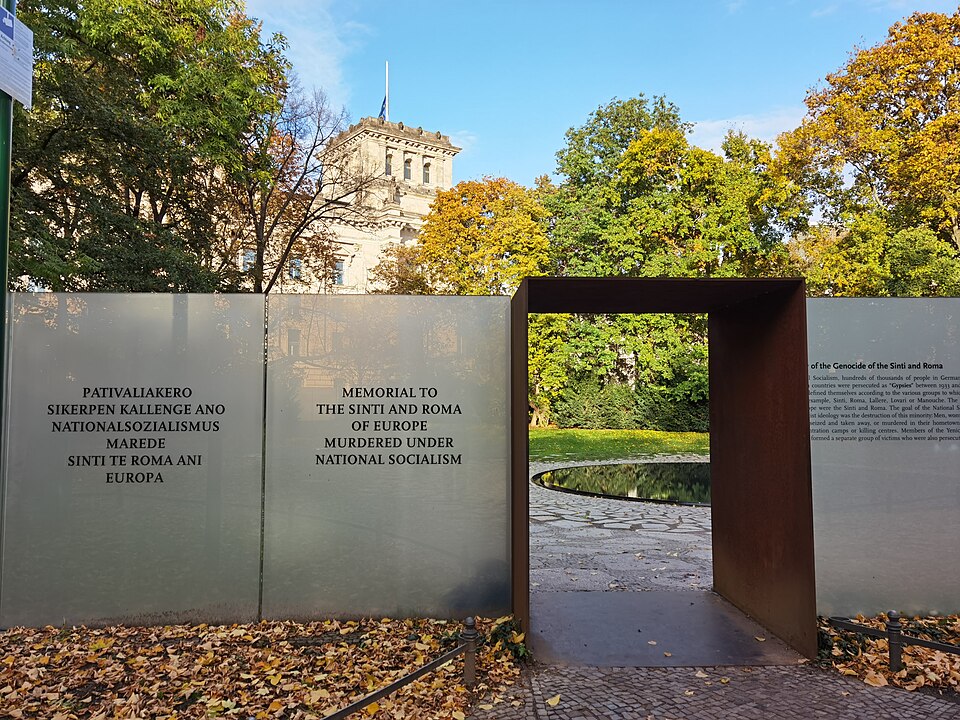
Most visitors spend twenty to forty minutes at this compact memorial. The information panels require careful reading for full comprehension. Those with limited background on Nazi persecution of Sinti and Roma may wish to allocate additional time. The memorial's emotional weight often prompts pause and reflection beyond pure information gathering. Photography and quiet observation extend typical visits. Combined with nearby Holocaust Memorial and Brandenburg Gate, it fits into broader historical itinerary. No guided tours operate on site, so self-paced engagement determines duration. Early morning or evening visits suit those seeking solitude.
Checked 2026-08-26

Operator-confirmed hours are Not recorded pending review. The memorial occupies public parkland, suggesting daytime accessibility aligns with general Tiergarten visiting patterns. Berlin's variable climate affects comfort; winter brings early darkness and cold, summer offers extended daylight. The water feature's visibility and the stone's movement are best observed in daylight. Crowds concentrate midday near adjacent government district. Dawn and dusk provide atmospheric lighting for the reflective pool. Visitors should verify current conditions through official Berlin channels before planning, as maintenance or ceremonies may cause temporary access changes without widespread announcement.
Checked 2026-08-26
Operator-confirmed prices are Not recorded pending review. The memorial stands in public space, strongly indicating free admission without entry control. No ticket infrastructure is visible at the site. Voluntary donations may support associated documentation centers elsewhere. Berlin's memorial landscape generally operates without admission fees, though special exhibitions at nearby institutions sometimes charge separately. Visitors should carry minimal cash for incidental park purchases. Group arrangements or educational programming might involve separate booking systems not evident from exterior observation. Confirmation of absolutely no cost requires direct inquiry with Berlin memorial administration or municipal tourism authorities.
Checked 2026-08-26

The memorial sits in Tiergarten between Reichstag building and Brandenburg Gate, address Simsonweg. Reachable via S-Bahn lines S1, S2, S25 to Brandenburger Tor station, or U-Bahn U55 to Bundestag. Bus lines M85 and 100 serve nearby stops. Walking from Friedrichstrasse or Potsdamer Platz stations takes fifteen to twenty minutes through parkland. Cyclists find paths throughout Tiergarten. Limited parking exists in government quarter; public transport strongly advised. The site lacks prominent vertical signage, so precise mapping coordinates assist location. Wheelchair access appears possible via paved paths though verification recommended.
Checked 2026-08-26

The memorial's understated design makes it easy to overlook amid grander surroundings. Visitors should approach respectfully; this is active commemoration site, not mere tourist attraction. Water basin edges present slip hazard, particularly in frost. The disappearing stone mechanism operates on timed cycle; patience required to witness full movement. Some information panels may deteriorate from weather exposure. Nearby political demonstrations occur given government district location. The content addresses genocide directly, potentially distressing. Children require contextual preparation. No staff presence means self-directed conduct; report vandalism through city channels. Winter darkness falls early in tree-shaded park.
Checked 2026-08-26

Photography appears permitted in this public memorial space without restriction. The reflective pool and disappearing stone offer distinctive visual elements. Morning and evening light enhance the dark water's mirror quality. Respectful distance from other visitors maintains contemplative atmosphere. Tripod use in crowded government district may attract security attention. Drone operation strictly prohibited near federal buildings. The inscribed poem rewards close-up documentation. Night photography possible with portable lighting, though park safety considerations apply. Commercial or journalistic photography may require permits through Berlin memorial authorities. Visitors should prioritize experiential engagement over image collection at this somber site.
Checked 2026-08-26
No. The nearby Memorial to the Murdered Jews of Europe is a separate installation. This memorial specifically commemorates Sinti and Roma victims, addressing distinct historical persecution that was long underrepresented.
The triangular stone rises and sinks through mechanical means on a timed cycle. This is a deliberate design element by Dani Karavan, not an optical illusion.
Not recorded. No on-site staff or scheduled tours are evident. Visitors engage independently with the information panels.
The memorial features text in German and English based on standard Berlin memorial practice, though full language coverage is not independently verified.
The site appears reachable via paved Tiergarten paths, but specific accessibility features are Not recorded pending verification with operators.
Sinti and Roma persecution faced prolonged marginalization in postwar German remembrance. Political recognition and dedicated commemoration required decades of advocacy by survivor communities.
Loading the interactive map…
The interactive map could not be loaded.
Last updated:
Source: OpenStreetMap contributors, Wikidata ·