
_au_Petit_Palais_de_Paris.jpg)
.jpg)
.jpg)

.jpg)
1 min walk · Paris 8e Arrondissement
Jardin de Kyiv
- High
- Nature site
Language · 1 published
Museum · Paris 8e Arrondissement, Paris
Petit Palais, Musée des beaux-arts de la Ville de Paris
| Monday | Closed |
|---|---|
| Tuesday | 10:00 – 18:00 |
| Wednesday | 10:00 – 18:00 |
| Thursday | 10:00 – 18:00 |
| Friday | 10:00 – 18:00 |
| Saturday | 10:00 – 18:00 |
| Sunday | 10:00 – 18:00 |
Checked 2026-08-24 · Source
Read from the OpenStreetMap access tags; anything not listed has no tag recorded.
Set the group type to family in the planner and the day window contracts to about three quarters of a solo day.
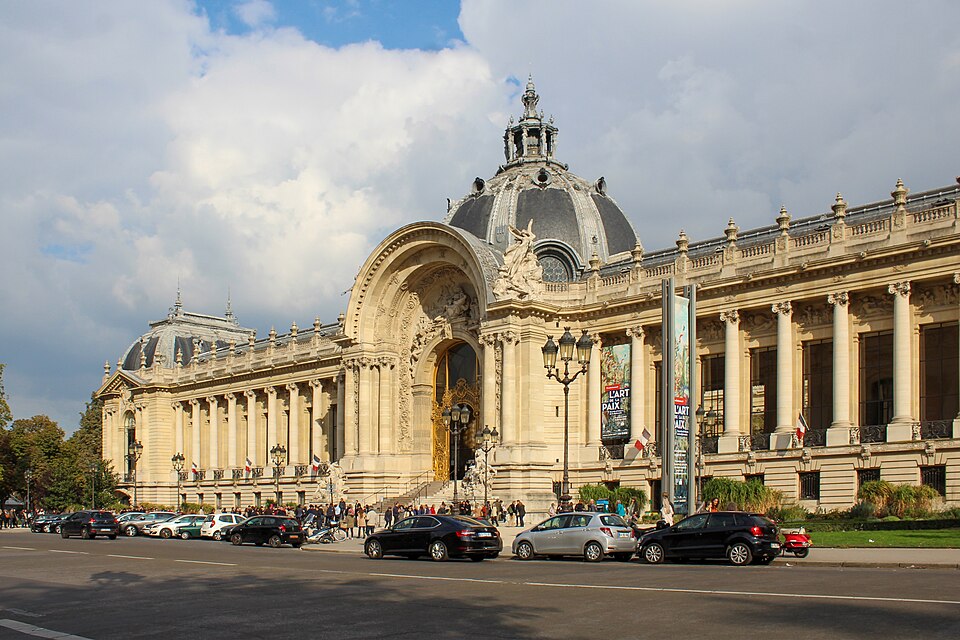
The Petit Palais was built for the 1900 World's Fair as an exhibition hall and has held the City of Paris's fine arts museum ever since.
Architect Charles Girault designed it alongside the larger Grand Palais across the Avenue Winston Churchill, the two forming a matched pair built for the same exposition and finished in the same year. Where the Grand Palais was built for temporary exhibitions on an industrial scale, the Petit Palais was designed from the outset with the semicircular colonnade and interior garden that let it become a permanent museum once the fair closed.
It opened as the Musée des Beaux-Arts de la Ville de Paris and has held the city's own fine art collection since, distinct from the Louvre and the Musée d'Orsay, which hold the national collections; the building itself is a listed historic monument.
Checked 2026-08-24 · Source
A permanent collection spanning antiquity to 1914, arranged around a semicircular garden courtyard under Girault's painted dome and colonnade.
The permanent galleries cover ancient Greek and Egyptian objects, medieval and Renaissance art, and a strong 19th-century French holding that includes Courbet, Cézanne, Monet and a substantial group of works by Paris-based sculptor Auguste Carpeaux. The building's own decoration is part of the exhibit: painted ceilings, mosaic floors and wrought ironwork survive largely as built for 1900.
The interior garden, glassed on one side and open to the sky through the courtyard, is free to enter even without a museum ticket and holds a café, making it a rest stop in its own right independent of the collection.
Checked 2026-08-24 · Source

An hour and a half for the permanent collection at a normal pace; the garden and café can be visited separately in a few minutes.
The permanent galleries are laid out around the courtyard in a loop, so a visitor can walk the full ring without doubling back, spending more time in whichever period draws the most interest. Temporary exhibitions, when running, are ticketed separately and add their own hour depending on scale.
Because the garden is free and open independent of the museum, a short stop for the courtyard alone — without visiting the collection — takes only the time it takes to walk in and sit down.
Checked 2026-08-24 · Source

Weekday mornings, since the museum sits opposite the Grand Palais and shares its crowd patterns whenever a major exhibition is running next door.
The permanent collection is free, which makes the Petit Palais one of the less crowded major museums in central Paris even at peak tourist season — most visitors to the avenue are headed for a ticketed exhibition at the Grand Palais rather than for the free galleries across the street.
Late-opening evenings, when the museum runs them, are the quietest time to see the courtyard lit and the collection with the smallest crowds of the week.
Checked 2026-08-24 · Source
The permanent collection is free. Temporary exhibitions are separately ticketed. Current rates for those exhibitions are not published on the sources this page uses and are not reproduced here.
Free entry to a permanent collection of this size is unusual among major Paris museums, and it is one of the reasons the Petit Palais draws a steadier, more local crowd than its ticketed neighbours.
The museum is covered by the Paris Museum Pass for its temporary exhibitions, where the pass otherwise adds nothing to a permanent collection that costs nothing to begin with.
Checked 2026-08-24 · Source

Avenue Winston Churchill, on the Right Bank between the Champs-Élysées and the Seine, in the 8th arrondissement.
Champs-Élysées–Clemenceau, served by Métro lines 1 and 13, sits directly at the museum's entrance, and Invalides across the river on RER C and Métro lines 8 and 13 is a short walk over the Pont Alexandre III. The Grand Palais stands directly opposite across the avenue, and the Champs-Élysées itself is a few minutes' walk north.
The Pont Alexandre III, built for the same 1900 exposition, connects the museum directly to the Invalides esplanade across the river.
Checked 2026-08-24 · Source

The permanent collection is free but temporary exhibitions are not, and the two use different entrances and different queues on busy days — checking which line is which avoids a wait for the wrong one.
The museum is closed on Mondays, as most Paris city-run museums are, which is worth checking before building a day's plan around it.
The courtyard garden is glassed on part of its perimeter but open to the sky at the centre, so weather reaches it even though it reads as an indoor space in photographs.
Checked 2026-08-24 · Source

The semicircular colonnade around the garden courtyard, shot from the far end looking back toward the entrance, is the building's signature interior image and captures both the architecture and the garden in one frame.
The painted dome above the entrance hall rewards looking straight up rather than across, and is easiest to shoot with the hall otherwise empty, early in the day.
From across Avenue Winston Churchill, the facade lines up with the Grand Palais opposite, and a wide shot from the avenue's centre island — timed against traffic — takes in both buildings from the same exposition in a single frame.
Checked 2026-08-24 · Source
The permanent collection is free. Only temporary exhibitions are ticketed.
They were built as a matched pair for the 1900 World's Fair by the same fair. The Grand Palais was built for large temporary exhibitions; the Petit Palais was designed from the start to become the City of Paris's permanent fine arts museum.
Ancient Greek and Egyptian objects, medieval and Renaissance art, and a strong 19th-century French collection including Courbet, Cézanne, Monet and sculptor Auguste Carpeaux.
Yes. The interior courtyard garden and its café are open to the public independent of the free permanent collection and any ticketed exhibition.
The pass covers its temporary exhibitions; the permanent collection is already free and needs no pass.
Mondays, in line with most museums run by the City of Paris.
Loading the interactive map…
The interactive map could not be loaded.
Last updated:
Source: OpenStreetMap contributors, Wikidata ·