The Élysée Palace is where the President of France lives and works, and it is closed to visitors for all but one weekend a year.
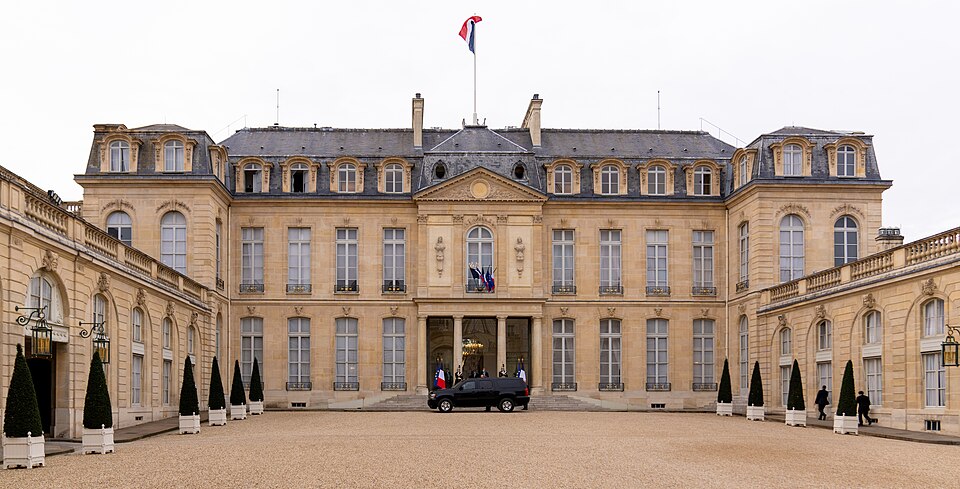
Armand-Claude Mollet built it between 1718 and 1722 for Louis Henri de La Tour d'Auvergne, Count of Évreux — a neo-classical house of three storeys with single-storey wings, set behind a courtyard at 55 Rue du Faubourg Saint-Honoré.
Madame de Pompadour lived here from 1753 to 1764, the banker Nicolas Beaujon after her, and Napoleon signed his abdication in the building on 22 June 1815.
Parliament made it the official residence of the president in 1848 and it became the working presidential seat in 1873, under the Third Republic.
The Salle des Fêtes is where every presidential inauguration and state banquet takes place. The Salon Doré is the president's study — the room in the photographs of every French head of state at a desk.
Behind the building is a garden of some two hectares with chestnut avenues, which is where the garden parties are held and which cannot be seen from any public street.
None of this is visitable on an ordinary day. The description exists because the building is on every walking route through the 8th arrondissement and people ask what is behind the gate.
Five minutes from the pavement, unless it is the third weekend in September.
What a visitor sees is a guarded gate on the Rue du Faubourg Saint-Honoré with a Republican Guard standing at it, and a glimpse of the courtyard when a car goes in.
On European Heritage Days the palace opens and the queue runs for hours — this is one of the most sought-after openings in France and people arrive before dawn.
The street itself is the visit the rest of the year: it is the luxury retail street of Paris and it runs from the Madeleine to the Place Beauvau in twenty minutes.
The third weekend of September, for European Heritage Days, or not at all.
That is the one occasion the building opens to the public, and the queue reflects it.
At any other time the Élysée is a closed gate on a busy street. There is no viewing point, no visitor entrance and nothing published in advance about presidential movements.
The Rue du Faubourg Saint-Honoré around it is at its best on a weekday morning, before the shops fill.
There is no ticket, because there is no general admission.
European Heritage Days entry is free and unticketed, allocated by queueing on the day. Group visits are arranged through official channels well in advance.
No tour operator can sell access to the Élysée, and anyone offering it is selling something else.
The 8th arrondissement, at 55 Rue du Faubourg Saint-Honoré, a few streets north of the Champs-Élysées.
Champs-Élysées–Clemenceau on Métro lines 1 and 13 is five minutes south; Miromesnil on lines 9 and 13 and Saint-Philippe-du-Roule on line 9 are both a short walk.
The Métro runs 16 lines across 321 stations, with stations 548 m apart on average — a two-stop journey is usually faster walked.
This is a guarded government building and the security perimeter is real. Loitering at the gate, photographing the guards or the entrances, or approaching the barriers will draw an intervention.
The surrounding streets close without notice for state visits and motorcades, sometimes for hours.
The palace is not open and no ticket exists. The only public opening is European Heritage Days in September, by queueing on the day.
Demonstrations are routinely held nearby and the Place Beauvau, with the Interior Ministry on it, is a frequent focal point.
The street is one of the most heavily policed in Paris and bag checks near it are ordinary.
There is not much to photograph, and some of it should not be.
The gate on the Rue du Faubourg Saint-Honoré is the only public view of the building, and photographing the guards or the security arrangements at it is not acceptable and is challenged.
The palace cannot be seen from the Champs-Élysées gardens behind it; the garden wall and the trees close the view completely.
On European Heritage Days photography inside is generally permitted in the rooms opened, subject to whatever is said on the day.
The street's shopfronts and the Place Beauvau are the photographs available here the rest of the year.
Checked 2026-08-23
Common questions
Can I visit the Élysée Palace?
Only on European Heritage Days in September, free and unticketed by queueing on the day. There is no general admission and no tour operator can sell access.
Who lives there?
The President of France. Parliament designated it the official presidential residence in 1848 and it became the working seat in 1873.
Who built it?
Armand-Claude Mollet, between 1718 and 1722, for Louis Henri de La Tour d'Auvergne, Count of Évreux.
Who lived there before the presidents?
Madame de Pompadour from 1753 to 1764 and the banker Nicolas Beaujon after her. Napoleon signed his abdication in the building on 22 June 1815.
What is the Salon Doré?
The president's study — the room in the photographs of every French head of state at their desk. The Salle des Fêtes hosts inaugurations and state banquets.
Can I see it from the street?
Only the gate and the courtyard beyond it. Photographing the guards or the security arrangements is not acceptable and is challenged.
Nothing non-essential is set before you choose, in regions where consent is required. If you decline, ads still appear but they are non-personalised, and analytics is switched off entirely.



_(cropped).jpg)


