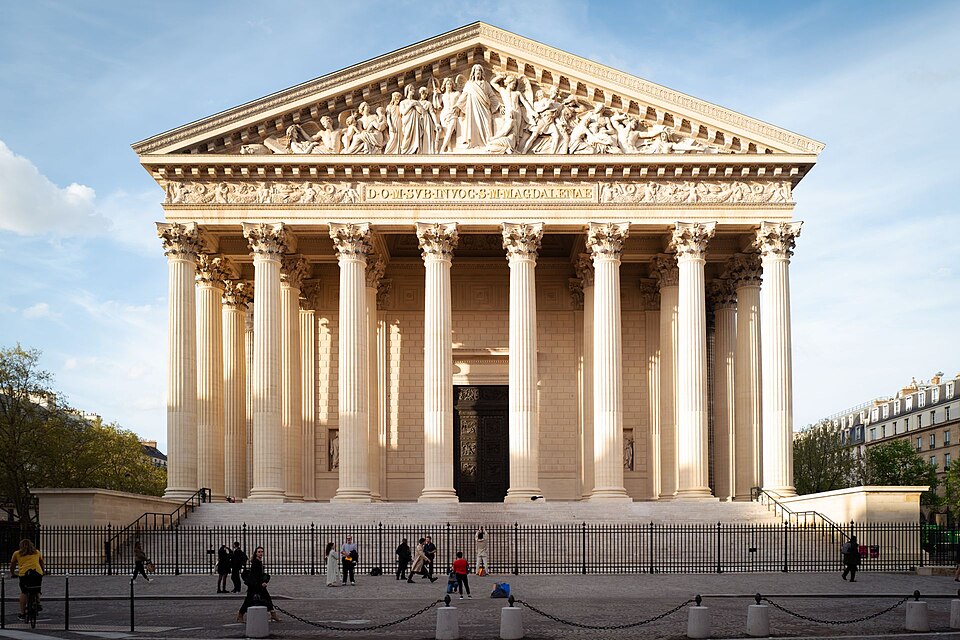
La Madeleine is a Greek temple in the middle of Paris, and it took seventy-nine years and several changes of mind to finish.
Louis XV laid the first stone in 1763. The Revolution stopped the work in 1789. In 1806 Napoleon declared it a Temple to the Glory of the Grand Army rather than a church. Pierre-Alexandre Vignon designed what was actually built and died in 1828; Jacques-Marie Huvé finished it, and it was inaugurated as a church on 24 July 1842.
It is 108 m long and 43 m wide, surrounded by fifty-two Corinthian columns each 20 m high, and there is no other large building in Paris that commits this completely to the classical temple.
A church with no windows in its walls, lit entirely from above.
The nave is three wide bays, each domed, each with a circular skylight. Because the exterior is a peripteral temple there is nowhere for a window to go, so the whole interior depends on those three openings — which makes it dim, even and unlike any other church in the city.
Jules-Claude Ziegler painted the fresco in the choir dome, a history of Christianity. Charles-Joseph Lameire made the Byzantine-styled ceramic mosaic. François Rude's The Baptism of Christ is among the monumental sculpture.
Camille Saint-Saëns was organist here from 1858 to 1877 and Gabriel Fauré from 1896 to 1905. Chopin's funeral was held here on 30 October 1849, delayed almost two weeks.
It is one room and it is read quickly. The interest is the light, the darkness of the stone and the strangeness of a church that looks nothing like one from outside.
The steps at the south front give the view down the Rue Royale to the Concorde obelisk and, in line beyond it, the Assemblée Nationale across the river. That alignment is deliberate and is the best thing about the building's siting.
The Place de la Madeleine around it holds the city's oldest luxury food shops, which is another half hour of windows.
Midday, when the sun is high enough to come through the three skylights.
This building is lit from directly above and nothing else, so it is at its best in the middle of a bright day and genuinely gloomy on an overcast morning.
It is a working parish church with services daily, and it holds concerts — the organ tradition here is serious and the acoustics of a stone box with three domes are unusual.
The interior is unheated stone and cold in winter.
The 8th arrondissement, on the Place de la Madeleine at the top of the Rue Royale.
Madeleine serves Métro lines 8, 12 and 14 and comes up at the foot of the steps. Concorde on lines 1, 8 and 12 is five minutes down the Rue Royale, and walking that way gives the axial view of the portico.
The Métro runs 16 lines across 321 stations, with stations 548 m apart on average — a two-stop journey is usually faster walked.
The portico from the Rue Royale, with the fifty-two columns closing into a wall of stone as the angle narrows, is the photograph, and it takes afternoon light on the south front.
From the top of the steps, the reverse view down to the Concorde obelisk with the Assemblée Nationale beyond is the alignment worth recording.
Inside, the three skylights are the subject — a shaft of daylight in a dark box — and they need exposure set for the dome rather than for the floor.
The Rude sculpture and the choir fresco are both too dim for a handheld phone.
Because Napoleon declared it a Temple to the Glory of the Grand Army in 1806. Pierre-Alexandre Vignon designed what was built, and it was inaugurated as a church on 24 July 1842.
How many columns are there?
Fifty-two Corinthian columns, each 20 m high, around a building 108 m long and 43 m wide.
Why is it so dark inside?
There are no windows in the walls — the exterior is a closed temple. The three domed bays are lit only by circular skylights above them.
How long did it take to build?
From the first stone in 1763 to the inauguration in 1842. The Revolution stopped work in 1789 and the purpose of the building changed twice.
Is it free?
Yes. It is a parish church with no admission charge, no tower and no paid section. Concerts held in it are ticketed separately.
Who played the organ here?
Camille Saint-Saëns from 1858 to 1877 and Gabriel Fauré from 1896 to 1905. Chopin's funeral was held here on 30 October 1849.
Nothing non-essential is set before you choose, in regions where consent is required. If you decline, ads still appear but they are non-personalised, and analytics is switched off entirely.


_Hugo_%C3%A0_la_Madeleine_-_btv1b53143444q.jpg)


_-_btv1b530049809.jpg)