


,_QB.87.jpg)
1 min walk · Paris 8e Arrondissement
Galeries Lafayette
- Must see
- Market
Language · 1 published
Historic monument · Paris 8e Arrondissement, Paris
Champs Élysées
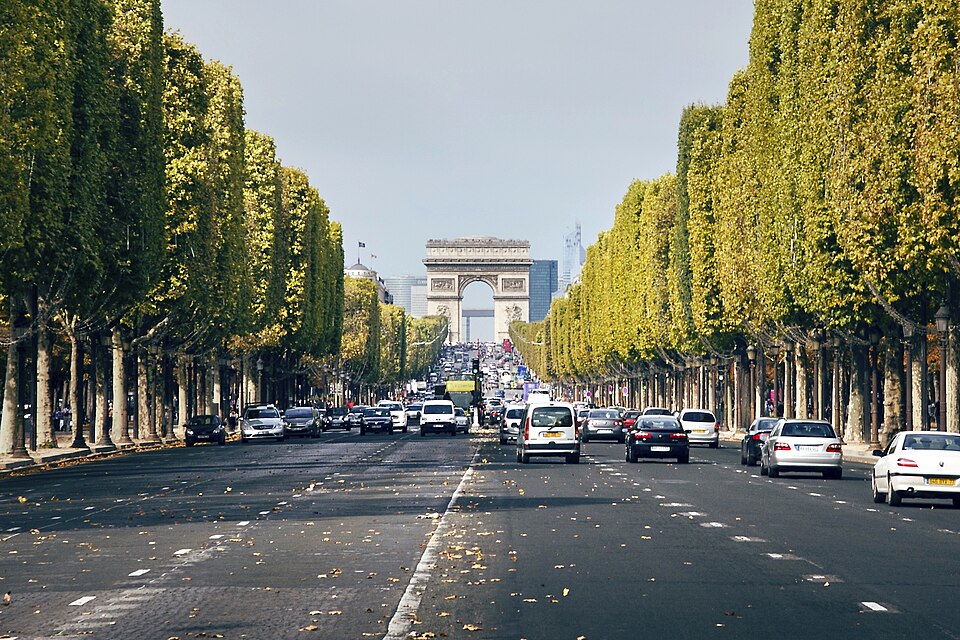
The Champs-Élysées is 1.91 km long, 70 m wide, and it is a garden path that became a shopping street.
André Le Nôtre laid it out in 1667 as an extension of the Tuileries. It took its present name in 1709 and was carried up to what is now the Place Charles de Gaulle by 1710.
It runs through the 8th arrondissement from the Place de la Concorde to the Arc de Triomphe, uphill the whole way, which is why the view from the bottom works and the view from the top works better.
In 2019 about 100,000 pedestrians used it daily; 72% of them were tourists and another 22% worked there.
Checked 2026-08-23 · Source
Two different streets that happen to share a name.
The lower half, from the Concorde to the Rond-Point, is gardens — chestnut trees, gravel walks, the Grand and Petit Palais on the south side, and almost no shops. This is the part Le Nôtre would recognise and the part visitors skip.
The upper half, from the Rond-Point to the Étoile, is the retail avenue: flagship stores, cinemas, car showrooms and cafés, on some of the most expensive commercial frontage in Europe.
Europe's largest military parade runs down it every 14 July. The Tour de France finished here every year from 1975 to 2023, with the winner's ceremony on the avenue itself.
Checked 2026-08-23 · Source
Forty-five minutes to walk it end to end, and walk it downhill.
From the Arc de Triomphe to the Concorde is 1.91 km with the slope in your favour and the obelisk in front of you the whole way. In the other direction it is a climb with the shops on both sides.
The gardens in the lower half take twenty minutes if you leave the roadway and walk under the trees, which almost nobody does.
Add an hour for the Arc de Triomphe terrace at the top and half an hour for the Petit Palais, which is free.
Checked 2026-08-23 · Source

The first Sunday of the month, when the avenue is closed to traffic.
The city has done this since 2016 to reduce pollution — nitrogen dioxide here exceeds WHO recommendations — and on those days a 70 m roadway becomes a pedestrian street, which is the only time the avenue's width can actually be felt.
Otherwise, early morning before the shops open, or late evening when the trees are lit.
14 July closes the avenue for the parade and draws the largest crowd of the year. Late December brings the Christmas lights along the whole length.
Checked 2026-08-23 · Source
Free. It is a street.
The Arc de Triomphe terrace at the top and the Grand Palais on the south side are ticketed separately, at 22 EUR and 15 EUR per person on 24 August 2026; the Petit Palais opposite is free for its permanent collection.
The cafés on the upper half charge avenue prices, which are roughly double what the same coffee costs two streets away.
Checked 2026-08-23

The 8th arrondissement, running north-west from the Place de la Concorde.
Five stations on Métro line 1 serve it: Charles de Gaulle–Étoile at the top, then George V, Franklin D. Roosevelt, Champs-Élysées–Clemenceau and Concorde at the bottom. One line does the whole avenue.
The Métro runs 16 lines across 321 stations, with stations 548 m apart on average — a two-stop journey is usually faster walked.
Checked 2026-08-23 · Source

This is the densest concentration of street operations in Paris: the petition clipboard, the gold ring found on the pavement, the string bracelet, the three-cup game. All of them work the upper half and all of them open with a question in English.
Café and restaurant prices on the avenue are roughly double the streets behind it, and terrace service carries a further premium.
The traffic circle at the top has no pedestrian crossing; use the underpasses.
14 July and major football victories close the avenue and fill it entirely.
Pickpockets work the Métro exits, particularly George V and Franklin D. Roosevelt.
Checked 2026-08-23 · Source

The avenue photographs as a line, and the line only reads with the Arc at the end of it. From the Rond-Point pavement looking up, at sunset, is the shot — the sun sets along the axis behind the Arc twice a year.
Standing in the central reservation for the axial view means standing in eight lanes of traffic. The pavement gives nearly the same line and all of the survival.
The lower gardens, under the chestnuts with the Grand Palais through the trees, are the pictures nobody takes here.
From the Arc de Triomphe terrace the avenue reads as one of twelve, which is the more honest photograph of what it actually is.
Checked 2026-08-23
1.91 km, and 70 m wide, running from the Place de la Concorde up to the Arc de Triomphe in the 8th arrondissement.
André Le Nôtre, in 1667, as an extension of the Tuileries Garden. It took its present name in 1709 and reached the Étoile by 1710.
Downhill, from the Arc de Triomphe to the Concorde. The slope is in your favour and the obelisk is in front of you the whole way.
The first Sunday of every month since 2016, a measure against pollution. It is the only time the avenue's full width can be walked.
No. The lower half, from the Concorde to the Rond-Point, is gardens under chestnut trees with the Grand and Petit Palais on the south side. The shops are the upper half.
About 100,000 pedestrians a day in 2019, of whom 72% were tourists and 22% worked there.
Loading the interactive map…
The interactive map could not be loaded.
Last updated:
Source: OpenStreetMap contributors, Wikidata ·