


_le_jeune_(Albert)_Derancourt_(9_ans),_as_du_volant_(dans_une_voiture_de_course_Salmson,_place_de_la_Concorde)_-_btv1b53140236d.jpg)
.jpg)
.jpg)
2 min walk · Paris 1er Arrondissement
Fame Riding Pegasus
- Notable
- Art and culture venue
Language · 1 published
Historic monument · Paris 8e Arrondissement, Paris
Place de la Concorde

| Monday | 00:00 – 23:59 |
|---|---|
| Tuesday | 00:00 – 23:59 |
| Wednesday | 00:00 – 23:59 |
| Thursday | 00:00 – 23:59 |
| Friday | 00:00 – 23:59 |
| Saturday | 00:00 – 23:59 |
| Sunday | 00:00 – 23:59 |
Parsed from OpenStreetMap opening hours on 2026-08-24.
Read from the OpenStreetMap access tags; anything not listed has no tag recorded.
Set the group type to family in the planner and the day window contracts to about three quarters of a solo day.
The Place de la Concorde is a 7.6-hectare traffic island that was once the busiest execution ground in Europe. It is the largest public square in Paris.
It was commissioned in 1748 to mark Louis XV's recovery from illness, designed by Ange-Jacques Gabriel from 1757 and finished in 1772, as the Place Louis XV.
Between 1793 and 1795 roughly 1,119 people were guillotined here, including Louis XVI on 21 January 1793 and Marie Antoinette on 16 October 1793. The square was renamed Concorde — concord — after that, which is one of the more optimistic acts of naming in French history.
It sits at the eastern end of the Champs-Élysées in the 8th arrondissement.
Checked 2026-08-23 · Source
An Egyptian obelisk that predates everything around it by three thousand years, and two fountains copied from Rome.
The Luxor Obelisk is 3,300 years old, 23 m of granite weighing more than 250 tonnes. Muhammad Ali Pasha gave it to France in 1829 and it was raised here on 25 October 1836. France added a gold-leafed pyramidion to the top in 1998, replacing the one lost in antiquity.
The two fountains, each nine metres high, were installed between 1836 and 1840 and are modelled on those in St Peter's Square in Rome.
After the 2024 Olympics the city announced partial pedestrianisation, with the redesign due to start in 2026.
Checked 2026-08-23 · Source

Twenty minutes, and it is a place you pass through rather than visit.
The square is the hinge of the great axis: the Tuileries and the Louvre one way, the Champs-Élysées and the Arc de Triomphe the other, the Madeleine north and the Assemblée Nationale across the river south. Standing at the obelisk and turning through 360 degrees is the whole of it.
It works best as the middle of a walk rather than as a destination — the Tuileries on one side and the Champs-Élysées on the other are each half an hour.
Checked 2026-08-23

Sunset, from the obelisk looking west, when the Champs-Élysées runs uphill into the sun with the Arc de Triomphe at the end of it.
That view is the reason to be here and it is the one thing the square does better than anywhere else in Paris.
The square is open, unshaded and made of stone, which makes it unpleasant in July and exposed in January. Spring and autumn are the comfortable seasons.
Redesign work is scheduled from 2026 and will change access; expect hoardings.
Checked 2026-08-23 · Source
Free. It is a public square and there is nothing to buy a ticket for.
The two buildings on the north side are the Hôtel de la Marine, which is a ticketed museum, and the Hôtel de Crillon. The Jeu de Paume and the Orangerie are in the Tuileries at the eastern corner and are separately ticketed.
Current rates for those are not published on the sources this page uses and are not reproduced here.
Checked 2026-08-23

The 8th arrondissement, between the Tuileries and the Champs-Élysées, on the north bank.
Concorde station serves Métro lines 1, 8 and 12 and comes up at the corner of the square. Tuileries on line 1 is one stop east and arrives through the garden, which is the better approach.
The Métro runs 16 lines across 321 stations, with stations 548 m apart on average — a two-stop journey is usually faster walked.
Checked 2026-08-23 · Source
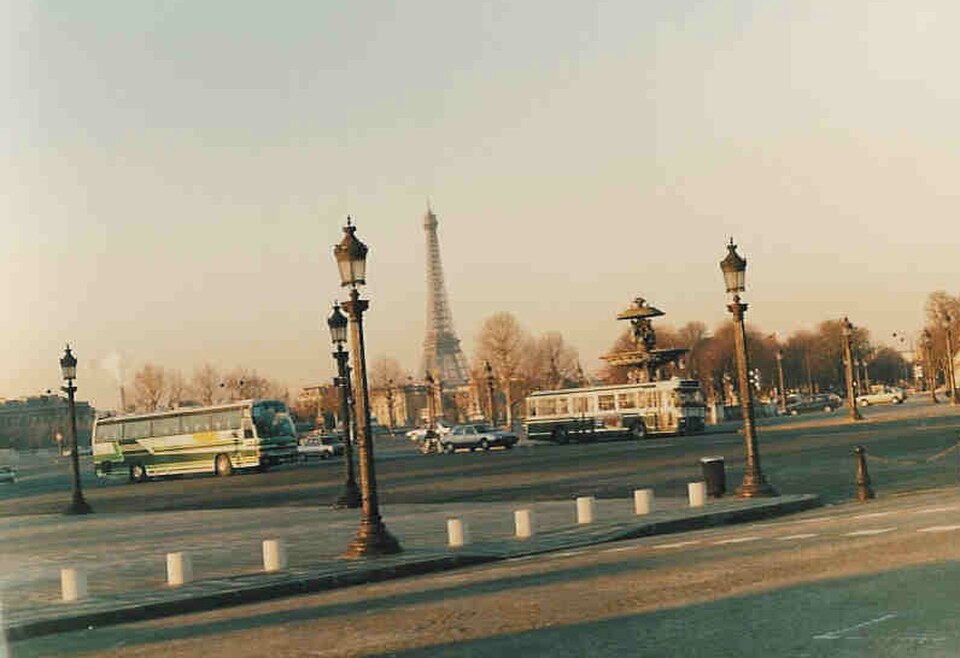
It is a roundabout. Eight lanes of traffic circle the obelisk and the crossings are long, signalled and not always obeyed. Cross at the lights and do not cut across.
There is no shade anywhere on 7.6 hectares of stone, and no drinking water on the square itself.
Redesign work from 2026 will close parts of it.
The pavement between here and the Champs-Élysées carries the petition and bracelet operations that work the whole axis.
There is nothing marking where the guillotine stood, and the many confident claims about the exact spot disagree with each other.
Checked 2026-08-23 · Source
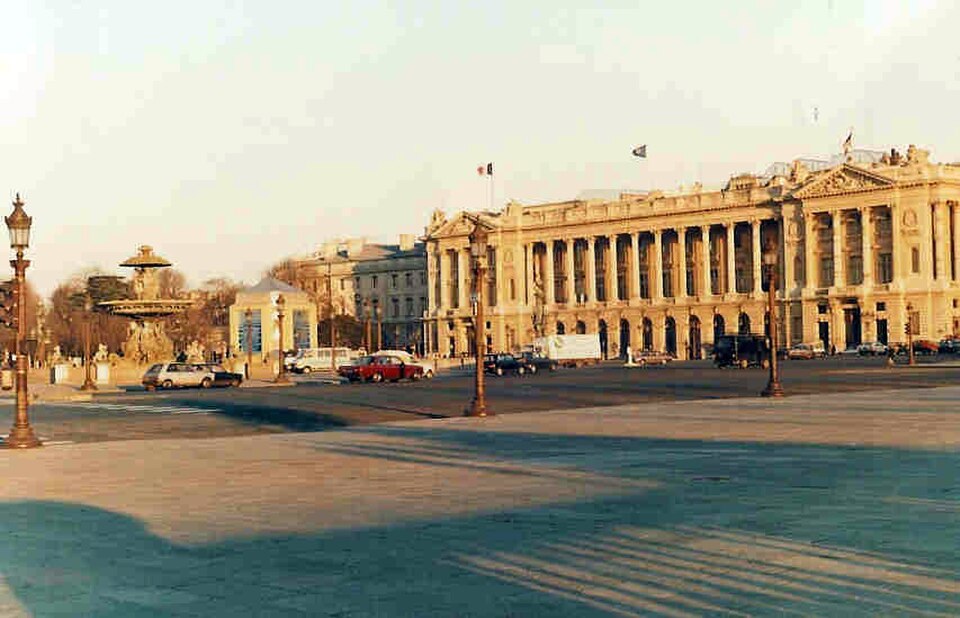
The obelisk with the Arc de Triomphe behind it, from the eastern side at sunset, is the photograph. The alignment is exact and it is the only place the two line up.
Facing the other way, the obelisk against the Tuileries and the Louvre works in the morning.
The fountains are nine metres high and photograph best from close in at their base with the obelisk behind, rather than from across the square where the traffic fills the frame.
There is no elevated position on the square; every photograph here is taken at street level among cars, which is why the wide-angle versions rarely work.
Checked 2026-08-23
It was renamed after the Revolution, having been the Place Louis XV. Roughly 1,119 people were guillotined here between 1793 and 1795, Louis XVI and Marie Antoinette among them.
3,300 years. It is 23 m of granite weighing over 250 tonnes, given to France by Muhammad Ali Pasha in 1829 and raised here on 25 October 1836.
A gold-leafed pyramidion added by France in 1998, replacing the original lost in antiquity.
7.6 hectares, which makes it the largest public square in Paris. It was designed by Ange-Jacques Gabriel from 1757 and completed in 1772.
Not on its own. It is the hinge between the Tuileries and the Champs-Élysées and works as the middle of a walk. Twenty minutes.
Nothing on the square marks it, and the confident claims about the exact spot do not agree with each other.
Loading the interactive map…
The interactive map could not be loaded.
Last updated:
Source: OpenStreetMap contributors, Wikidata ·