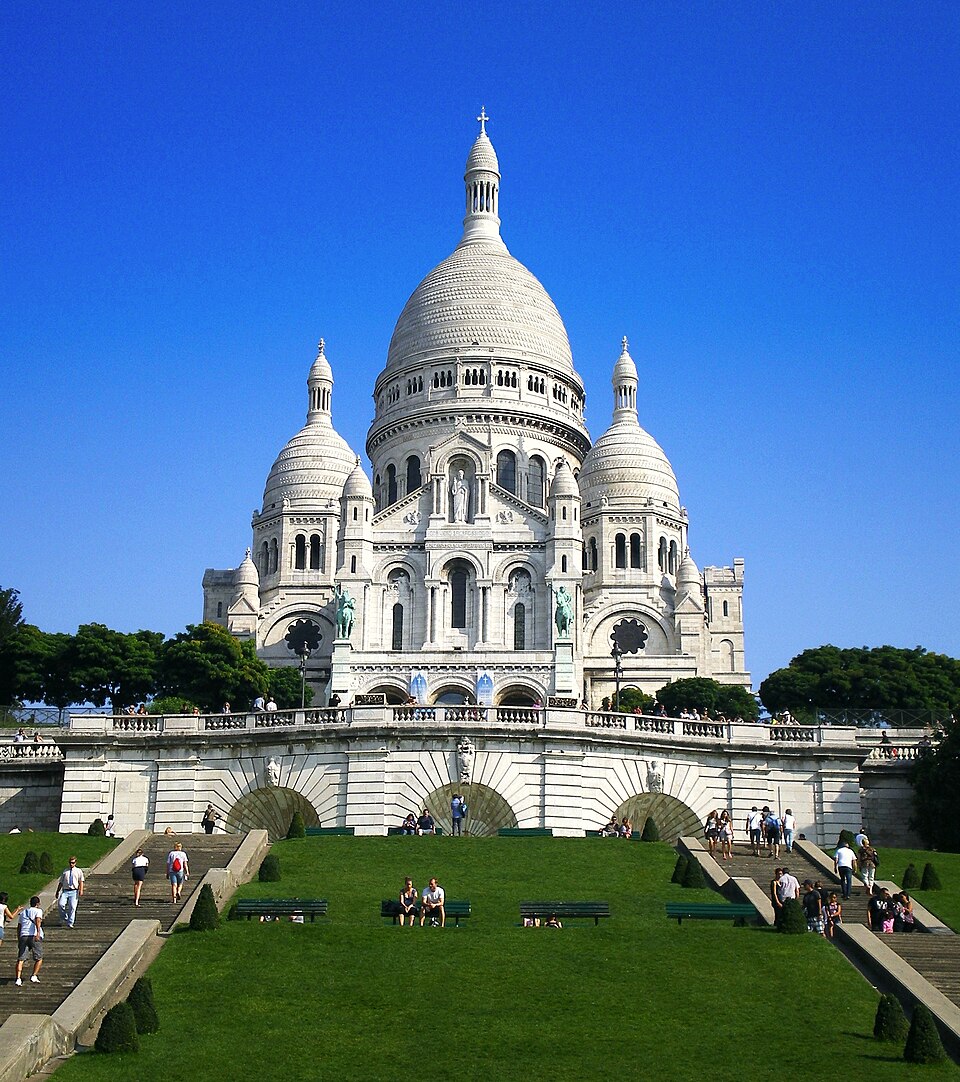
Sacré-Cœur was built as an apology. After France lost the war of 1870, Bishop Felix Fournier proposed a church as an act of national penitence, reading the defeat as divine punishment for the country's moral decline since the Revolution.
Paul Abadie won the competition against 77 other proposals. Work started in 1875, five architects succeeded one another over forty years, the building was finished in 1914 and consecrated in 1919.
It stands on Montmartre, the highest ground in Paris, and the site was so unstable that the foundations required eighty-three wells, each thirty metres deep, before anything could be built on top.
The largest mosaic in France, one of the world's heaviest bells, and continuous prayer since 1885.
The apse mosaic, The Triumph of the Sacred Heart, covers 475 m² in 25,000 enamelled and gilded ceramic pieces. The Cavaillé-Coll organ has 109 ranks and 78 stops. The Savoyarde bell in the campanile weighs 18,835 kg.
Perpetual adoration of the Holy Eucharist has been maintained here without a break since 1885, which means somebody is praying in this building at every hour of every night.
The dome rises 83.33 m and the campanile 84 m, and the dome is climbable.
An hour for the basilica, two if you climb the dome and stay for the view.
The interior is one large space and is read quickly; the mosaic is the reason to stand still.
The dome climb is a long spiral and the platform at the top gives the widest view over Paris available from any building in the city, because Montmartre puts the base of it 130 m above the river before the dome starts.
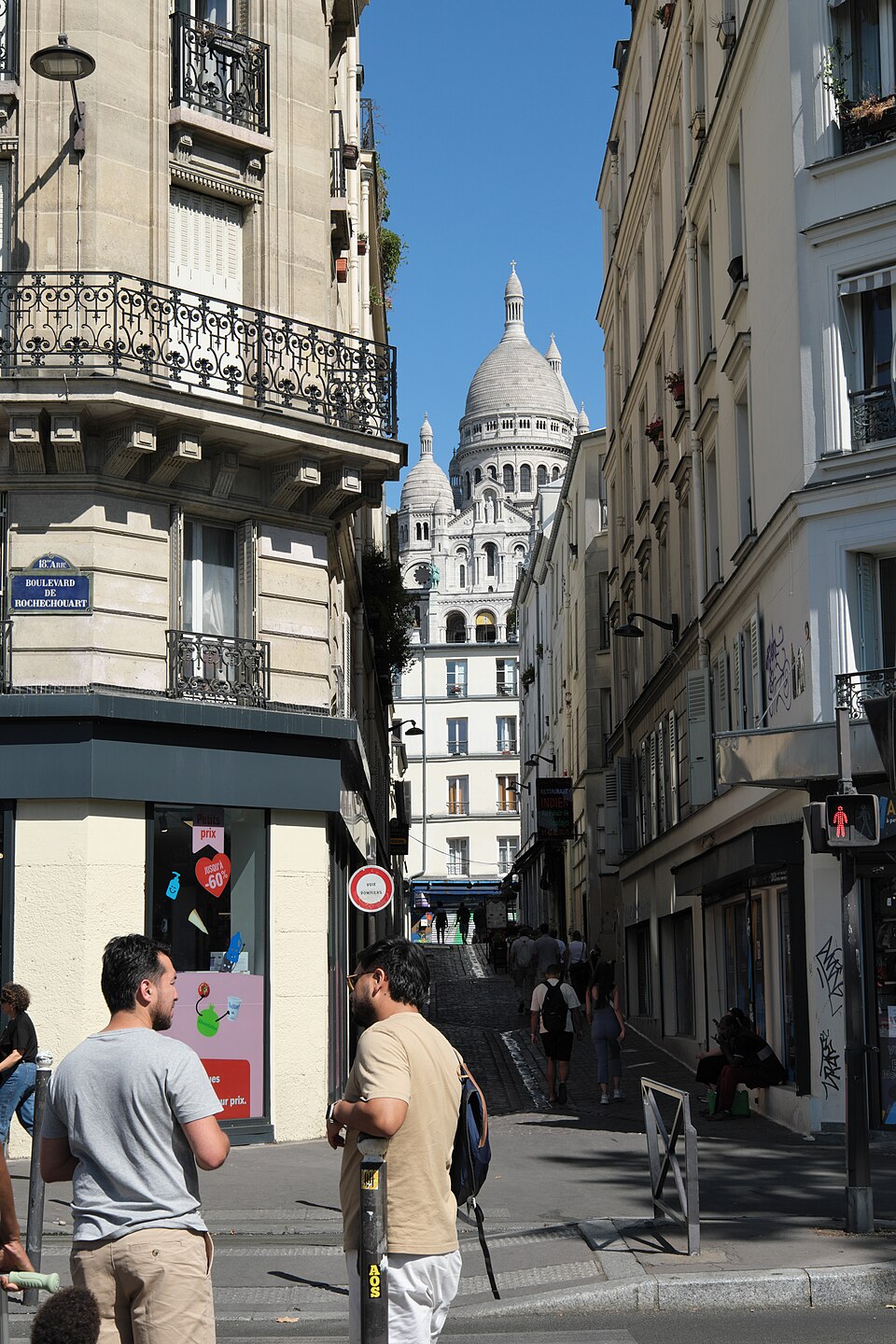
The steps down the front and the streets of Montmartre behind will take another two hours if you let them.
Early. The basilica opens well before the rest of Montmartre and the square in front is empty at eight in the morning and impassable by noon.
Sunset from the steps is the famous version and it is genuinely crowded — several thousand people, buskers, and a police presence.
The travertine from Chateau-Landon exudes calcite when it rains, which is why the building is still white after a century of city air. It is at its brightest just after rain, which is the opposite of most stone.
Entry to the basilica is free. The dome climb is ticketed.
Current rates for the dome are not published on the sources this page uses and are not reproduced here.
The funicular up the hill is part of the Paris transport network and takes an ordinary Métro ticket, which is worth knowing before starting up the steps.
Anvers on Métro line 2 is the usual approach, up the Rue de Steinkerque to the funicular or the steps. Abbesses on line 12 arrives on the west side of the hill and avoids the souvenir gauntlet; its own lift is essential because the station is one of the deepest in Paris.
The Métro runs 16 lines across 321 stations, with stations 548 m apart on average — a two-stop journey is usually faster walked.
The steps below the basilica are where the string-bracelet operation works. Someone takes your wrist, ties a thread and then demands money. Keep hands in pockets and do not stop.
This is a functioning basilica with perpetual adoration; silence is asked for and enforced, and photography inside is prohibited.
Dress and conduct rules apply: shoulders and knees covered, hats off.
The dome climb is a long tight spiral with no lift.
The three-cup game at the foot of the hill is a fixed loss, and the crowd around it is working with the operator.
Photography inside the basilica is prohibited. The mosaic cannot be taken and asking will not change that.
Outside, the building faces south, so it is lit all day and is at its whitest after rain.
From the dome platform the view is the widest in Paris; a wide lens flattens it, and a short telephoto picking out the Eiffel Tower or the Panthéon across the roofs is the stronger picture.
The classic frame of the basilica above the steps is taken from the Square Louise Michel below, and it is better in the morning than at sunset, when the sun is behind it and the steps are full of people.
As national penitence after the defeat of 1870. Bishop Felix Fournier proposed it, reading the loss as divine punishment for France's moral decline since the Revolution.
When was it finished?
Work began in 1875, it was completed in 1914 and consecrated in 1919. Five architects succeeded one another over the forty years.
Why is it so white?
The Chateau-Landon travertine it is built from exudes calcite on contact with rainwater, so the stone bleaches itself rather than soiling.
Is it free?
Entry to the basilica is free. The dome climb is ticketed and is a long spiral with no lift.
Can I take photographs inside?
No. Photography inside the basilica is prohibited. Perpetual adoration has been maintained here since 1885 and silence is asked for.
How do I get up the hill?
Anvers on Métro line 2 and then the funicular, which takes an ordinary Métro ticket. Abbesses on line 12 arrives on the quieter west side.
Nothing non-essential is set before you choose, in regions where consent is required. If you decline, ads still appear but they are non-personalised, and analytics is switched off entirely.