
.jpg)


15 min walk
Erotic Heritage Museum
- Must see
- Museum
Language · 1 published
Historic monument · Las Vegas
| Monday | 00:00 – 23:59 |
|---|---|
| Tuesday | 00:00 – 23:59 |
| Wednesday | 00:00 – 23:59 |
| Thursday | 00:00 – 23:59 |
| Friday | 00:00 – 23:59 |
| Saturday | 00:00 – 23:59 |
| Sunday | 00:00 – 23:59 |
Parsed from OpenStreetMap opening hours on 2026-08-26.
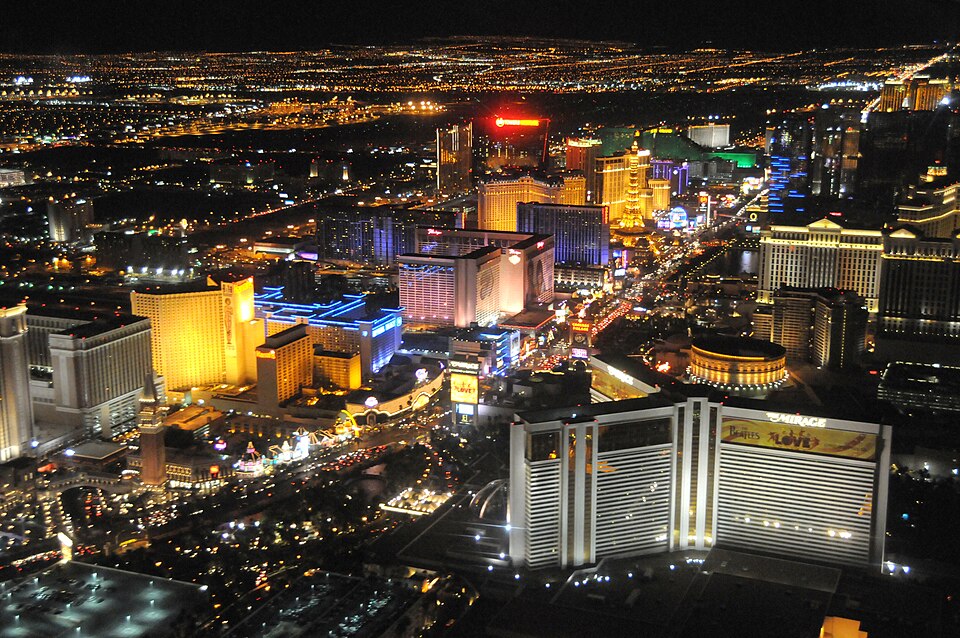
The Las Vegas Strip is the resort corridor along Las Vegas Boulevard where the city’s largest casinos, theatres, restaurants and themed public interiors form one continuous visitor district. It is not a single attraction with an entrance; the experience comes from moving between individually operated resorts, street-level landmarks and pedestrian bridges. Much of the corridor lies outside the incorporated City of Las Vegas, despite the familiar name. In practical terms, its long sequence of independently operated resorts, bridges and public forecourts shape this part of the visit. Keeping that identity in view prevents the stop from becoming a generic Las Vegas checklist item and makes the surrounding route, timing and expectations easier to judge.
Checked 2026-08-26 · Source
The Strip combines casino floors, hotel lobbies, shopping passages, performance venues and free public spectacles. Its most useful structure is a chain of resort clusters: Mandalay Bay and Luxor in the south, the central Bellagio–Caesars area, and the Venetian–Wynn area farther north. Treat each cluster as a separate walk. Crossing one property can involve escalators, bridges and long indoor detours before the next landmark appears. In practical terms, its long sequence of independently operated resorts, bridges and public forecourts shape this part of the visit. Keeping that identity in view prevents the stop from becoming a generic Las Vegas checklist item and makes the surrounding route, timing and expectations easier to judge.
Checked 2026-08-26 · Source
Allow at least half a day for one focused section of the Strip and a full day for several neighbouring clusters. Trying to cover the entire corridor on foot usually turns the visit into transit rather than sightseeing. Choose a few interiors or attractions in advance, leave time for indirect entrances, and reserve a second session if evening lights are an important part of the plan. In practical terms, its long sequence of independently operated resorts, bridges and public forecourts shape this part of the visit. Keeping that identity in view prevents the stop from becoming a generic Las Vegas checklist item and makes the surrounding route, timing and expectations easier to judge.
Checked 2026-08-26
Late afternoon into evening gives the clearest transition from architectural detail to illuminated signs and outdoor shows. Midday can be punishing in hot weather, while weekend nights bring the heaviest pedestrian congestion. The corridor itself has no single opening schedule because every resort and attraction is independently operated. Current property hours are therefore not recorded here and should be checked with each operator. In practical terms, its long sequence of independently operated resorts, bridges and public forecourts shape this part of the visit. Keeping that identity in view prevents the stop from becoming a generic Las Vegas checklist item and makes the surrounding route, timing and expectations easier to judge. Opening hours: Not recorded.
Checked 2026-08-26 · Source
Walking the public sidewalks and entering accessible resort areas does not require one Strip-wide ticket. Paid observation decks, exhibitions, rides and performances each use their own admission system, and prices can change by date or demand. Combined admission price: Not recorded. Book only the timed attractions that anchor the day and leave unscheduled room for free architecture, gardens and street views. In practical terms, its long sequence of independently operated resorts, bridges and public forecourts shape this part of the visit. Keeping that identity in view prevents the stop from becoming a generic Las Vegas checklist item and makes the surrounding route, timing and expectations easier to judge.
Checked 2026-08-26 · Source

The Strip is reached by RTC buses, the Las Vegas Monorail on the east side, resort trams on limited segments and rideshare drop-off zones. None of these serves every frontage directly. Use pedestrian bridges where required and confirm which side of Las Vegas Boulevard an entrance occupies before leaving transit. Downtown is several miles north and should be treated as a separate transfer rather than the end of a continuous walk. In practical terms, its long sequence of independently operated resorts, bridges and public forecourts shape this part of the visit. Keeping that identity in view prevents the stop from becoming a generic Las Vegas checklist item and makes the surrounding route, timing and expectations easier to judge.
Checked 2026-08-26 · Source
Distances are deceptive, crossings are channelled through bridges, and casino interiors can make orientation difficult. Carry water, especially between outdoor segments, and do not rely on a straight-line map distance. Resort policies differ for minors, bags, photography and event access. Street performers are independent and may expect payment for posed photographs; agree on any tip before taking a staged picture. In practical terms, its long sequence of independently operated resorts, bridges and public forecourts shape this part of the visit. Keeping that identity in view prevents the stop from becoming a generic Las Vegas checklist item and makes the surrounding route, timing and expectations easier to judge.
Checked 2026-08-26 · Source
Photograph the corridor from public sidewalks, pedestrian bridges where stopping does not obstruct traffic, and open resort forecourts. Blue hour balances illuminated signs with visible building detail, while full darkness emphasizes marquees and fountains. Inside casinos and performance areas, rules vary and security may prohibit gaming-table or guest photography. Keep tripods out of busy walkways and use the operator’s policy for any ticketed interior. In practical terms, its long sequence of independently operated resorts, bridges and public forecourts shape this part of the visit. Keeping that identity in view prevents the stop from becoming a generic Las Vegas checklist item and makes the surrounding route, timing and expectations easier to judge.
Checked 2026-08-26
The Las Vegas Strip is the resort corridor along Las Vegas Boulevard where the city’s largest casinos, theatres, restaurants and themed public interiors form one continuous visitor district. It is not a single attraction with an entrance; the experience comes from moving between individually operated resorts, street-level landmarks and pedestrian bridges. Much of the corridor lies outside the incorporated City of Las Vegas, despite the familiar name.
The Strip combines casino floors, hotel lobbies, shopping passages, performance venues and free public spectacles. Its most useful structure is a chain of resort clusters: Mandalay Bay and Luxor in the south, the central Bellagio–Caesars area, and the Venetian–Wynn area farther north. Treat each cluster as a separate walk. Crossing one property can involve escalators, bridges and long indoor detours before the next landmark appears.
Allow at least half a day for one focused section of the Strip and a full day for several neighbouring clusters. Trying to cover the entire corridor on foot usually turns the visit into transit rather than sightseeing. Choose a few interiors or attractions in advance, leave time for indirect entrances, and reserve a second session if evening lights are an important part of the plan.
Late afternoon into evening gives the clearest transition from architectural detail to illuminated signs and outdoor shows. Midday can be punishing in hot weather, while weekend nights bring the heaviest pedestrian congestion. The corridor itself has no single opening schedule because every resort and attraction is independently operated. Current property hours are therefore not recorded here and should be checked with each operator.
Walking the public sidewalks and entering accessible resort areas does not require one Strip-wide ticket. Paid observation decks, exhibitions, rides and performances each use their own admission system, and prices can change by date or demand. A single combined admission price is therefore not recorded. Book only the timed attractions that anchor the day and leave unscheduled room for free architecture, gardens and street views.
Distances are deceptive, crossings are channelled through bridges, and casino interiors can make orientation difficult. Carry water, especially between outdoor segments, and do not rely on a straight-line map distance. Resort policies differ for minors, bags, photography and event access. Street performers are independent and may expect payment for posed photographs; agree on any tip before taking a staged picture.
Loading the interactive map…
The interactive map could not be loaded.
Last updated:
Source: OpenStreetMap contributors, Wikidata ·