7 min walk · Şehzadeler
Nişancı Paşa Cami
- Notable
- Place of worship
Language · 1 published
Museum · Şehzadeler, Manisa
Manisa Mevevihane Müzesi
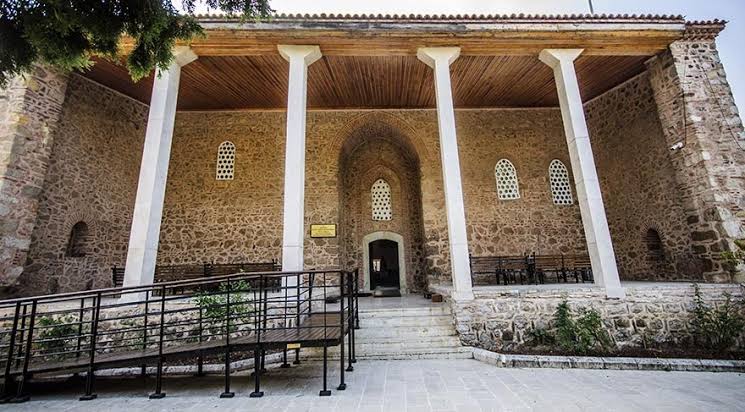
The Manisa Mevlevihane is a Mevlevi dervish lodge built in 1368-69 by İshak Çelebi, grandson of the Saruhanoğlu ruler Saruhan Bey, on a slope at the foot of Spil Mountain. For roughly five centuries it was a working tekke: a house where dervishes of the Mevlevi order lived, trained and held the whirling sema ceremony in its domed semahane. It is not a mosque and it was never a palace; it is a lodge, one of the oldest Mevlevi buildings to survive in Anatolia with its original plan intact.
The Republic-era decades were unkind to it — much of the upper floor and the dervish cells that once ringed the courtyard were lost before the Directorate of Foundations began repairing the surviving core in the 1960s and 1970s. A further restoration in 1999-2001 stabilised what remains and opened it to the public, and it is that restored building — not the medieval original in full — that stands today. Since then it has operated as a small museum, first housing the Manisa Museum's Islamic tombstone and inscription collection through the 1980s and now serving as a heritage building in its own right under the city's Turkish History and Culture research centre.
Checked 2026-08-24 · Source
The building is close to square in plan, 27.6 by 20.25 metres, built of cut stone, rubble stone and brick. At its centre sits the semahane, the domed hall where the sema was performed: a square chamber 7.20 by 7.20 metres, raised on a low platform, with a 16th-century dome that still carries red-and-white tilework overhead. Four vaulted eyvans open off the courtyard in a symmetric cruciform arrangement, a plan that marks the building as purpose-built for Mevlevi ritual rather than adapted from something else.
What a visitor actually sees today is the shell of that plan — the domed courtyard, the semahane space, the stonework of the eyvans — rather than a furnished dervish lodge with cells and belongings intact, since the upper floor and the surrounding cell rooms did not survive the 20th century. Information panels around the courtyard set out the history of the Mevlevi order in Manisa and the building's own repair history. There is no large object collection to see here; the building itself, and the sense of the space the sema was danced in, is the exhibit.
Checked 2026-08-24 · Source
Twenty to thirty minutes covers it. The building is one open courtyard with the semahane at its centre and a handful of side eyvans — there is no multi-room circuit and no large collection to slow a visit down. Most of that time is spent standing in the semahane looking up at the dome and reading the panels; a quick pass with photographs takes barely ten minutes.
It pairs naturally with the Hafsa Sultan Şifahane a short walk away in central Şehzadeler — the two together make a compact hour-long stop rather than two separate trips.
Checked 2026-08-24
Go in the morning or early afternoon, on a weekday. The lodge sits on an open, largely unshaded slope, and the domed courtyard has no roof over the central space, so a midsummer midday visit means standing in direct sun; spring and autumn mornings are more comfortable. Weekday opening also avoids the closed weekend (see Tickets), so a Saturday or Sunday plan needs to route around it rather than through it.
The dome's red-and-white tilework and the stonework of the eyvans read best in the low, angled light of morning, when the courtyard is not yet in full glare.
Checked 2026-08-24
Admission is free. The Mevlevihane is not on the Ministry's DÖSİMM fee list — there is no ticket booth and no Müzekart requirement. Reported opening hours are Monday to Friday, 9:00 to 17:00, closed Saturday and Sunday. This page checked that figure against two independent sources beyond the original one — Manisa's own municipal tourism listing and a Kültür Portalı entry — and neither published a conflicting figure, though neither carries an independent time either; both, like the original source, give no separate note for public or religious holidays, so a visit planned for one of those days is worth confirming locally first.
Checked 2026-08-24 · Source
The Mevlevihane sits in the Bayındırlık neighbourhood of Şehzadeler, on the slope where Manisa's National Park begins at the foot of Spil Mountain — a walk of roughly fifteen to twenty minutes uphill from the Sultan Camii and the Hafsa Sultan Şifahane in the city centre, or a short taxi ride if the incline is unwelcome. There is no dedicated visitor car park at the site itself; street parking on the approach roads is the practical option for anyone driving.
Manisa's city-centre sights, including this one, are all within walking distance of each other, so a single loop on foot from the Sultan Camii up to the Mevlevihane and back covers the historic core without needing a vehicle.
Checked 2026-08-24
The approach is uphill and the courtyard is unroofed, so footing and sun exposure matter more here than at a flat, indoor museum — flat shoes and water in summer are worth having. The site is small enough that there is little to lose track of, but because it closes on Saturday and Sunday, a weekend Manisa itinerary needs to place this stop on a different day or accept it will be closed.
As a former dervish lodge and a site still treated with some reverence locally, ordinary museum conduct — no loud noise in the semahane, no climbing on the stonework — is expected rather than posted.
Checked 2026-08-24
The semahane dome, with its red-and-white 16th-century tile pattern, is the single best frame in the building, shot from the courtyard floor looking straight up. The cruciform eyvans photograph well from the centre of the courtyard, where all four are visible at once, and morning light coming low across the stonework brings out the texture of the cut and rubble stone better than the flatter light of midday.
Because the space is unroofed and open, there is no interior-lighting problem to work around, unlike the darker, artificially lit rooms of the Hafsa Sultan Şifahane nearby.
Checked 2026-08-24
It was a working Mevlevi dervish lodge, built in 1368-69, where dervishes lived and performed the whirling sema ceremony in the domed semahane at its centre. It is a museum today, not a mosque and not a former palace.
Yes. It carries no admission charge and is not on the Ministry's priced museum list.
Reported hours are Monday to Friday, 9:00 to 17:00, with the site closed on Saturday and Sunday. This is checked against more than one source but all trace back to the same underlying schedule, so a local check is still worth it before a weekday visit outside normal working hours.
The building itself is the exhibit: the domed courtyard, the semahane and the four vaulted eyvans. There is no large object collection, since the original dervish cells and upper floor did not survive intact.
Both sit in central Şehzadeler and are an easy walk apart, but they are different institutions: the Mevlevihane was a dervish lodge, the Şifahane was a hospital in the Hafsa Sultan complex. They are often visited together but should not be confused with one another.
The Directorate of Foundations repaired the surviving core through the 1960s and 1970s after Republic-era losses, and a further restoration in 1999-2001 opened the building to visitors in close to its present form.
Loading the interactive map…
The interactive map could not be loaded.
Last updated:
Source: OpenStreetMap contributors ·