
.jpg)
.jpg)
.jpg)
.jpg)
.jpg)
3 min walk · เขตบางกอกใหญ่
Ton Son Mosque
- Must see · Heritage site
- Place of worship
Language · 1 published
Place of worship · เขตธนบุรี, Bangkok
มัสยิดบางหลวง
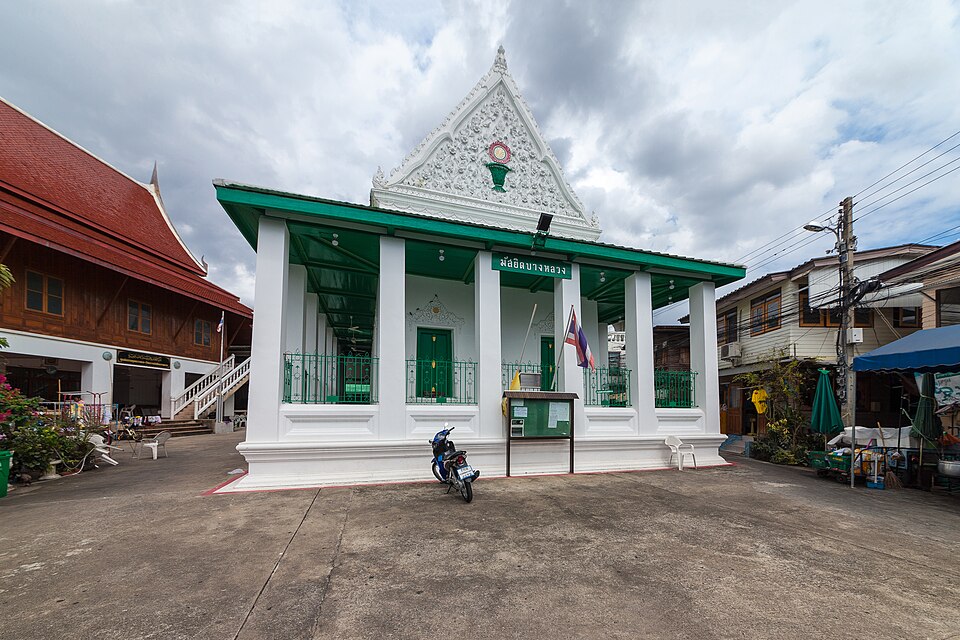
Bang Luang Mosque, also called Kudi Toh Yi and Kudi Khao, the White Kudi, is a mosque built in the shape of a Thai temple hall — brick and lime plaster throughout, whitewashed, with its woodwork painted green, and no dome anywhere on it. It stands in the community along Khlong Bang Luang in Wat Kanlaya subdistrict, Thon Buri, and it was built in the reign of King Rama I, thought to be around 1785, by Toh Yi, a merchant. Its interior carries decoration from three traditions at once — Thai, Chinese and European — and it is described as the only Thai-form mosque in the world. Because no main road cuts through to it, it is treated as one of Bangkok's unseen places: the way in is on foot along narrow canalside lanes. It appears among the registered ancient monuments of Thon Buri district, in the same list as Wat Kalayanamit, Santa Cruz Church and the Kian Un Keng shrine.
Checked 2026-08-25 · Source
The building is a rectangle in plan, twelve metres wide, twenty-four metres long and sixteen metres high, built entirely of brick and lime plaster rather than of the timber the roofline suggests. What takes a first-time visitor by surprise is that the exterior is a Thai temple shape while everything that names the building as a mosque is inside it, above all the minbar, the stepped pulpit from which the sermon is given. The decoration is the reason the mosque is written about: Thai, Chinese and European motifs share the same interior surfaces, which is exactly what one would expect of a Thonburi canal community where a Muslim congregation, a Chinese shrine, a Catholic church and Thai temples grew up within a few hundred metres of each other. In front of the mosque is its cemetery. Set slightly to the right as one faces the building is a Thai-style sala, which Toh Phimsen is said to have bought as an old palace residence and re-erected here; it serves as a hall for meals and for storing the mosque's equipment.
Checked 2026-08-25 · Source
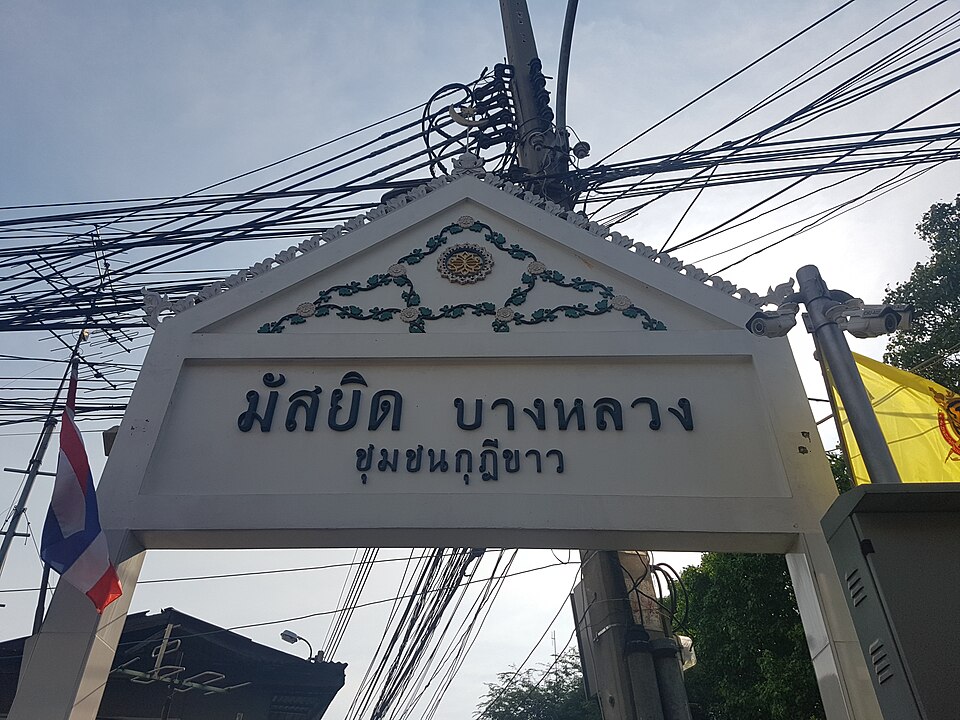
Thirty minutes. Bang Luang Mosque is one modest building, a graveyard and a sala, and there is nothing to queue for and nothing sold; what the half hour buys is the time to walk around the exterior, look properly at the roofline and the green woodwork, and — if the congregation is content for it — to look inside at the minbar and the decoration. The walk in from the bus stop is another ten minutes each way and is genuinely part of the visit, since the lanes and the canal frontage are what put the mosque in its context. Visitors combining it with the Kudi Chin quarter should think in terms of half a day for the group of religious buildings rather than of a trip to this one.
Checked 2026-08-25
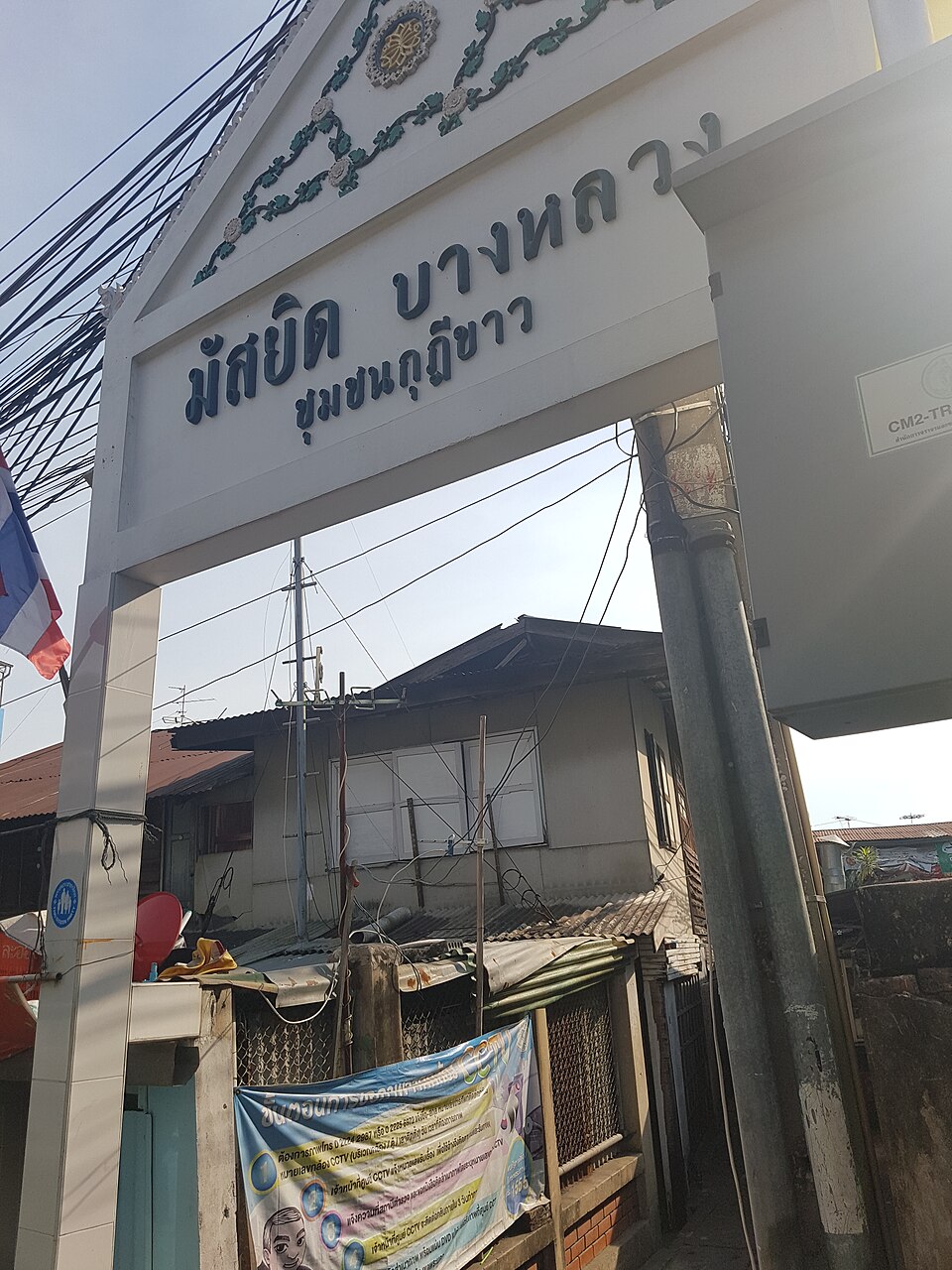
Morning, on a weekday, outside prayer. Bang Luang is a functioning mosque serving a small residential community, not a monument with a visiting season, and the courtesy is to come when the building is not in use and when the lanes are not full of people going to it. Friday around midday is the one time to avoid outright. Daylight matters more here than at most Bangkok sites because the interior has no electric spectacle to fall back on and the decoration reads best on natural light through the windows. The wet season is awkward for a different reason: the approach is a narrow canalside lane rather than a road, and it becomes an unpleasant walk in heavy rain with nowhere to shelter along the way.
Checked 2026-08-25
There is no ticket and no admission is stated. Bang Luang Mosque is a place of worship maintained by its congregation rather than a museum operated for visitors, and no operator publishes a rate for it: the mosque has no website of its own, and the Department of Religious Affairs register entry for it could not be retrieved. So admission rates are not published, and this page records none rather than guessing at a donation figure. If a visitor wants to give something, put it in whatever box the mosque keeps and ask first; do not offer money to an individual for being shown around.
Checked 2026-08-25
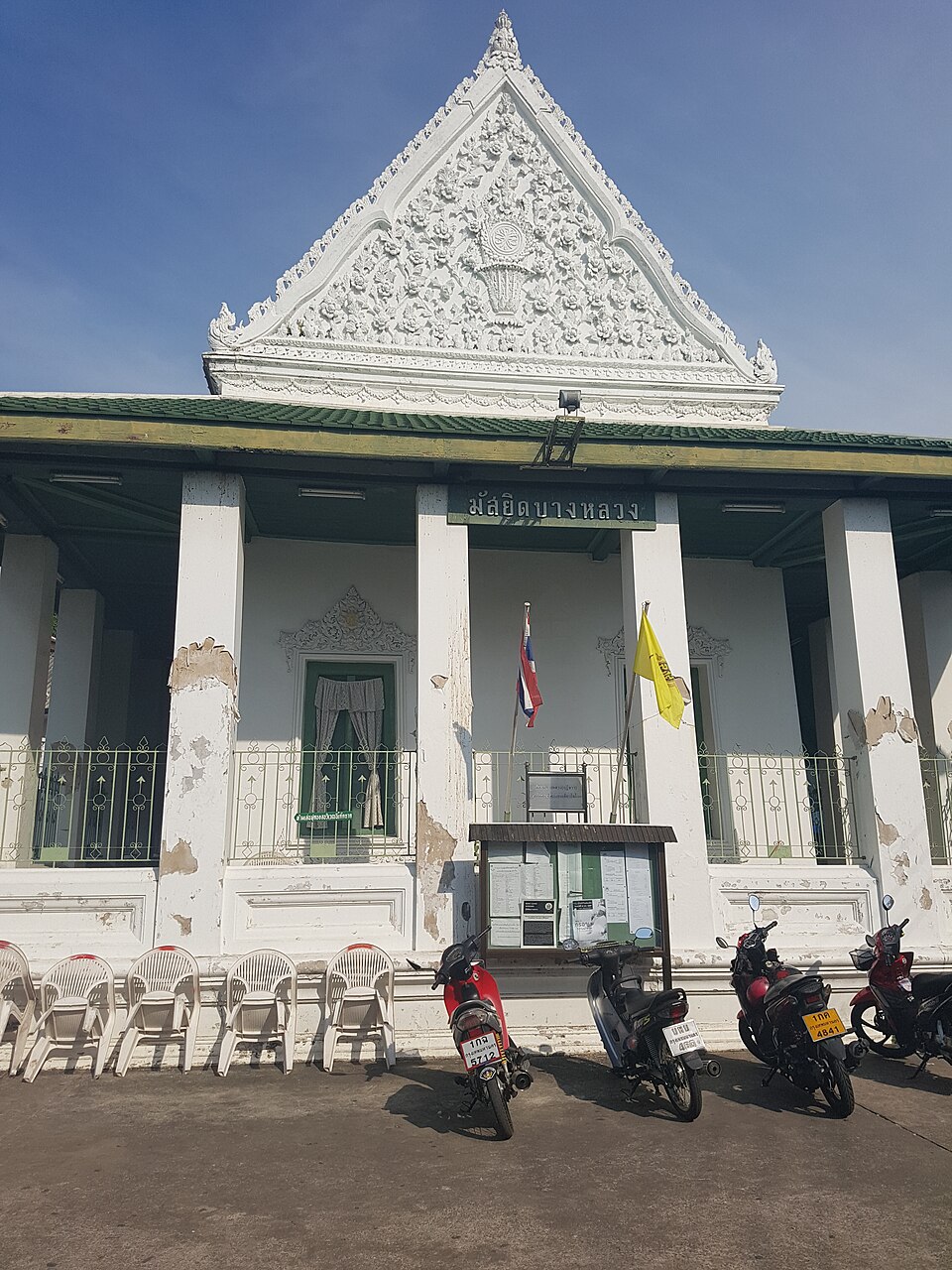
The mosque is at 151 Soi Arun Amarin 7, off Arun Amarin Road, in Wat Kanlaya subdistrict, Thon Buri, Bangkok 10600, and no main road reaches it. City bus routes 19, 56 and 57 pass along the road; get off at the Bupparam police station stop and walk in about 200 metres through the community lane. That last stretch is the reason the mosque stays quiet, and it is also the reason a taxi cannot deliver a visitor to the door. The other sensible approach is on foot from the Kudi Chin riverside — Wat Kalayanamit, Santa Cruz Church, the Kian Un Keng shrine and Wat Prayurawongsawat are all in the same pocket of Thon Buri — which turns the walk in from an errand into the interesting part of the day.
Checked 2026-08-25 · Source
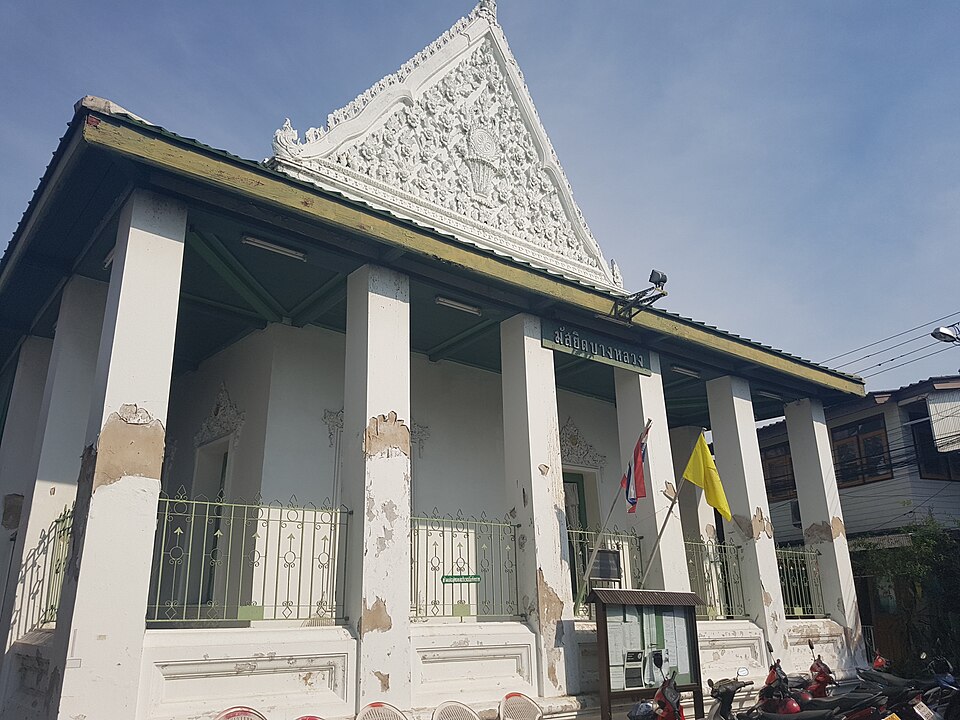
Treat this as someone's mosque, because it is. Entry to the prayer hall is at the congregation's discretion and not a right: find someone, ask, and accept a refusal without argument. Remove shoes before entering, cover shoulders and knees, women should cover the hair, and do not walk in front of anyone praying. Prayer times are not published for this mosque anywhere this guide could read, so a visitor cannot plan around them from a distance and should simply be ready to wait or to come back. The route in runs between people's houses along a canal — keep to the lane, do not photograph into doorways, and keep voices down, because at this width a small group of visitors is loud. The cemetery in front of the mosque is a burial ground and not a shortcut or a place to stand for a photograph. The lanes are narrow, uneven and partly unlit, so this is a daylight visit; and because there are no facilities here — no ticket desk, no toilets for visitors, no shop — arrive already sorted out.
Checked 2026-08-25
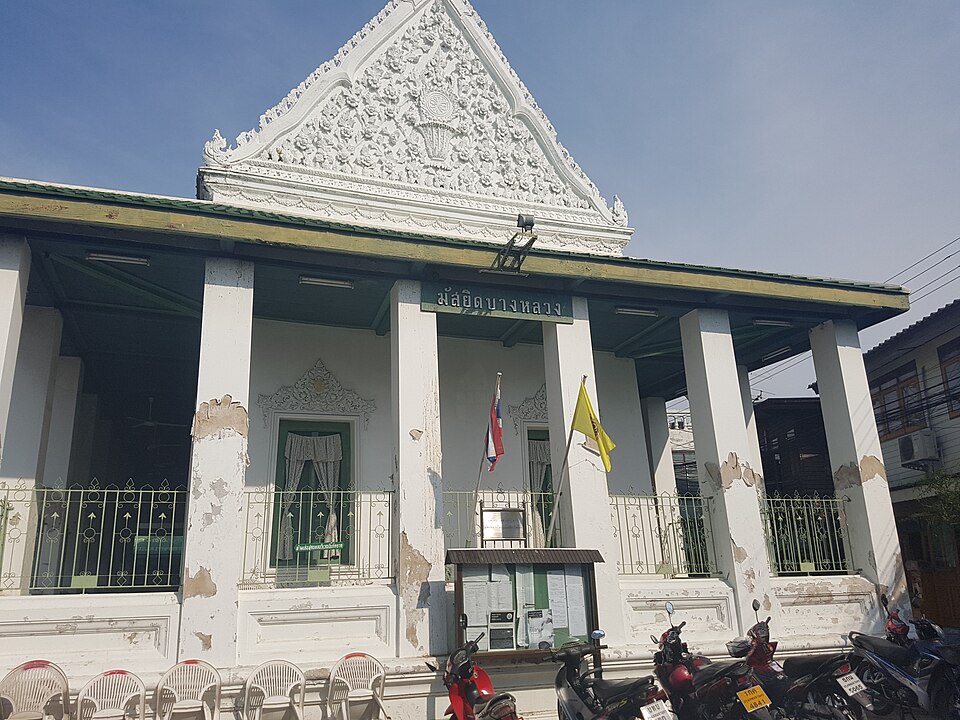
The photograph that explains Bang Luang in one frame is the exterior taken low and from a corner, so that the Thai roofline and the green window frames read against the white plaster and nothing suggests a mosque at all; that ambiguity is the whole point of the building and it is lost in a straight-on elevation. Morning light on the white walls is flat and clean; late afternoon puts the roof structure into relief but risks a hard shadow across the front. The building is twenty-four metres long in a tight lane, so a wide lens is needed and there is no distance to be had — the canalside is the only open frontage. Inside, ask before raising a camera, never photograph people at prayer, and leave the minbar to a respectful single frame rather than a session. The lanes on the way in are private frontages and not a street-photography subject; ask, or leave the camera down.
Checked 2026-08-25
It is a mosque built in Thai form: brick and lime plaster painted white with green-painted woodwork, and no dome. Its interior is decorated with Thai, Chinese and European art together, and it is described as the only Thai-style mosque in the world. It is also known as Kudi Khao, the White Kudi, and as Kudi Toh Yi.
It was built in the reign of King Rama I, with the year given as uncertain but estimated at about 1785, by Toh Yi, a merchant who had come to Thailand. The exact founding date is not known.
The address is 151 Soi Arun Amarin 7, off Arun Amarin Road, Wat Kanlaya subdistrict, Thon Buri, Bangkok 10600. Buses 19, 56 and 57 pass; get off at the Bupparam police station stop and walk in about 200 metres. No main road reaches the mosque, which is why it is counted among Bangkok's unseen places.
No. Bang Luang Mosque is a working place of worship maintained by its congregation, and admission rates are not published anywhere this guide could read — the mosque has no website of its own and the Department of Religious Affairs register entry could not be retrieved. Ask before giving anything, and give to the mosque rather than to an individual.
The mosque is a rectangle twelve metres wide, twenty-four metres long and sixteen metres high, built of brick and lime plaster throughout. In front of it lies its cemetery, and to the right as one faces the building stands a Thai-style sala said to have been bought as an old palace residence by Toh Phimsen and used as a hall for meals and for the mosque's stores.
Ask, and accept a no. Entry is at the congregation's discretion. Remove shoes, cover shoulders and knees, women should cover the hair, and do not cross in front of anyone praying. No prayer timetable is published for this mosque, so be prepared to wait or to return.
Loading the interactive map…
The interactive map could not be loaded.
Last updated:
Source: OpenStreetMap contributors, Wikidata ·