
.jpg)
.jpg)

_-_img_01.jpg)
_-_img_02.jpg)
1 min walk
tenryu-ji
- Must see
- Historic monument
Language · 1 published
Historic monument · Kyoto
天龍寺
| Monday | 08:30 – 17:00 |
|---|---|
| Tuesday | 08:30 – 17:00 |
| Wednesday | 08:30 – 17:00 |
| Thursday | 08:30 – 17:00 |
| Friday | 08:30 – 17:00 |
| Saturday | 08:30 – 17:00 |
| Sunday | 08:30 – 17:00 |
Checked 2026-08-26 · Source
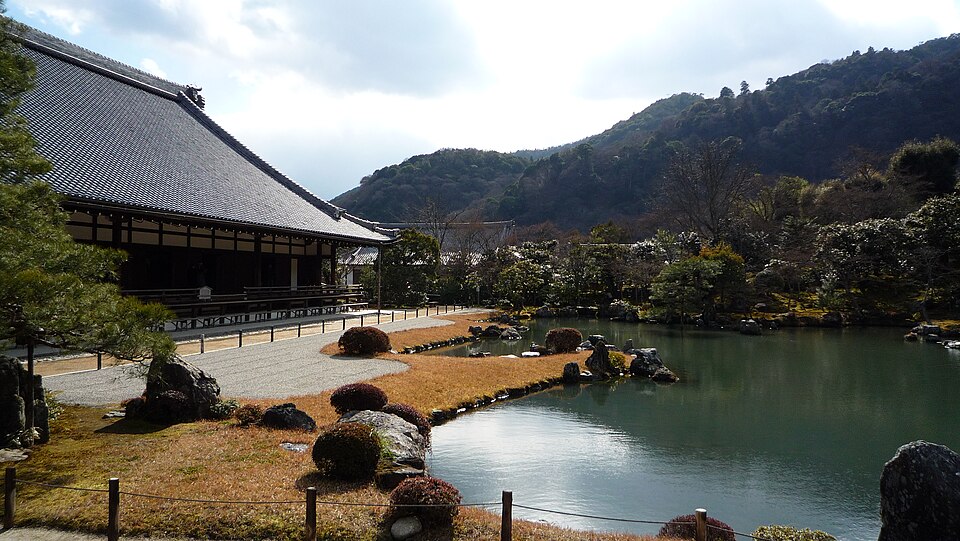
Tenryu-ji sits in Arashiyama, at the foot of the mountains on the western edge of Kyoto, and it is easier to understand once a visitor separates its garden from its buildings. The temple was established in 1339 by the shogun Ashikaga Takauji in memory of Emperor Go-Daigo, with the Zen master Muso Soseki as founding abbot. The donated estates did not cover the building costs, so Muso and Ashikaga Tadayoshi sent two trading ships to China and paid for the temple out of the profits; it was consecrated in 1345 and ranked first among Kyoto's Five Mountains, a position it still holds. Eight major fires followed, in 1358, 1367, 1373, 1380, 1447, 1468, 1815 and 1864, and in 1877 the Meiji government confiscated most of the four square kilometres of Sagano land the temple owned, leaving it under a tenth of its former property. That history explains what stands here now. The Hojo and Kuri were finished in 1900, the Kohojo in 1924, the Tahoden and the two teahouses in 1934. The old part is the ground: the Sogenchi pond garden was laid out by Muso Soseki nearly seven hundred years ago and keeps its original form. Tenryu-ji is inscribed on the UNESCO World Heritage list.
Checked 2026-08-26 · Source
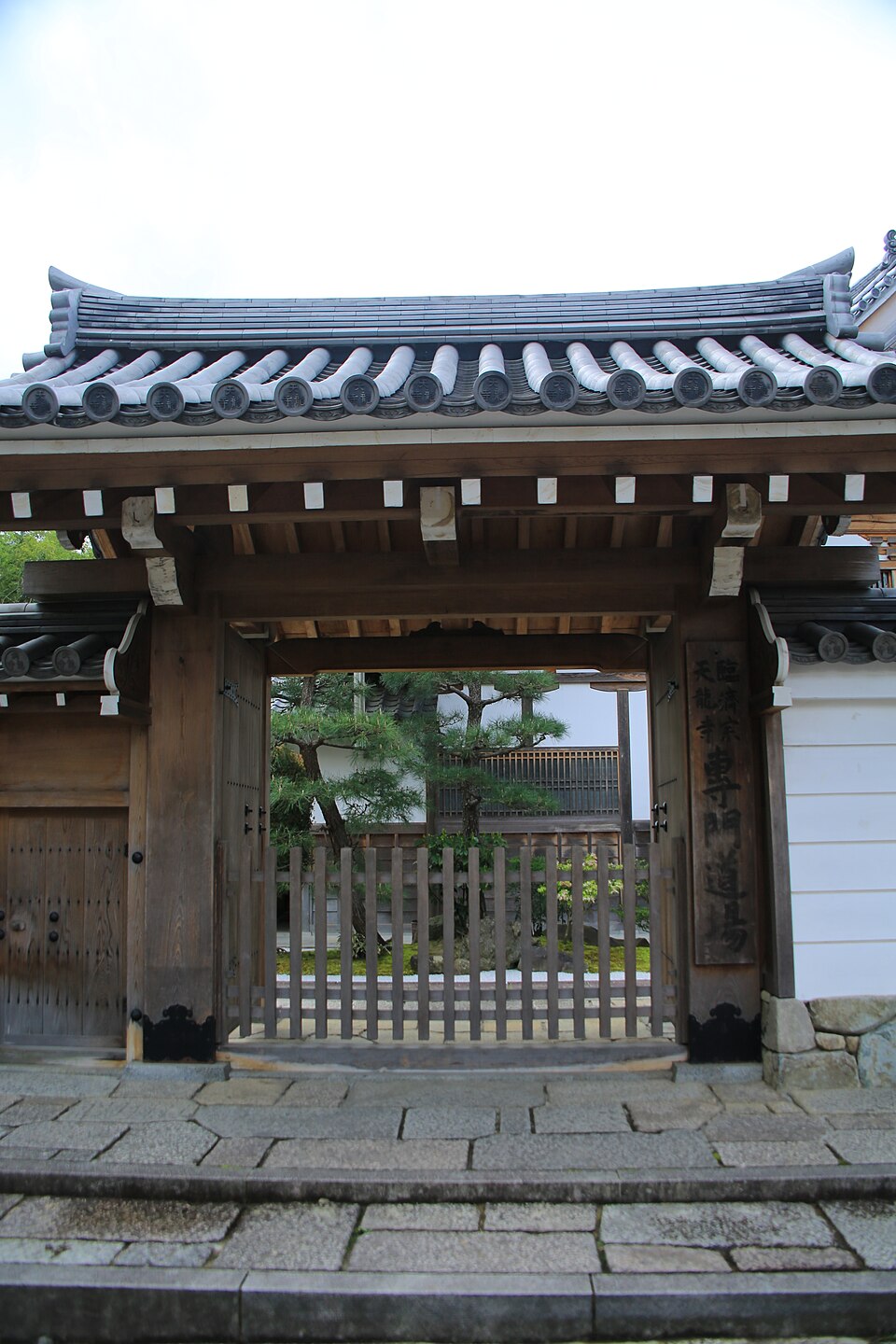
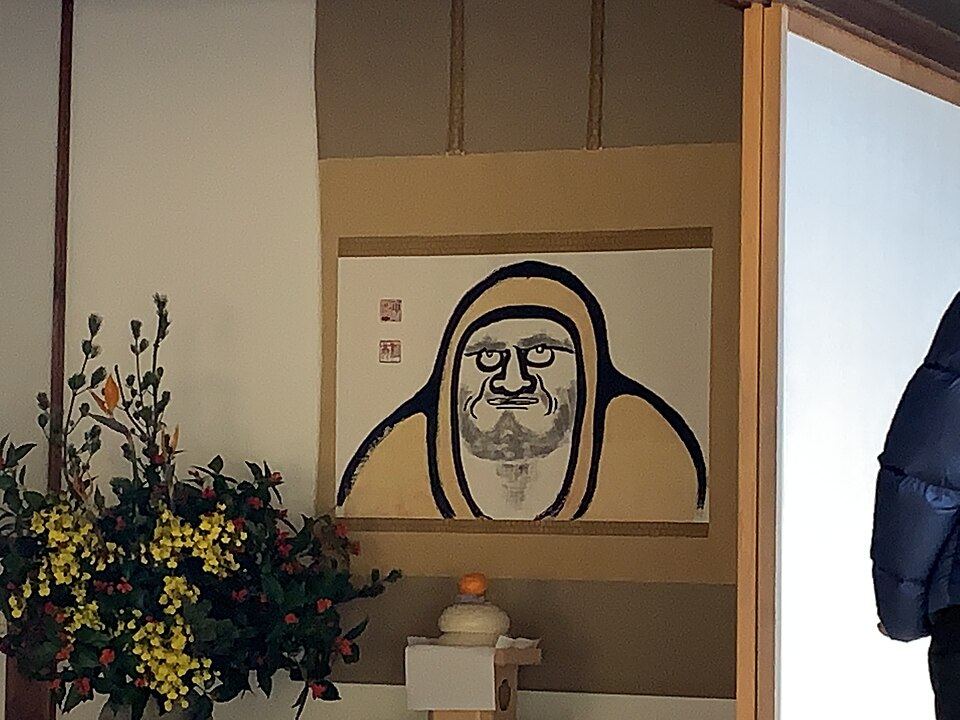
The route runs through a handful of named buildings and one garden. The Kuri, built in 1899 and renovated in 2013, is the white-plastered hall with the high curved gable that most visitors photograph first; inside its entrance hangs a large Bodhidharma by the late Chief Abbot Hirata Seiko. Behind it the Hojo divides into the Daihojo, the temple's largest building and its main ceremonial space, and the smaller Kohojo of 1924. The Daihojo holds a seated Shakyamuni registered as an Important Cultural Property, believed to date from the late Heian period and older than the temple itself, having survived all eight fires. Its west veranda looks over the Sogenchi garden, a strolling pond garden that uses the hills behind as borrowed scenery and was the first place in Japan designated a Site of Special Historic and Scenic Importance. Directly across the water stands the Dragon Gate Falls stone arrangement, unusual in placing the carp stone beside the falls rather than below them. A covered corridor climbs past the Shoun-kaku and Kan'u-tei teahouses to the Tahoden, which holds a statue of Emperor Go-Daigo, and beyond it the Hyakka'en flower garden runs up to the north gate. The Hatto, with its ceiling dragon, is entered separately. The Sodo training monastery is closed to the public.
Checked 2026-08-26 · Source
Ninety minutes is the figure this guide recommends, and it is editorial judgement rather than a number Tenryu-ji publishes; the temple gives opening times and last-admission times but no suggested visit length. The ninety minutes divides roughly as follows. The Sogenchi garden circuit, from the garden reception around the pond, up past the teahouses and the Tahoden and through the Hyakka'en to the north gate, takes forty-five minutes to an hour at a pace that allows standing still at the pond. Adding the buildings, which means shoes off and a slow walk through the Daihojo and the Kohojo verandas, adds about half an hour. The Hatto and its cloud dragon is a separate ticket and a separate entrance, and fifteen minutes covers it. Two things stretch the visit well beyond ninety minutes. Lunch at Shigetsu inside the grounds runs from 11.00 to 14.00 and needs a reservation placed two or three days ahead depending on the set, so it is a planned hour rather than an impulse. And the north gate opens straight onto the road through the Sagano bamboo grove, which is where most visitors go next, so a strict budget for Tenryu-ji alone will not describe the morning.
Checked 2026-08-26
Tenryu-ji opens every day and does not close for a weekly rest day, so the choice is about season and hour rather than about which day. Two dated things the temple has announced for 2026 shape the calendar. From 14 to 30 November 2026 the Sogenchi garden opens at 7.30 instead of 8.30, half an hour earlier than usual, expressly so that visitors can see the autumn colour in early morning light; the early opening applies at the garden reception, with the north gate reception still starting at 8.30. That announcement is the clearest signal the operator gives about when the garden peaks. The Hatto cloud dragon, normally a weekend and public-holiday sight, is on show every day during the special periods of 1 March to 31 May 2026 and 19 September to 6 December 2026. In the heat of summer the Hatto runs a shortened day, roughly 9.00 to 13.00 on its open days, because the hall becomes dangerously hot. For the hour, this guide's judgement is to arrive at 8.30 when the gate opens: the garden path is narrow in places and Arashiyama fills steadily from mid-morning. Nothing about that timing comes from the temple.
Checked 2026-08-26 · Source
Tenryu-ji charges in layers, and a visitor decides how many to buy at the desk. The garden, meaning the Sogenchi pond and the Hyakka'en, costs 500 yen for high school students and older and 300 yen for elementary and middle school students; preschool children enter free. Seeing the buildings, that is the Daihojo, the Shoin and the Tahoden, adds 300 yen to whichever garden rate applies, so an adult who wants both pays 800 yen. The Hatto and its cloud dragon painting is not part of either ticket: it costs a further 500 yen per person, with no charge for preschoolers, and is bought at its own reception on the west side of the hall. The temple's Japanese page records a discount the English page omits, 100 yen off for a visitor presenting a disability certificate and for one carer. The two language versions also count the ticket offices differently: the English page names three, at the garden entrance, the main building entrance and the north gate, while the Japanese page names four, adding the Hatto desk. Two other prices are published: sutra copying at the Tahoden is 1,800 yen including admission and materials, and diners at Shigetsu still pay the 500 yen garden fee.
Checked 2026-08-26 · Source
No car is needed, and the temple's own access page makes the rail case plainly. Three separate lines land within walking distance. The Keifuku Dentetsu Arashiyama line, the little tram usually called the Randen, stops at Arashiyama station at the temple's front; the temple's English page calls this a five-minute walk while its Japanese page describes it as directly in front of the station, and both are the operator's own wording. The JR Sagano line stops at Saga-Arashiyama, thirteen minutes on foot, and the Hankyu line stops at its own Arashiyama station, fifteen minutes on foot across the river. By bus, city bus numbers 11, 28 and 93 serve the Arashiyama Tenryuji-mae stop; the temple lists Kyoto Bus numbers 61, 72 and 83 as well, naming that same stop on the English page and the Keifuku Arashiyama station stop on the Japanese one. There is a car park, first come first served with no reservations, holding 100 cars at 1,000 yen per entry, open 8.30 to 17.00 with the gate shut at 17.00 sharp; buses pay 1,000 yen an hour and taxis 500 yen for two hours. On designated peak autumn days the road in front of the temple closes to traffic from 13.00 to 17.00.
Checked 2026-08-26 · Source
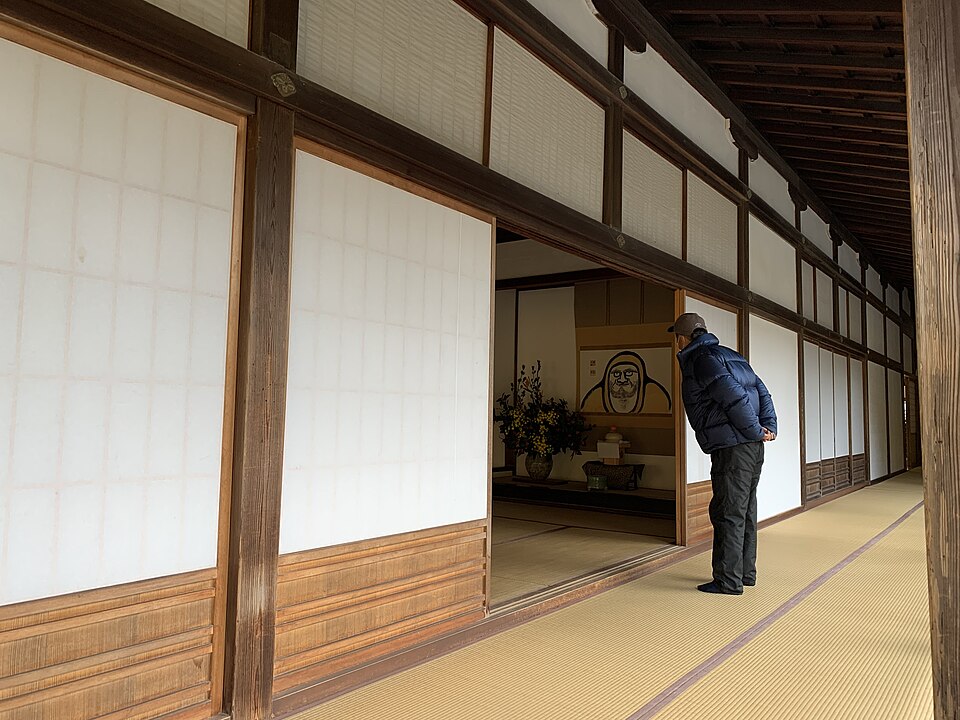
The single trap here is that the parts of Tenryu-ji do not close together. The garden runs 8.30 to 17.00 with the last admission at 16.50, but the buildings close at 16.45 with their reception shutting at 16.30, and the Hatto closes at 16.30 with its last admission at 16.20. A visitor arriving at 16.40 with an hour of daylight left will get the garden and nothing else, so buy the layered ticket earlier in the day rather than on the way past. The buildings also close outright for ceremonies, without notice in the general case and on announced dates in the known ones: for 2026 the temple lists 1 April from 12.30, and 29 and 30 October, which are its annual Founder's Day observances, with the halls reopening around 11.30 and 12.30 respectively. The Hatto is shut to the public on 28, 29 and 30 October 2026 and on 2 January 2027, reopening around 12.45 on 30 October. Shigetsu, the vegetarian restaurant inside the grounds, serves only 11.00 to 14.00 and takes Thursdays off. The Sodo training monastery is closed to visitors entirely, and the temple's photographs and texts are not free to reuse.
Checked 2026-08-26 · Source
Three positions do most of the work. The first is the Kuri seen head-on from the forecourt, the white gable against the roof line, which is the picture the temple itself uses as its emblem and the one place where a wide lens earns its keep. The second is the west veranda of the Daihojo, looking across the Sogenchi pond to the Dragon Gate Falls stones with the hills of Arashiyama standing behind them; the garden was built to borrow those hills, so a frame that crops them out throws away the composition. The third is the path up through the Hyakka'en to the north gate, where the ground rises and the pond drops out of sight. On light, the pond sits west of the Hojo, so the morning sun comes over a visitor's shoulder and lands on the water and the far bank, while the afternoon backlights the slope; an early arrival is a photographic argument as much as a crowd-avoidance one. Shoes come off for the verandas, which in practice means a bag to carry them and one free hand. Tenryu-ji publishes no photography rules on its site, so whether the Hatto ceiling may be photographed is a question for the desk there, not an assumption to carry in.
Checked 2026-08-26
The garden is open daily from 8.30 to 17.00, with the last admission at 16.50, and there is no weekly closing day. The temple buildings keep shorter hours, 8.30 to 16.45 with reception closing at 16.30, and the Hatto with the cloud dragon runs 9.00 to 16.30 with the last admission at 16.20. From 14 to 30 November 2026 the garden reception opens early, at 7.30.
The garden costs 500 yen for high school students and older and 300 yen for elementary and middle school students, and preschool children are free. Adding the buildings costs 300 yen more on top of the garden rate. The Hatto cloud dragon is a separate 500 yen per person. The temple's Japanese page also records 100 yen off for a visitor with a disability certificate and one carer.
No. The Hatto, where Kayama Matazo's 1997 ceiling dragon is, opens on Saturdays, Sundays and public holidays, plus designated daily periods in spring and autumn — for 2026 the temple lists 1 March to 31 May and 19 September to 6 December. It is not shown while temple ceremonies are held, and it is closed on 28 to 30 October 2026 and 2 January 2027. In high summer its day is shortened to about 9.00 to 13.00 because of heat.
Allow ninety minutes. Tenryu-ji publishes no suggested visit length, so this is the guide's judgement: about an hour for the garden circuit from the pond up through the Hyakka'en, half an hour more for the buildings, and roughly fifteen minutes for the Hatto if that ticket is bought. Lunch at Shigetsu or a walk out of the north gate into the bamboo grove takes the morning well past that.
No. The Keifuku Arashiyama tram station is at the temple's front, JR Saga-Arashiyama is a thirteen-minute walk, Hankyu Arashiyama a fifteen-minute walk, and city buses 11, 28 and 93 stop at Arashiyama Tenryuji-mae. There is a 100-space car park, first come first served, at 1,000 yen per car, open 8.30 to 17.00 with the gate closed at 17.00 sharp, but on designated peak autumn days the road in front closes to traffic from 13.00 to 17.00.
Yes. Shigetsu, run directly by Tenryu-ji, serves shojin ryori vegetarian cuisine beside the Sogenchi pond from 11.00 to 14.00 and is closed on Thursdays. The sets are Yuki at 3,800 yen, Tsuki at 6,500 yen and Hana at 9,000 yen, and diners also pay the 500 yen garden admission. Reservations are required: two days ahead for Yuki, three for the larger sets when booking two or more people.
Loading the interactive map…
The interactive map could not be loaded.
Last updated:
Source: OpenStreetMap contributors, Wikidata ·