Historic monument · Kyoto
Nijō Castle
二条城
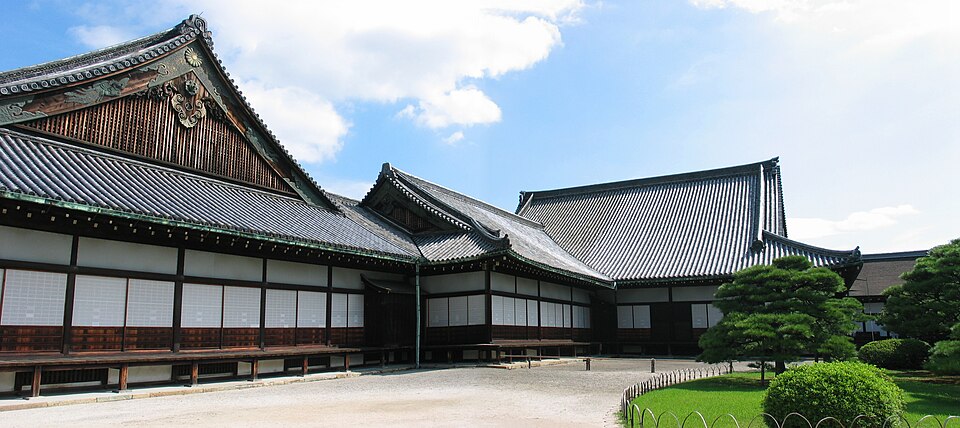
Photograph

Opening hours
| Monday | 08:45 – 17:00 |
|---|---|
| Tuesday | 08:45 – 17:00 |
| Wednesday | 08:45 – 17:00 |
| Thursday | 08:45 – 17:00 |
| Friday | 08:45 – 17:00 |
| Saturday | 08:45 – 17:00 |
| Sunday | 08:45 – 17:00 |
Checked 2026-08-26 · Source
- Today
- Open today, 08:45 – 17:00
- Visit duration
- 2 hours
- Accessibility
- Not recorded
- Price
- ¥800 per person
- Standing
- Must see · Heritage site
- Rank
- Rank 18 of 10,058
What it is
Nijo-jo Castle is the Kyoto seat of the Tokugawa shoguns, completed in 1603 on the orders of Tokugawa Ieyasu in the year he was appointed Shogun, and it bracketed the whole of the regime it was built for. Ieyasu came here to announce his appointment to the assembled feudal lords, and in 1867 the fifteenth shogun, Tokugawa Yoshinobu, summoned the senior vassals of forty domains resident in Kyoto to the Ohiroma of the Ninomaru-goten Palace and told them that political control was going back to the Emperor. Two hundred and sixty years of Tokugawa rule opened and closed inside the same walls.
The whole complex is a national Historic Site and is on the UNESCO World Heritage List. Inside it, six buildings of the Ninomaru-goten Palace are a National Treasure, the Higashi Ote-mon Gate and twenty-two other buildings are Important Cultural Properties, 1,016 of the palace wall paintings are Important Cultural Properties in their own right, and the Ninomaru Garden is a Special Place of Scenic Beauty.
The grounds are large and flat: about 275,000 square metres, roughly 600 metres east to west and 400 metres north to south, with a perimeter of two kilometres. That matters more than it sounds, because a visit here is mostly walking on gravel between widely separated buildings rather than moving through one continuous interior.
Checked 2026-08-26 · Source
What's inside
The Ninomaru-goten Palace is the reason most people come. Six buildings connected in a diagonal line, it is the only surviving fortified palace complex of its kind and the textbook example of shoin-zukuri architecture. The route through it runs from the Tozamurai, where waiting feudal lords faced gold-ground paintings of tigers and were meant to feel small, through the Shikidai where gifts and messages were handed over, into the Ohiroma audience halls, then to the more intimate Kuro-shoin and finally the Shiro-shoin, the shogun's private rooms, where the gold stops and the walls turn to ink-wash landscapes. Over 3,600 wall paintings survive in the palace, many from the Kan'ei era, with the Kan'ei work attributed to the young Kano Tan'yu. The corridor floors squeak underfoot, an effect of clamps moving against the nails in the supporting beams.
West of the palace is the Ninomaru Garden, a pond garden reworked around 1626 for Emperor Go-Mizuno-o's visit, with Kobori Enshu among the officials in charge.
Beyond the inner moat, the Honmaru-goten Palace is a different building entirely: parts of the Katsura-no-miya family's palace, moved here in 1893-94, reopened to the public in September 2024 after repairs. Also inside the grounds are the Honmaru Garden, the Seiryu-en Garden with the Waraku-an tea house, and the Painting Gallery.
Checked 2026-08-26 · Source

How long to spend
The castle publishes three model routes and calls the two-hour one recommended. The one-hour route, for the time-pressed, takes in the Higashi Ote-mon Gate, the Bansho, the Tonan corner turret, the Kara-mon Gate, the Ninomaru-goten Palace and its garden, the Seiryu-en Garden and the Painting Gallery. The two-hour route adds the Honmaru-goten Palace and garden, the base of the keep tower and the Waraku-an tea house. The two-and-a-half-hour route, for the enthusiast, adds the Minami-mon Gate and, on the southern loop, the plum grove and the cherry grove.
The castle's own FAQ puts figures on the two halves separately: the Ninomaru-goten Palace with the Ninomaru Garden takes one to one and a half hours, and adding the Honmaru Garden and the Honmaru-goten Palace brings the total to two and a half to three hours, depending on walking speed.
Two hours is the number to plan on, and it is what this guide records. Two things stretch it. Walking from the Higashi Ote-mon Gate to the Honmaru-goten Palace is about 850 metres and takes fifteen to twenty minutes, and holders of a timed Honmaru ticket are asked to arrive twenty minutes before their slot. There is also an eight-minute guidance video before entry.
Checked 2026-08-26 · Source
Season and crowds
The castle opens at 8:45 a.m., admits its last visitors at 4:00 p.m. and closes at 5:00 p.m., every day of the week. There is no weekly closing day and no midday break. The castle itself shuts only from 29 to 31 December, but the two palaces inside it keep their own calendars, and those are what catch people out. The Ninomaru-goten Palace does not admit visitors on Tuesdays in January, July, August and December, or from 26 December to 3 January. The Honmaru-goten Palace is shut on the third Monday of each month and the day after it, and from 26 December to 3 January; if that Monday is a national holiday the palace stays open.
Arriving near 8:45 buys the Ninomaru-goten corridors before the coach parties, which the castle notes fill its coach bays around 9:00, 10:30 and 13:30.
For the grounds, the plum grove in the south-west flowers from mid-February to late March and is at its best between late February and mid-March; the roughly 300 cherry trees, some fifty varieties among them, run from late March into late April, with evening illuminations usually from mid-March to mid-April; azaleas follow in late April; autumn colour lasts from late October into early January.
Checked 2026-08-26 · Source

Tickets
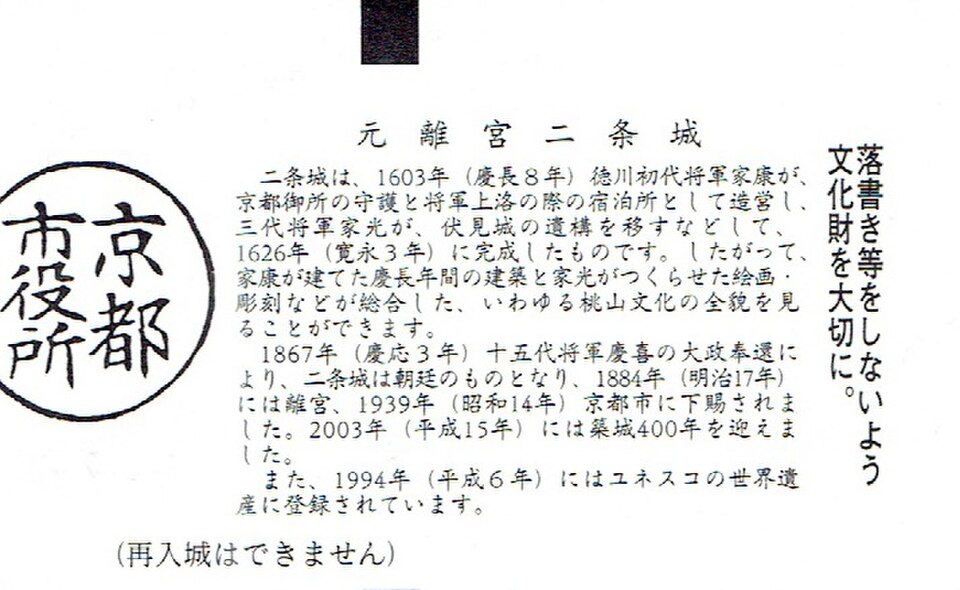
Admission is layered, and the base ticket does not include the palaces. A castle admission ticket is 800 yen for a general adult, 400 yen for junior high and high school students and 300 yen for elementary school students, with under-sixes free. The usual purchase is the combined castle admission plus Ninomaru-goten Palace ticket at 1,300 yen for adults, 400 yen and 300 yen for the two school bands. Group rates, for parties of thirty or more, take the adult figures to 700 and 1,100 yen. If only the base ticket was bought, the Ninomaru-goten Palace can be added inside the castle at the General Information Desk for 500 yen. The Painting Gallery costs 100 yen on top, bought inside.
The Honmaru-goten Palace works differently. It is 1,000 yen for adults, 300 yen for junior high and high school students and 200 yen for elementary school students, it requires a separate castle admission ticket, and it must be reserved in advance as a web ticket, on sale from thirty days before the visit. About fifteen people enter each hour, so the ticket count is capped, there are no group rates, and no changes, cancellations or refunds are allowed. Even visitors exempt from all fees must book. A one-day subway or subway-and-bus pass takes the adult castle ticket to 700 yen, bought at the ticket office on the day.
Checked 2026-08-26 · Source
.JPG)
Getting there
The address is 541 Nijojo-cho, Nijo-dori Horikawa Nishi-iru, Nakagyo-ku, Kyoto 604-8301, and the castle asks visitors to come by public transport.
The cleanest route from Kyoto Station is the subway: six minutes on the Karasuma Line to Karasuma Oike, change to the Tozai Line for two minutes to Nijojo-mae, then a short walk to the gate. City bus routes 9, 50, 101 and 111 run from Kyoto Station to the Nijojo-mae stop in about sixteen minutes. The JR Sagano Line reaches Nijo Station in five minutes, but leaves a seventeen-minute walk at the far end, so it only helps someone already on that line. From Sanjo Keihan the Tozai Line takes six minutes direct to Nijojo-mae, and from Shijo Karasuma bus routes 12 and 101 take about nine minutes.
A car is not needed and is discouraged. If one is used, Parking Lot 1 east of the castle and Parking Lot 3 to the south open 8:15 to 18:00. In Lot 1 a car pays 600 yen per forty minutes with a same-day maximum of 1,800 yen, rising to 700 yen per forty minutes from 10 March to 10 April and through November. Lot 3 charges 1,000 yen for the first two hours. Car spaces cannot be reserved.
Checked 2026-08-26 · Source
What to watch out for
Re-entry is not permitted, to the castle or to either palace, so anything left outside the gate stays outside. Shoes come off in both palaces; the Honmaru-goten additionally requires socks, and shoes go into a locking shoe box there. Bags larger than 35 by 35 by 50 centimetres have to go into the luggage store at the main rest area, which costs 500 yen, or into coin lockers by the ticket counter and inside the rest area.
Heat is the castle's own stated concern from roughly May to October. Neither palace is air-conditioned, because the wall paintings cannot take it, so the temperature and humidity along the viewing corridors match the outside. There is almost no shade in the grounds and a single lap takes thirty minutes to an hour. Drinking is forbidden inside both palaces and while walking anywhere in the grounds; there are vending machines at the rest areas and a water cooler in front of the office, and the east rest area is the one with real air conditioning.
Food is limited to the main rest area, where seats cannot be reserved. Paths are gravel: free electric wheelchairs are lent at the General Information Desk, and indoor wheelchairs are provided at each palace. Accessible toilets are at the West Bridge, Seiryu-en and Green Garden east rest areas. No pets except guide and hearing dogs.
Checked 2026-08-26 · Source
.jpg)
Photography
The rule is simple and strict: cameras work outdoors and stop at the palace thresholds. Photography and video are permitted anywhere on the outdoor viewing route as long as they do not obstruct other visitors, and they are prohibited outright inside the Ninomaru-goten Palace and the Honmaru-goten Palace, both because the corridors are too narrow for people to stop in and because of the paintings. So the tiger rooms, the Ohiroma and the Otsune-goten exist only in memory and in the guidebook.
The Painting Gallery is the exception that recovers some of that. Photography and video are allowed there, and it is the one place inside where the Ninomaru murals can be captured, though flash, monopods, tripods and extended selfie sticks are not permitted and lingering in one spot is discouraged. Monopods and tripods should be left alone across the rest of the castle too, and drones are banned on the grounds entirely.
For group shots, the castle designates the open space between the Kara-mon Gate and the Ninomaru-goten Palace. The Kara-mon's gilding reads best in the earlier part of the morning, before the sun climbs behind it and the crowd in front of it thickens. Commercial and published photography needs written permission applied for at least ten days ahead, and wedding or coming-of-age shoots are often refused.
Checked 2026-08-26 · Source
Common questions
Do I need to book Nijo-jo Castle in advance?
Only for the Honmaru-goten Palace. No reservation is needed to enter the castle grounds or to view the Ninomaru-goten Palace; those tickets can be bought at the Nijo-jo Castle Ticket Office on the day. The Honmaru-goten Palace requires an advance web ticket, on sale from thirty days before the visit, and the reservation is required even for visitors who are exempt from the admission fee or who hold a Kyoto City Citizen Annual Passport. About fifteen people are admitted each hour, so the number of web tickets is limited, and no changes, cancellations or refunds are allowed after purchase. A small number of same-day Honmaru tickets is sold at the General Information Desk inside the castle, but not at the main ticket office.
What time does Nijo-jo Castle open and close?
The castle opens at 8:45 a.m. and closes at 5:00 p.m., with last admission at 4:00 p.m. There is no midday break and no weekly closing day. Last admission to the Ninomaru-goten Palace is 4:10 p.m. The castle grounds close only from 29 to 31 December. The palaces inside have their own closed days: the Ninomaru-goten Palace is shut on Tuesdays in January, July, August and December and from 26 December to 3 January, and the Honmaru-goten Palace is shut on the third Monday of each month and the following day, and from 26 December to 3 January. If that third Monday is a national holiday, the Honmaru-goten Palace can be visited.
How much does it cost to enter Nijo-jo Castle?
A general adult castle admission ticket is 800 yen; junior high and high school students pay 400 yen, elementary school students 300 yen, and children below elementary school age enter free. The combined castle admission plus Ninomaru-goten Palace ticket, which is what most visitors want, is 1,300 yen for a general adult. The Honmaru-goten Palace is a further 1,000 yen for adults and needs its own advance reservation, and it does not include castle admission. The Painting Gallery is 100 yen extra, bought inside. Groups of thirty or more pay 700 yen for castle admission and 1,100 yen for the combined ticket, and a one-day subway or subway-and-bus pass reduces the adult castle ticket to 700 yen.
How long should I allow for Nijo-jo Castle?
Two hours is the castle's own recommended route and the figure to plan on. Its FAQ breaks that down: the Ninomaru-goten Palace with the Ninomaru Garden takes one to one and a half hours, and adding the Honmaru Garden and the Honmaru-goten Palace brings the visit to two and a half to three hours depending on walking speed. A one-hour route exists for anyone short of time, and a two-and-a-half-hour route adds the plum and cherry groves on the southern loop. Allow extra if a Honmaru-goten ticket is held: the walk there from the Higashi Ote-mon Gate is about 850 metres and takes fifteen to twenty minutes, arrival is asked for twenty minutes before the reserved time, and an eight-minute guidance video precedes entry.
Can I take photos inside Nijo-jo Castle?
Outdoors, yes. Photography and video are permitted along the outdoor viewing route provided they do not obstruct other visitors, and the castle designates the space between the Kara-mon Gate and the Ninomaru-goten Palace for group photographs. Inside the Ninomaru-goten Palace and the Honmaru-goten Palace, photography and video are prohibited, because the viewing corridors are narrow and the wall paintings are protected cultural properties. The Painting Gallery is the exception: photography is allowed there, without flash, monopods, tripods or extended selfie sticks. Monopods and tripods should be avoided elsewhere in the castle as well, and drones are prohibited on the grounds. Commercial or published photography requires an application submitted at least ten days in advance.
Do I need a car to visit Nijo-jo Castle?
No, and the castle explicitly asks visitors to use public transport. From Kyoto Station the subway takes six minutes on the Karasuma Line to Karasuma Oike and two more on the Tozai Line to Nijojo-mae, which is a short walk from the gate; city buses 9, 50, 101 and 111 make the same trip in about sixteen minutes. Sanjo Keihan is six minutes away on the Tozai Line. Parking does exist east and south of the castle, open 8:15 to 18:00, at 600 yen per forty minutes with a same-day maximum of 1,800 yen in Parking Lot 1, rising to 700 yen per forty minutes from 10 March to 10 April and through November. Car spaces cannot be reserved.
Where it is
Loading the interactive map…
The interactive map could not be loaded.
Nearby
In Kyoto
Same category
Fit it into a plan
External links
Last updated:
Source: OpenStreetMap contributors, Wikidata ·