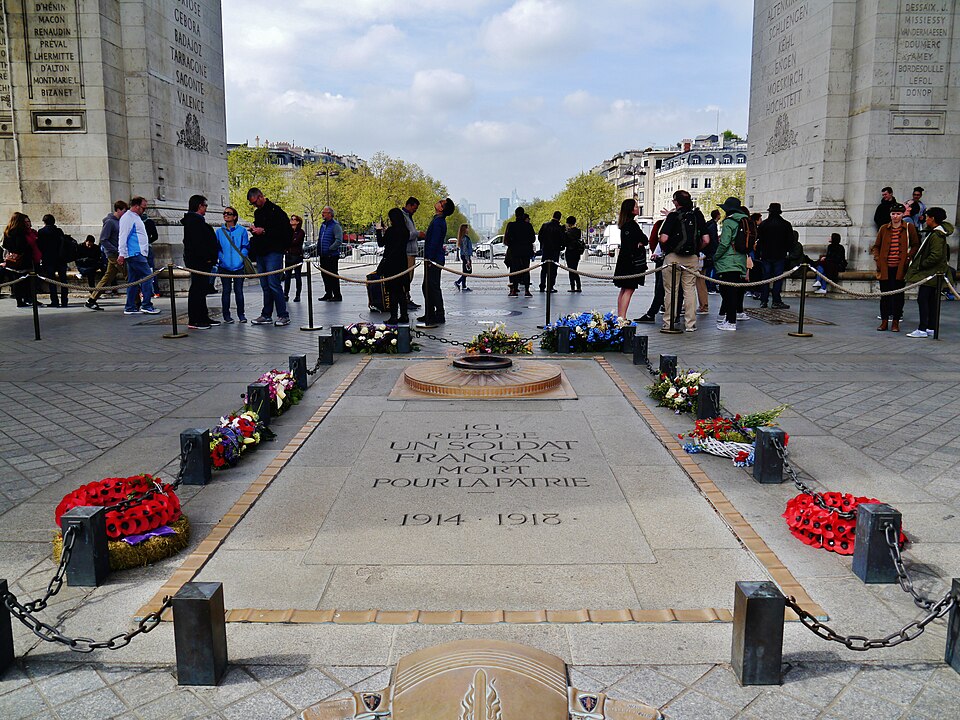
The Tomb of the Unknown Soldier is a flat paving stone beneath the Arc de Triomphe, at the centre of Place Charles de Gaulle, marking the grave of an unidentified French soldier from the First World War.
The body was chosen on 10 November 1920 from eight unidentified soldiers exhumed from different sectors of the front, and interred here on 11 November 1920, the second anniversary of the armistice. It is a grave in the literal sense, not a monument standing for one — the remains are beneath the stone visitors stand around.
There is no building or chamber to enter; the entire memorial is this single stone and the flame beside it, in the open air beneath the arch.
Placing an unknown soldier's grave under a triumphal arch was itself a break with older commemorative practice — the arch had celebrated named victories and generals since Napoleon commissioned it, and the 1920 burial turned it, for the first time, into a memorial to an ordinary, anonymous casualty rather than to a commander.
There is nothing to go inside — the tomb itself is the flat inscribed stone set into the pavement under the arch's vault, reading 'Ici repose un soldat francais mort pour la patrie 1914-1918.'
Beside it burns the Flame of Remembrance, first lit on 11 November 1923 and rekindled every evening at 18:30 in a short ceremony performed by veterans' associations, a tradition that has continued without a missed evening since, including through the German occupation of Paris in the Second World War.
The stone and flame sit directly beneath the arch's central vault, which is itself carved with the names of French victories and generals from the Revolutionary and Napoleonic wars — the tomb's plain, unadorned inscription is a deliberate contrast to the ornate carving above it.
Five to ten minutes at the stone itself. Most visitors combine it with climbing the Arc de Triomphe or with crossing to the arch from the Champs-Elysees, which extends the stop but is a separate, ticketed activity from viewing the tomb.
Timing a visit for the 18:30 flame-rekindling ceremony adds a wait beforehand if arriving early to get close to the stone.
The rekindling ceremony at 18:30 every evening is the one fixed, repeatable event here and draws a crowd that thins quickly once it ends. Outside that hour the stone can be seen at any time, since it is an open, unticketed monument.
11 November, Armistice Day, brings an official state ceremony with the French President and heavy security around the whole square, which makes it a poor day for a casual visit but a notable one to witness from a distance if travelling then.
Free. The tomb and flame sit at ground level in the open square and require no ticket at any time; only climbing the Arc de Triomphe itself, above the tomb, is a separate paid attraction reached from inside the pedestrian underpass, not from ground level next to the flame. No fee of any kind applies to viewing the tomb or attending the evening rekindling ceremony.
The stone is reached from the Champs-Elysees or the Avenue de la Grande Armee side only through the pedestrian underpass beneath Place Charles de Gaulle — crossing the traffic circle at street level is both illegal and dangerous, since twelve avenues converge here without pedestrian crossings.
Metro line 1, 2 or 6, or RER A, to Charles de Gaulle-Etoile surfaces directly into that underpass system.
Standing on or stepping over the flame and stone is treated as a serious breach of decorum at a war grave, not a minor faux pas, and is discouraged even for a photo.
The pedestrian underpass is the only safe route to the arch and tomb — do not attempt to cross the roundabout above ground.
The 18:30 ceremony draws a dense crowd around the flame for a few minutes; arriving 15 minutes early secures a clear sightline without needing to push forward during the ceremony itself.
The flame against the dark stone reads best at or just after dusk, close to the 18:30 ceremony when the surrounding light has dropped but the flame is not yet the only light source.
A wider shot from beneath the arch's vault, with the flame in the foreground and the Champs-Elysees receding through the arch's opening, is the standard composition and works at any hour the crowd thins enough to get close.
Yes. An unidentified French soldier from the First World War, chosen from eight exhumed remains on 10 November 1920, was interred here the following day.
Is the tomb free to visit?
Yes. It sits at ground level in the open square beneath the Arc de Triomphe and needs no ticket; only climbing the arch above it is paid.
What time is the flame ceremony?
Every evening at 18:30, when veterans' associations rekindle the Flame of Remembrance in a short ceremony, a tradition unbroken since 1923.
How do I reach the tomb safely?
Only through the pedestrian underpass beneath Place Charles de Gaulle; crossing the traffic circle at street level is dangerous and illegal.
Can I stand on the stone or step over the flame?
No. It marks a war grave and doing so is treated as a serious breach of decorum, not a minor rule.
Is the tomb inside the Arc de Triomphe?
It sits at ground level beneath the arch's vault, not inside a chamber — the arch above it is a separate, climbable, ticketed monument.
Nothing non-essential is set before you choose, in regions where consent is required. If you decline, ads still appear but they are non-personalised, and analytics is switched off entirely.



.jpg)