


2 min walk · Paris 8e Arrondissement
Monument to Guy de Maupassant
- Notable
- Historic monument
Language · 1 published
Nature site · Paris 8e Arrondissement, Paris
Parc Monceau
| Monday | 07:00 – 22:00 |
|---|---|
| Tuesday | 07:00 – 22:00 |
| Wednesday | 07:00 – 22:00 |
| Thursday | 07:00 – 22:00 |
| Friday | 07:00 – 22:00 |
| Saturday | 07:00 – 22:00 |
| Sunday | 07:00 – 22:00 |
Checked 2026-08-24 · Source
Parc Monceau began in 1769 as a private pleasure garden for Philippe d'Orleans, Duke of Chartres, laid out by the writer and painter Louis Carrogis, known as Carmontelle, in the English landscape style then fashionable as a counterpoint to the formal French garden.
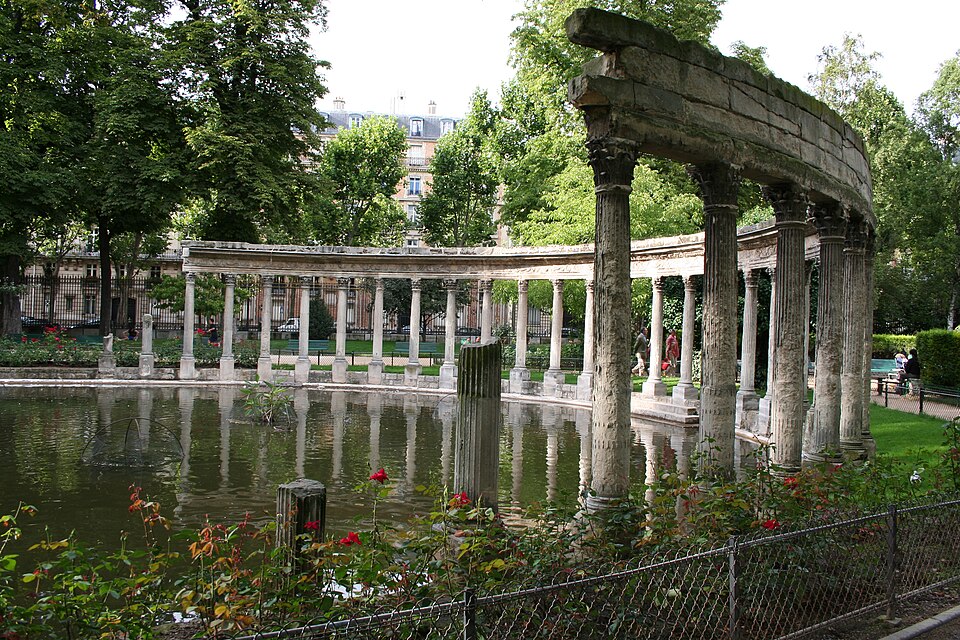
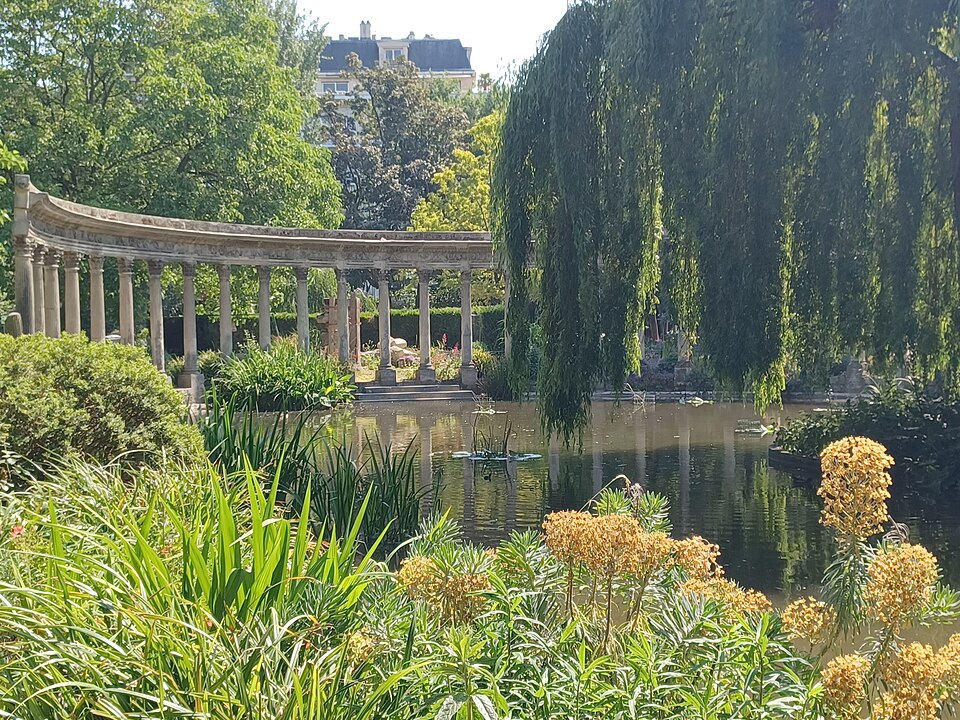
Carmontelle filled it with follies, or fabriques: a naumachie, a mock-ruined colonnade framing an oval pond, an Egyptian pyramid, a Dutch windmill, a Renaissance arch salvaged from the demolished Paris Hotel de Ville. Most were removed later; the naumachie colonnade and the Renaissance arch survive.
The Republic seized the garden after the Revolution, and in 1861 Baron Haussmann's engineer Adolphe Alphand redesigned and reduced it as one of the public parks created during the Second Empire's remaking of Paris, opening it to the public that year.
Checked 2026-08-24 · Source
The naumachie, an oval water basin ringed by a curved Corinthian colonnade originally built as a mock-ruined temple, is the park's set-piece and its most photographed corner.
The Chartres rotunda at the main entrance on boulevard de Courcelles is a surviving toll house from Claude Nicolas Ledoux's Wall of the Farmers-General, the customs barrier that once ringed Paris, and is one of the few Ledoux barrieres left standing. A pyramid folly, a stretch of Renaissance-style arcading, and statues of Chopin, Maupassant and Gounod are scattered along the winding paths, in keeping with Carmontelle's original idea of a garden that surprises at every turn rather than reveals itself from one point.
The park is surrounded by grand hotels particuliers from the same era, several now embassies or private mansions, which give the surrounding streets their own architectural interest. Marcel Proust grew up nearby and walked here as a child, and the park appears in his writing as a setting drawn directly from memory rather than research.
Checked 2026-08-24 · Source

Thirty to forty-five minutes for a full loop of the paths and the naumachie; an hour with a slow read of the follies and the statues.
It works well paired with a walk through the surrounding 8th-arrondissement streets, which hold some of Paris's grandest late-19th-century private mansions, several of them former private banking or industrial fortunes' homes. The park is small enough that a single loop covers everything, so there is no route to plan beyond following the paths from whichever gate is closest.
Checked 2026-08-24

Weekday mornings are quiet; the park is a neighbourhood green space for a residential arrondissement first and a sightseeing stop second, so it never gets as crowded as the Tuileries or the Luxembourg.
Spring is the strongest season, when the park's mature plane and chestnut trees and its flower beds around the naumachie are at their fullest. Like most Paris municipal parks it closes at dusk, with the exact hour posted at the gates and varying through the year.
Checked 2026-08-24
Free. Parc Monceau is a public city park run by the city of Paris, with no admission charge and no ticket at any gate.
It has several entrances along boulevard de Courcelles, avenue Velasquez and rue Rembrandt, and each is open the same posted hours as the others — there is no separate paid or premium entrance anywhere around the perimeter, unlike some of the city's larger gardens with a fee-charging annex.
Checked 2026-08-24

In the 8th arrondissement, on the edge of the Plaine Monceau neighbourhood, north of the Arc de Triomphe.
Metro line 2 stops directly at Monceau, at the boulevard de Courcelles entrance by the rotunda. Courcelles, one stop further on the same line, and Villiers, on lines 2 and 3, both reach the park's other gates within a five-minute walk.
Checked 2026-08-24 · Source
The park is fenced and gated like every Paris square, and the gates close at a posted dusk time that shifts through the year — check it rather than assume a fixed hour.
Cycling and rollerblading are restricted to marked paths in most Paris squares, and Parc Monceau enforces the same rule; a warden circulates and will ask riders off the lawns. Dogs are permitted on a lead in the outer paths in most Paris squares but not on the central lawns, and Parc Monceau follows the same general rule.
Checked 2026-08-24
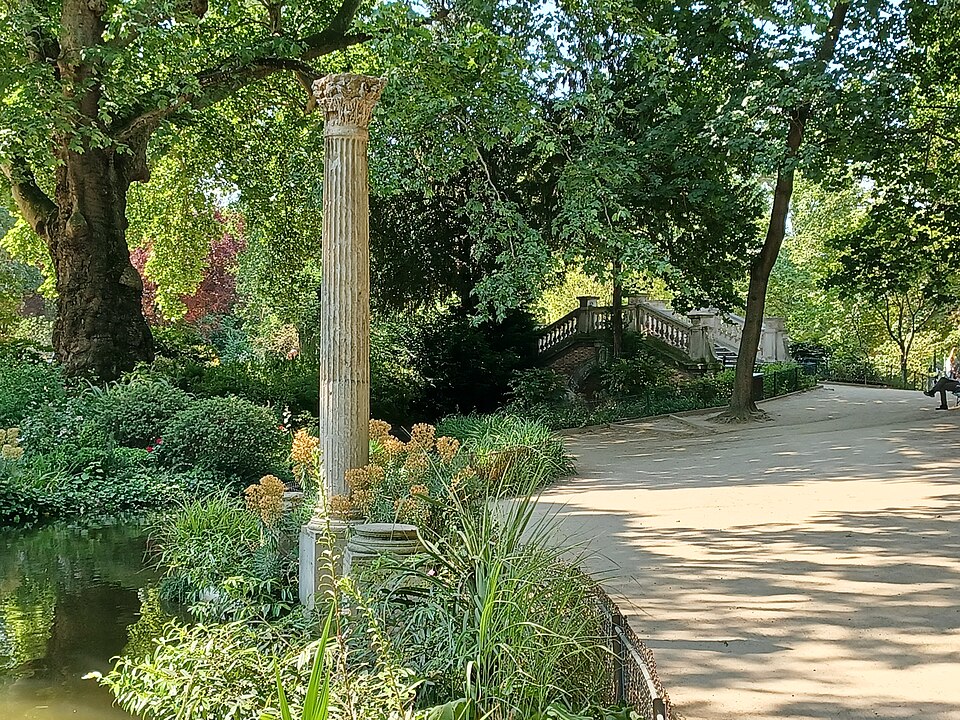
The naumachie colonnade reflected in its own pond is the shot everyone takes, and it reads best in the low side light of early morning or the last hour before closing, when the water is stillest.
The Chartres rotunda at the boulevard de Courcelles gate is a cleaner, less crowded subject and photographs well straight-on from the pavement outside the railings.
Checked 2026-08-24
The Duke of Chartres commissioned it in 1769 from Louis Carrogis, known as Carmontelle, as a private English-style pleasure garden full of follies.
An oval water basin ringed by a curved Corinthian colonnade, built as a mock-ruined temple and the park's central set-piece.
Yes, it is a public city park with no admission charge.
In 1861, after Adolphe Alphand redesigned it for Baron Haussmann's Second Empire remaking of Paris.
The Chartres rotunda, a surviving toll house from Claude Nicolas Ledoux's Wall of the Farmers-General customs barrier.
Monceau on line 2, right at the boulevard de Courcelles entrance.
Loading the interactive map…
The interactive map could not be loaded.
Last updated:
Source: OpenStreetMap contributors, Wikidata ·