
.jpg)
_MM._Blanchet,_Jaubert,_Kapferer,_capitaine_Ferber_(jardin_des_Tuileries,_Grand_Prix_de_l%27A%C3%A9ro-club,_le_29_septembre_1907)_-_btv1b531092959.jpg)

.jpg)
.jpg)
1 min walk · Paris 1er Arrondissement
Venus Callipyge
- Notable
- Art and culture venue
Language · 1 published
Nature site · Paris 1er Arrondissement, Paris
Jardin des Tuileries

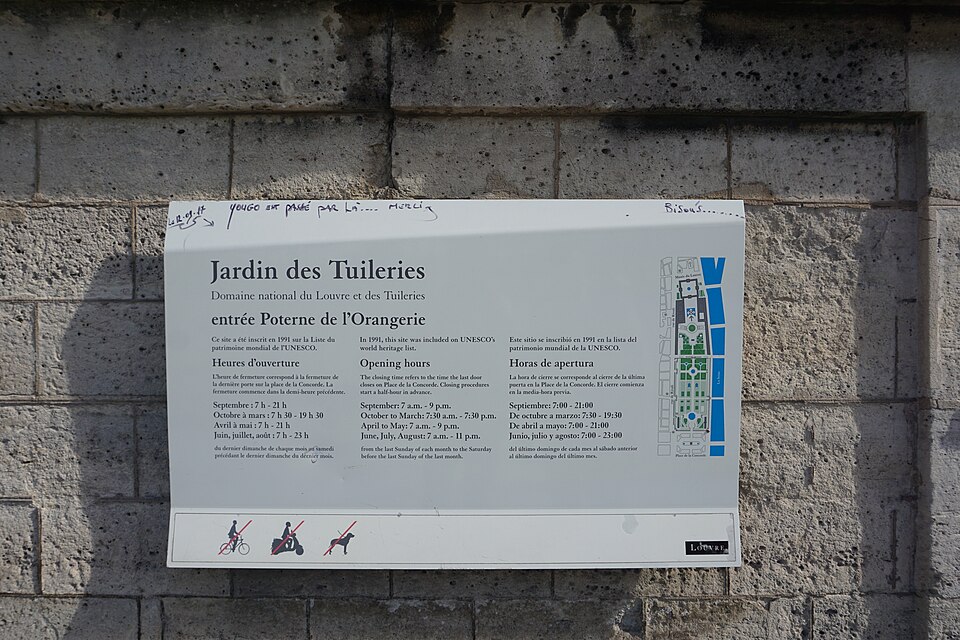
| Monday | 07:00 – 21:00 |
|---|---|
| Tuesday | 07:00 – 21:00 |
| Wednesday | 07:00 – 21:00 |
| Thursday | 07:00 – 21:00 |
| Friday | 07:00 – 21:00 |
| Saturday | 07:00 – 21:00 |
| Sunday | 07:00 – 21:00 |
Checked 2026-08-24 · Source
Read from the OpenStreetMap access tags; anything not listed has no tag recorded.
Set the group type to family in the planner and the day window contracts to about three quarters of a solo day.
The Tuileries is the first royal garden in Europe that let the public in, and it has outlived the palace it was built for.
Catherine de' Medici created it in 1564. André Le Nôtre redesigned it between 1664 and 1672 into the formal French garden it still is, and it opened to the public in 1667.
The Tuileries Palace at its eastern end was burned deliberately during the Commune in 1870 and demolished in 1883, which is why the Louvre now has an open western end and the garden runs straight into it.
It covers 25.5 hectares between the Louvre and the Place de la Concorde, with a central Grande Allée 350 m long.
Checked 2026-08-23 · Source
Two museums, a Napoleonic arch, and the statues André Malraux swapped.
The Musée de l'Orangerie, built as a greenhouse in 1852 and converted into a gallery in 1927, holds Monet's Water Lilies in the oval rooms designed for them. The Jeu de Paume, a real-tennis court of 1861, is now a contemporary photography gallery. Both are at the Concorde end.
The Arc de Triomphe du Carrousel, built by Napoleon in 1809, stands at the Louvre end.
Malraux replaced the nineteenth-century statuary with Aristide Maillol bronzes in 1964–65; there is also Rodin and Auguste Caïn, and contemporary work added between 1998 and 2000.
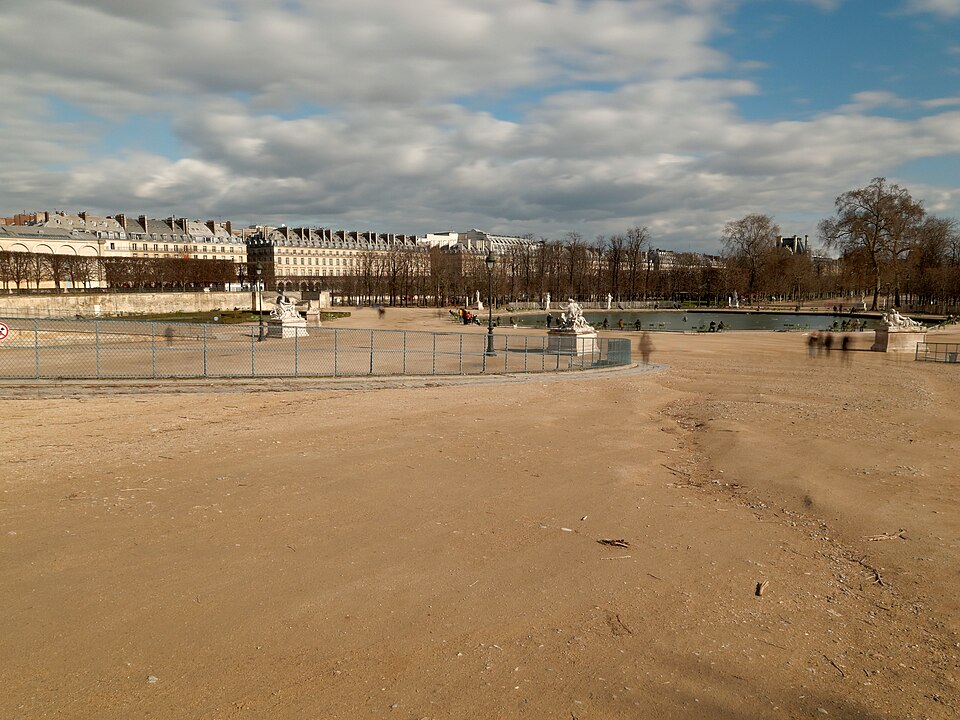
The octagonal basin at the western end is 60 m across.
Checked 2026-08-23 · Source
Forty minutes to walk it, half a day if you take the two museums.
The Grande Allée is 350 m and the garden 25.5 hectares, but the shape is simple and there is no risk of getting lost.
The Orangerie is ninety minutes and is the better of the two galleries — the Water Lilies rooms were built to Monet's specification and are one of the few places where a painting and its room were designed together.
The garden connects the Louvre to the Concorde on foot in fifteen minutes, which is the fastest and by far the most pleasant way to make that journey.
Checked 2026-08-23 · Source

Late afternoon, when the low sun runs along the Grande Allée from the Concorde end.
The garden's axis is the great east–west line of Paris, so it is lit end to end at sunrise and sunset and flat at noon.
A funfair sets up along the northern terrace in summer, which is loud, cheerful and not what anyone comes to a Le Nôtre garden for.
The gravel is white and the shade is thin; in July the middle of the garden is hot and there is little cover.
Checked 2026-08-23 · Source
The garden is free and always has been open to the public — since 1667, which was the innovation.
The Musée de l'Orangerie and the Jeu de Paume are separately ticketed — the Orangerie at 12.50 EUR per person on 24 August 2026, the Jeu de Paume by whichever exhibition is running; the Orangerie is covered by the Paris Museum Pass.
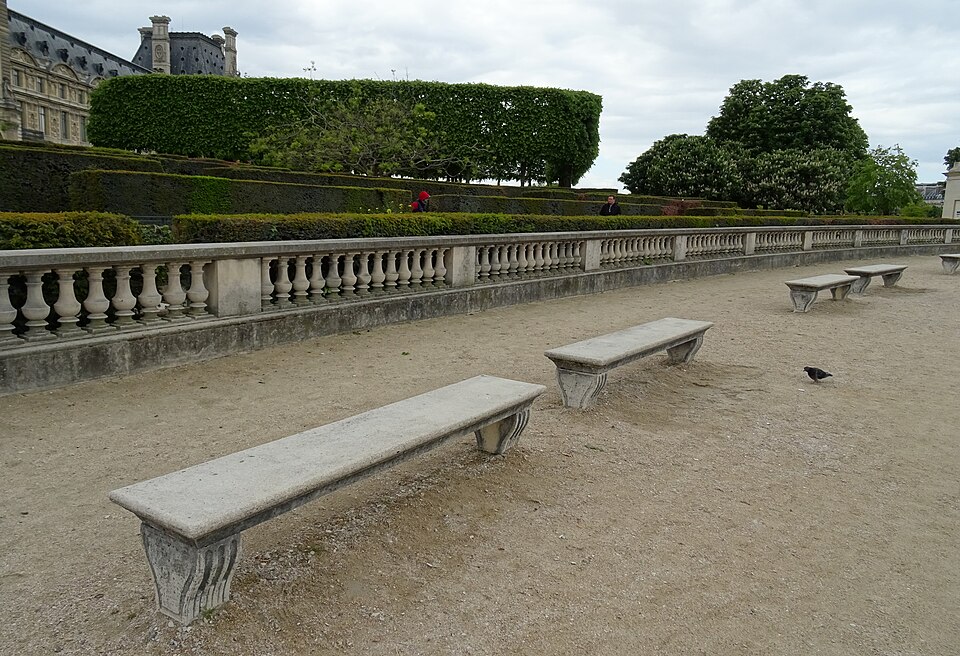
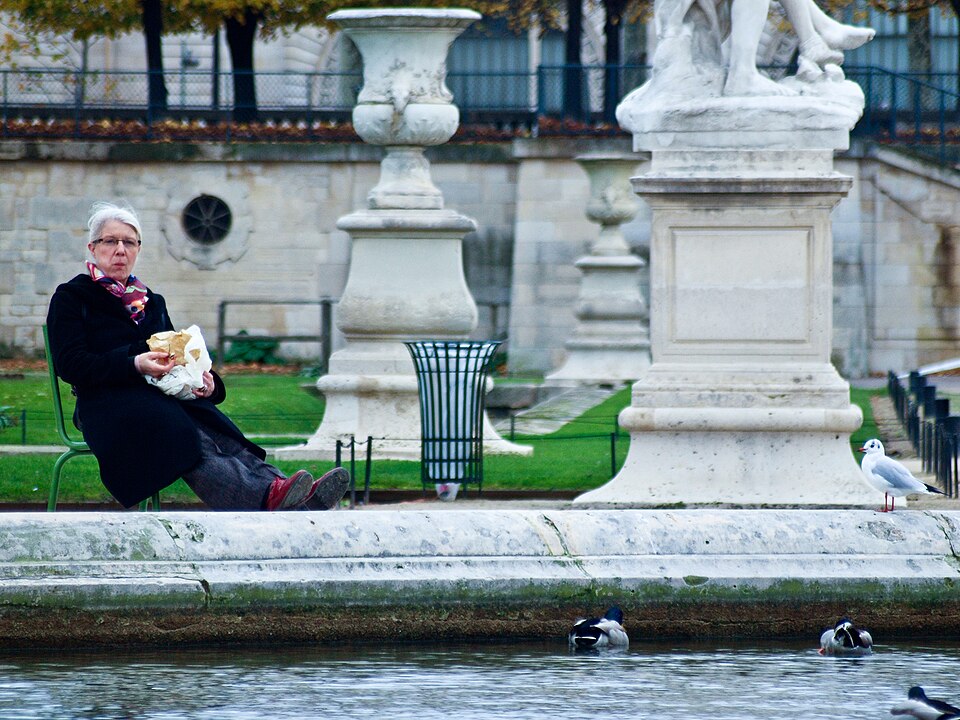
The green metal chairs around the basins are free and movable, which is the single most useful fact about the garden.
Checked 2026-08-23 · Source
The 1st arrondissement, on the Right Bank between the Louvre and the Place de la Concorde.
Tuileries on Métro line 1 is on the northern terrace, halfway along. Concorde on lines 1, 8 and 12 is at the west gate and Palais Royal–Musée du Louvre on lines 1 and 7 at the east.
The Métro runs 16 lines across 321 stations, with stations 548 m apart on average — a two-stop journey is usually faster walked.
Checked 2026-08-23 · Source
The garden closes at night and the hours change with the season; staff clear it before the gates shut.
Shade is scarce and the gravel reflects heat. There is drinking water, but not on the central allée.
The lawns are mostly not for walking on; the chairs are.
The summer funfair on the northern terrace changes the character of the garden entirely for several weeks and is worth knowing about before rather than after.
The stretch between the Concorde gate and the Orangerie carries the petition and bracelet operations working the axis.
Checked 2026-08-23 · Source
The axis is the photograph: standing on the Grande Allée with the Arc de Triomphe du Carrousel behind and the obelisk ahead, at either end of the day when the sun is on the line.
The octagonal basin, 60 m across, reflects the sky and the Concorde obelisk beyond it; the reflection is the frame, not the water.
The Maillol bronzes are the best-lit sculpture in central Paris — they stand in the open on gravel with nothing behind them — and reward a longer lens.
The garden from the Louvre's upper windows and from the Orangerie terrace gives the plan, which ground level never shows.
Checked 2026-08-23
Yes, and it has been open to the public since 1667, which made it the first royal garden in Europe to be so. The Orangerie and the Jeu de Paume within it are ticketed.
Gone. It was burned during the Commune in 1870 and demolished in 1883, which is why the Louvre's western end now opens straight onto the garden.
Catherine de' Medici created it in 1564 and André Le Nôtre redesigned it between 1664 and 1672 into the formal garden it remains.
25.5 hectares, with a central Grande Allée 350 m long, running between the Louvre and the Place de la Concorde.
Monet's Water Lilies, in the oval rooms designed for them. The building was a greenhouse of 1852, converted into a gallery in 1927.
Mostly not. André Malraux replaced the nineteenth-century statuary with Aristide Maillol bronzes in 1964–65, with contemporary work added between 1998 and 2000.
Loading the interactive map…
The interactive map could not be loaded.
Last updated:
Source: OpenStreetMap contributors, Wikidata ·