Photograph
· Another one of my pictures: This photograph was taken by Medium69 (William Crochot) and released under the license stated below. You are free to use it for any purpose as long as you credit the author (William Crochot), the Source (Wikimedia Commons) and the license (CC-BY-SA 4.0) in close relation to the image. Please do not upload an updated image here without consultation with the Author. The author would like to make corrections only at his own source RAW. This ensures that the changes are preserved.Please if you think that any changes should be required, please inform the author.Otherwise you can upload a new image with a new name. Please use one of the templates derivative or extract. ·
CC BY-SA 4.0
The Musee du quai Branly - Jacques Chirac gathers non-Western art and material culture from Africa, Asia, Oceania and the Americas under one roof, a collection that had previously been split between the ethnographic Musee de l'Homme and the Musee national des Arts d'Afrique et d'Oceanie.
It opened in 2006, championed by President Jacques Chirac, whose name the museum added in 2016. The architect Jean Nouvel designed the building on raised pilotis along the Seine, and it holds roughly 370,000 objects, of which around 3,500 are on permanent display at any time.
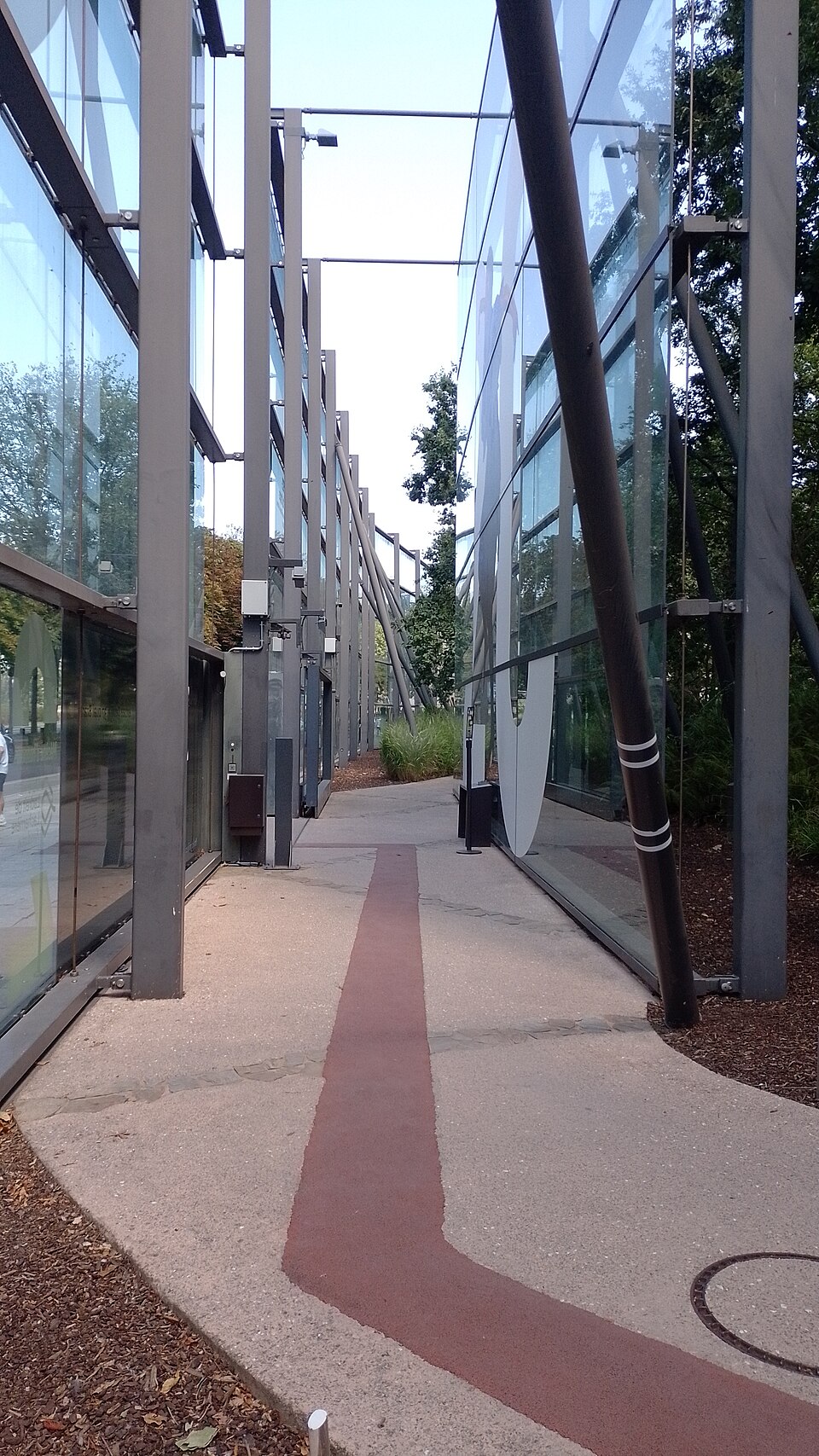
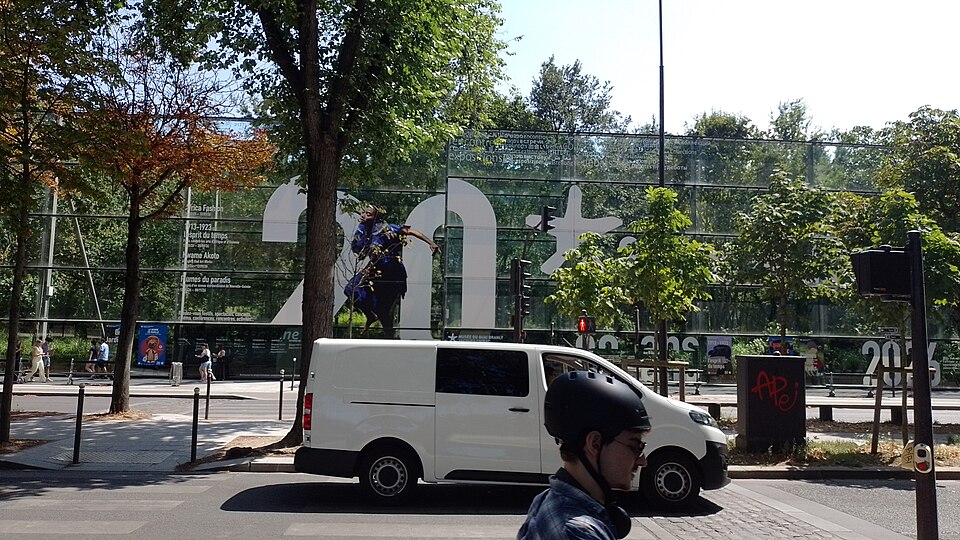
The building itself is as much the subject as the collection: a long, irregular block wrapped in coloured cantilevered boxes, set back from the quay behind a garden designed by landscape architect Gilles Clement.
A single sloping ramp, lined with a long illuminated glass case of musical instruments, carries visitors up into the permanent galleries, which are organised by continent rather than by chronology: Oceania, Asia, Africa and the Americas, each in its own zone with its own lighting and floor colour.
Highlights include Aboriginal Australian bark paintings and dot paintings commissioned directly for the building's ceilings, Benin bronzes and West African masks, pre-Columbian Andean textiles and ceramics, and Southeast Asian shadow puppets and temple carvings. A mezzanine mediatheque holds the museum's ethnographic library and film archive.
Outside, the exterior wall facing rue de l'Universite carries a 800-square-metre living wall of more than 15,000 plants, designed by the botanist Patrick Blanc, one of the largest green walls in Paris.
Two to three hours for the permanent collection at a normal pace, longer with a temporary exhibition added. The continuous ramp layout means most visitors walk the whole route rather than skipping sections, which is part of why the visit runs long for a single-building museum.
The garden and the living wall add fifteen to twenty minutes if walked separately rather than glimpsed from inside. A visitor short on time is better served picking one continental zone to see properly than rushing all four, since the collection is deep rather than a quick overview by design.
Weekday mornings, right at opening, are the quietest slot; the museum sits on a well-worn tourist route between the Eiffel Tower and the Trocadero and fills through the afternoon, especially on weekends.
The garden is at its fullest and the living wall at its most colourful in late spring and summer. Winter strips the garden back but keeps the indoor galleries exactly as interesting, so a rainy-day visit loses nothing.
The permanent collection and temporary exhibitions are paid entry, with a reduced rate for under-26 European Union residents and free entry for under-18s and for everyone on the first Sunday of the month, in line with most French national museums.
Current ticket prices are not reproduced here; check the museum's own billetterie before travelling, since national-museum rates are revised most years.
On quai Branly in the 7th arrondissement, on the Left Bank between the Eiffel Tower and the Alma bridge, a ten-minute walk from either.
The RER C stop Pont de l'Alma is closest, a few minutes' walk along the quay. Metro line 9 stops at Alma-Marceau on the opposite bank via the bridge, and Bir-Hakeim on line 6 reaches it from the Eiffel Tower side.
The permanent galleries are kept deliberately dim to protect organic objects such as textiles, feathers and wood, which some visitors find disorienting after the bright ramp — plan for low light rather than treating it as a fault.
Flash photography is not permitted in the galleries, standard for a museum holding light-sensitive material. The single ramp route means there is effectively one way through; going against the flow at busy times is awkward rather than dangerous but worth avoiding.
The living wall on rue de l'Universite is the most photographed exterior surface of the building and reads best from across the street, far enough back to take in its full height.
Inside, the illuminated glass case of instruments along the entrance ramp and the coloured light of each continental zone photograph well without flash; a wide lens handles the low light better than a slow shutter does in a moving crowd. The garden's mature planting along the quai Branly side also frames the building's cantilevered coloured boxes well from ground level, an angle less crowded than the living-wall side.
Checked 2026-08-24
Common questions
What does the Musee du quai Branly collect?
Non-Western art and material culture from Africa, Asia, Oceania and the Americas, formerly split between the Musee de l'Homme and the Musee des Arts d'Afrique et d'Oceanie.
Who designed the building?
The architect Jean Nouvel, who set it on raised pilotis along the Seine behind a garden by landscape architect Gilles Clement.
What is the living wall?
An 800-square-metre vertical garden of more than 15,000 plants on the rue de l'Universite facade, designed by botanist Patrick Blanc.
How many objects are in the collection?
Around 370,000 objects in total, with roughly 3,500 on permanent display at any time.
Is entry ever free?
Under-18s and, on the first Sunday of the month, all visitors get free entry, matching the pattern most French national museums use.
What is the nearest train stop?
RER C at Pont de l'Alma, a few minutes' walk along the quay.
Nothing non-essential is set before you choose, in regions where consent is required. If you decline, ads still appear but they are non-personalised, and analytics is switched off entirely.


.jpg)
_-_OSM_2022.svg)
_-_OSM_2022.svg)
_-_Flickr_-_dalbera.jpg)
-2.jpg)
.jpg)