


5 min walk · Paris 7e Arrondissement
Le Jules Verne
- Notable
- Restaurant or café
Language · 1 published
Historic monument · Paris 7e Arrondissement, Paris
| Monday | 00:00 – 23:59 |
|---|---|
| Tuesday | 00:00 – 23:59 |
| Wednesday | 00:00 – 23:59 |
| Thursday | 00:00 – 23:59 |
| Friday | 00:00 – 23:59 |
| Saturday | 00:00 – 23:59 |
| Sunday | 00:00 – 23:59 |
Parsed from OpenStreetMap opening hours on 2026-08-24.
Read from the OpenStreetMap access tags; anything not listed has no tag recorded.
Set the group type to family in the planner and the day window contracts to about three quarters of a solo day.
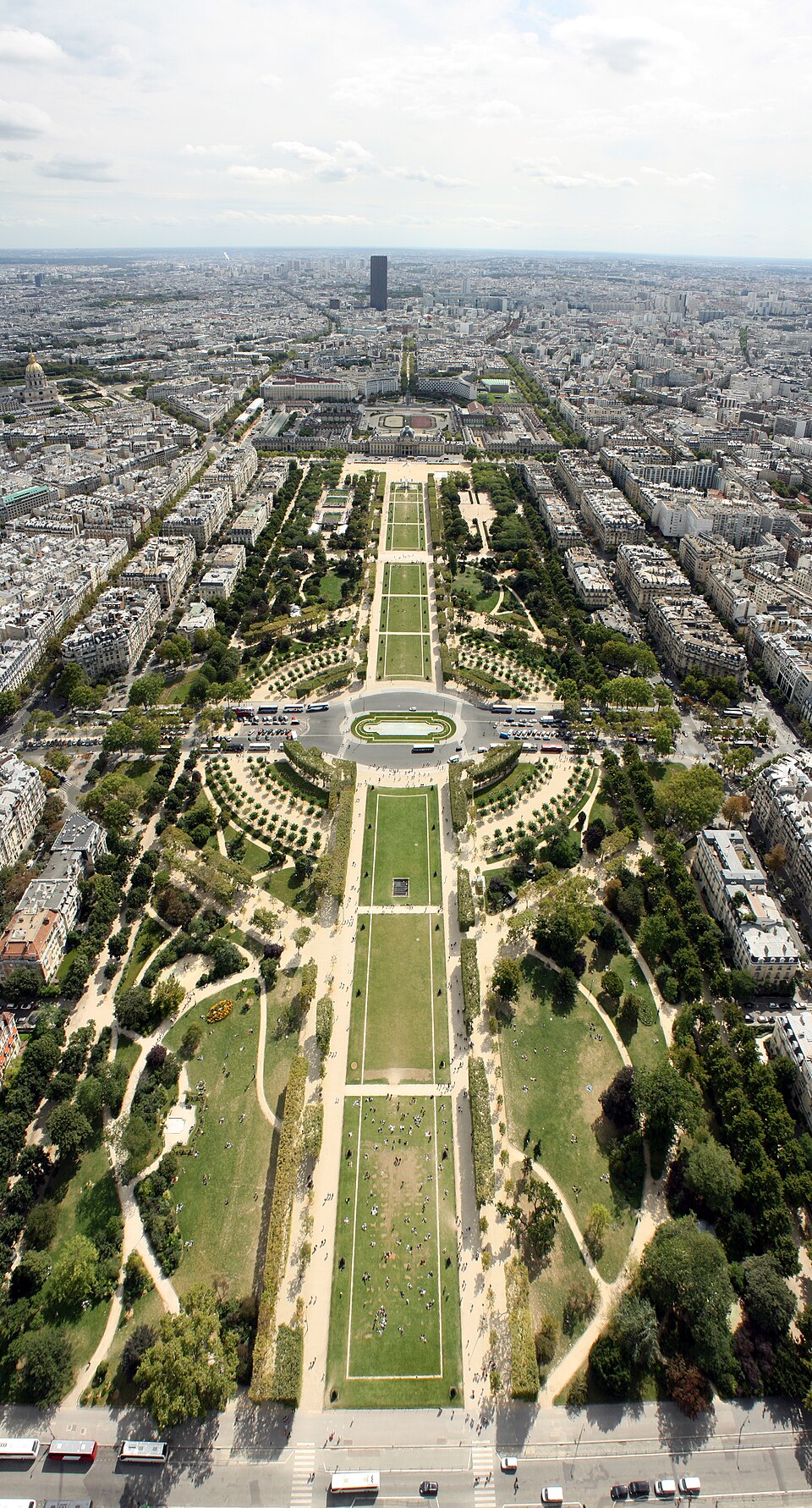
The Champ de Mars is a parade ground that became a lawn, and the Eiffel Tower stands at one end of it.
It runs through the 7th arrondissement from the tower at the north-west to the École Militaire at the south-east. The site was made when the École Militaire was built in 1765: the ground was levelled, ringed with a ditch and planted with a long avenue of elms, as an esplanade for drilling soldiers.
The name is Latin — the field of Mars, the god of war — and it was accurate.
It is now a public park, and the largest open green space in central Paris that is not a formal garden.
Checked 2026-08-23 · Source
Grass, gravel walks and the most photographed view in France.
What is here is mostly what happened here. The first hydrogen balloon went up from this ground on 27 August 1783. The first Bastille Day, the Fête de la Fédération, was held here on 14 July 1790, and the massacre followed on 17 July 1791. The Festival of the Supreme Being was staged here on 8 June 1794.
Five Expositions Universelles used the field — 1867, 1878, 1889, 1900 and 1937 — and the Eiffel Tower is what the 1889 one left behind.
The 2024 Olympics put the Eiffel Tower Stadium on the field for beach volleyball and blind football, with the Grand Palais Éphémère at the south end.
Checked 2026-08-23 · Source

Half an hour, and it is the best half hour near the Eiffel Tower.
The lawns face the tower directly, which makes this the place people sit for an hour with something to eat. Nobody queues for a lawn.
Walking the full length from the tower to the École Militaire takes fifteen minutes and gives the tower shrinking behind you, which is the only way to feel how large the thing actually is.
The Trocadéro across the river is the other free viewpoint and is twenty minutes away over the Pont d'Iéna.
Checked 2026-08-23 · Source

Early morning for the empty lawns, or the hour before sunset for the tower.
This is where people come to watch the Eiffel Tower's hourly illumination after dark, and it is crowded but not unpleasantly so — the field is large enough to absorb it.
The Eiffel Tower takes around seven million visitors a year and all of them cross this ground, so the north-west end is busy from mid-morning; the École Militaire end almost never is.
There is no shade on the central lawns.
Checked 2026-08-23 · Source
Free. It is a public park.
The Eiffel Tower at the north-west end is ticketed by level and by lift or stairs; the figure shown on the tower's own page is the one currently published.
The École Militaire at the south-east end is a working military academy and is not open to visitors.
Checked 2026-08-23 · Source
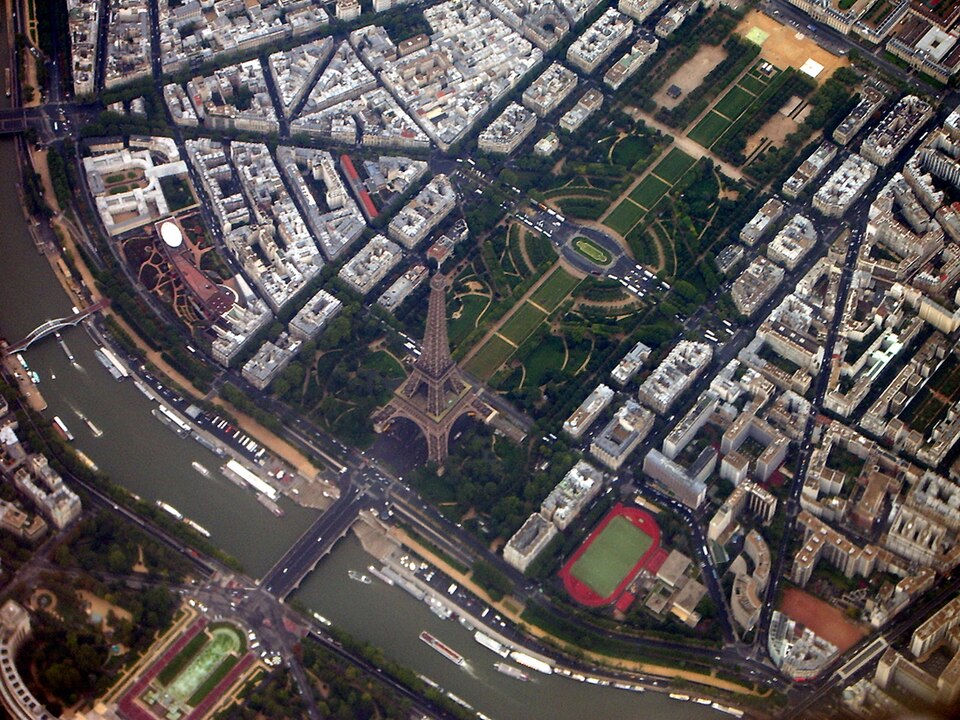
The 7th arrondissement, between the Eiffel Tower and the École Militaire.
École Militaire on Métro line 8 is at the south-east end and is the quiet arrival. Champ de Mars–Tour Eiffel on RER C and La Motte-Picquet–Grenelle on lines 6, 8 and 10 both serve the sides.
The Métro runs 16 lines across 321 stations, with stations 548 m apart on average — a two-stop journey is usually faster walked.
Checked 2026-08-23 · Source

The end nearest the Eiffel Tower carries the same street operations as the tower itself: the petition clipboard, the string bracelet, the three-cup game. They do not work the far end.
Sections of the lawn are fenced for restoration in rotation and the fencing moves.
Events close large parts of the field for days at a time, with hoarding.
There is no shade on the central lawns and limited drinking water.
Sitting on the grass is allowed where it is not fenced, which is the opposite of the rule in most formal Paris gardens.
The park is open at night and is much emptier and darker at the École Militaire end.
Checked 2026-08-23 · Source
The tower from the middle of the field, with lawn in the foreground, is the standard shot and it is better in the morning, when the sun is behind the photographer rather than behind the tower.
From the far south-east end near the École Militaire, a longer lens compresses the avenue and puts the tower at the end of a corridor of trees. Almost nobody walks that far.
For the tower's structure rather than its silhouette, stand under the four legs at the north-west end and shoot straight up.
The hourly night illumination is photographable from anywhere on the field; commercial use of images of the lit tower is restricted, which does not affect personal photographs.
Checked 2026-08-23 · Source
A public park in the 7th arrondissement between the Eiffel Tower and the École Militaire. It was made in 1765 as a drill ground for the military academy, and named after the god of war.
It was built for the Exposition Universelle of 1889, one of five world's fairs held on this field — 1867, 1878, 1889, 1900 and 1937 — and it is what the 1889 fair left behind.
The first hydrogen balloon flight on 27 August 1783, the first Bastille Day on 14 July 1790, the massacre of 17 July 1791, and the Festival of the Supreme Being on 8 June 1794.
Yes, where it is not fenced — unlike most formal Paris gardens. Sections are fenced for restoration in rotation.
Yes. The park is free and open. The Eiffel Tower at one end is ticketed and the École Militaire at the other is a working academy and closed.
The middle of the field in the morning, with the sun behind you. From the École Militaire end a longer lens puts the tower at the end of a corridor of trees.
Loading the interactive map…
The interactive map could not be loaded.
Last updated:
Source: OpenStreetMap contributors, Wikidata ·