.jpg)


1 min walk · Paris 7e Arrondissement
Musée des Plans-Reliefs
- Must see
- Museum
Language · 1 published
Historic monument · Paris 7e Arrondissement, Paris
Hôtel des Invalides
| Monday | 10:00 – 18:00 |
|---|---|
| Tuesday | 10:00 – 18:00 |
| Wednesday | 10:00 – 18:00 |
| Thursday | 10:00 – 18:00 |
| Friday | 10:00 – 18:00 |
| Saturday | 10:00 – 18:00 |
| Sunday | 10:00 – 18:00 |
Checked 2026-08-24 · Source
Read from the OpenStreetMap access tags; anything not listed has no tag recorded.
Set the group type to family in the planner and the day window contracts to about three quarters of a solo day.
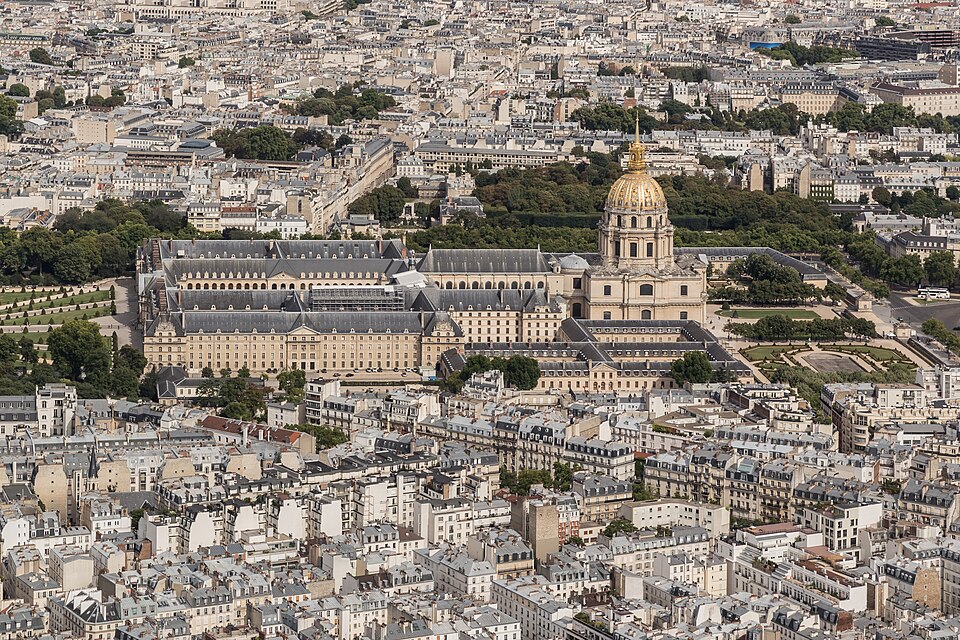
Les Invalides was built to house disabled soldiers and ended up housing Napoleon. Louis XIV ordered it on 24 November 1670; Libéral Bruant and Jules Hardouin-Mansart designed it, and it was completed in 1706.
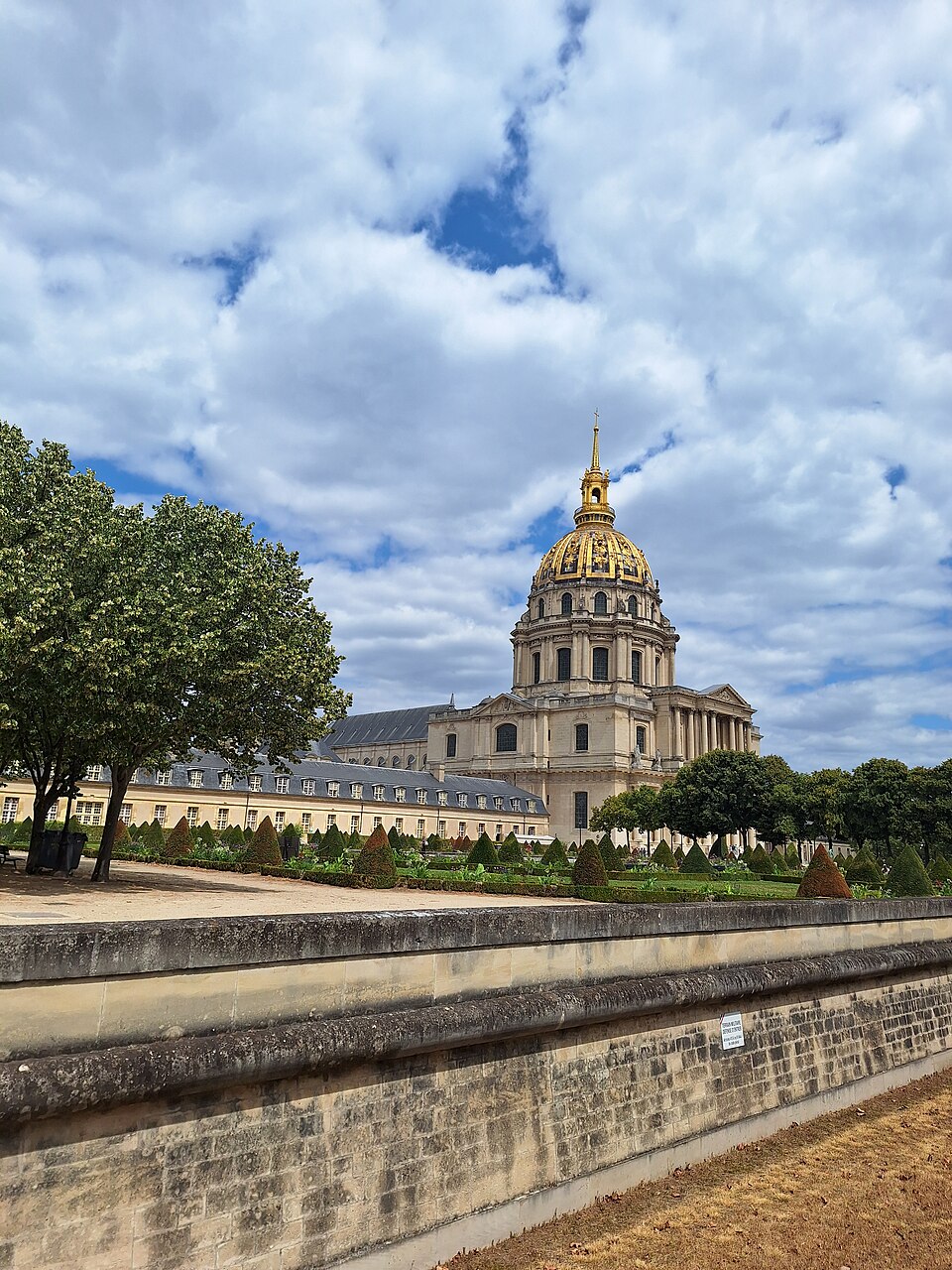
The Dôme des Invalides rises 107 m, which makes it the tallest church building in Paris. Its interior Baroque ceiling paintings were finished in 1705.
Napoleon's remains were brought back to France in 1840 in the ceremony known as the retour des cendres. The red quartzite sarcophagus on its green granite base took twenty years to build and was installed in 1861.
The complex is still partly a veterans' institution as well as a museum.
Checked 2026-08-23 · Source
Three things under one roof: the tomb, the army museum and the relief maps.
The Musée de l'Armée was created in 1905 by merging two earlier institutions, and it holds military equipment from antiquity to the twentieth century — one of the largest collections of arms and armour anywhere.
The Musée des Plans-Reliefs shows about twenty-eight models of fortified French coastal towns, from a collection of roughly 150 built between 1668 and 1870. They are enormous, precise, and almost nobody goes to see them.
The dome chapel holds Marshal Foch, buried in 1937, Turenne, moved here in 1800, and Vauban, in 1807–08, as well as Napoleon.
Checked 2026-08-23 · Source
Three hours if you take the army museum seriously; ninety minutes for the dome alone.
The Musée de l'Armée is genuinely large and covers antiquity to the twentieth century. The medieval arms and armour halls and the two world wars sections are effectively separate museums.
The dome and Napoleon's tomb take thirty minutes.
The relief maps take another thirty and are up several flights with no crowd at the top.
The Rodin Museum is next door and its garden is one of the better hours in Paris, so the two are often combined; that is a full day rather than a morning, and the army museum is the part that gets cut short when people try.
Checked 2026-08-23 · Source
Late morning, and the dome last rather than first.
Most visitors go straight to the tomb, so the dome is busiest early and the army museum is busiest at midday. Reversing that works.
The esplanade in front is one of the largest open lawns in central Paris and is a good place to sit in spring and autumn.
The dome interior is unheated stone and cold in winter, and the courtyards between the museum buildings are open to the wind.
Bastille Day, 14 July, is not a normal visiting day here: the military parade and its ceremonies involve the site directly and access changes.
Checked 2026-08-23
One ticket covers the Musée de l'Armée, the dome with Napoleon's tomb, and the Musée des Plans-Reliefs. The figure shown on this page is the one currently published.
It is covered by the Paris Museum Pass.
The esplanade and the cour d'honneur are free to walk into; the ticket is for the museums and the dome.
Checked 2026-08-23 · Source
The 7th arrondissement, on the Left Bank, with its esplanade running down to the Pont Alexandre III.
Invalides station serves Métro lines 8 and 13 and RER C. La Tour-Maubourg on line 8 and Varenne on line 13 are both a short walk and both quieter; Varenne comes out beside the Rodin Museum, which is next door.
The Métro runs 16 lines across 321 stations, with stations 548 m apart on average — a two-stop journey is usually faster walked.
Checked 2026-08-23 · Source
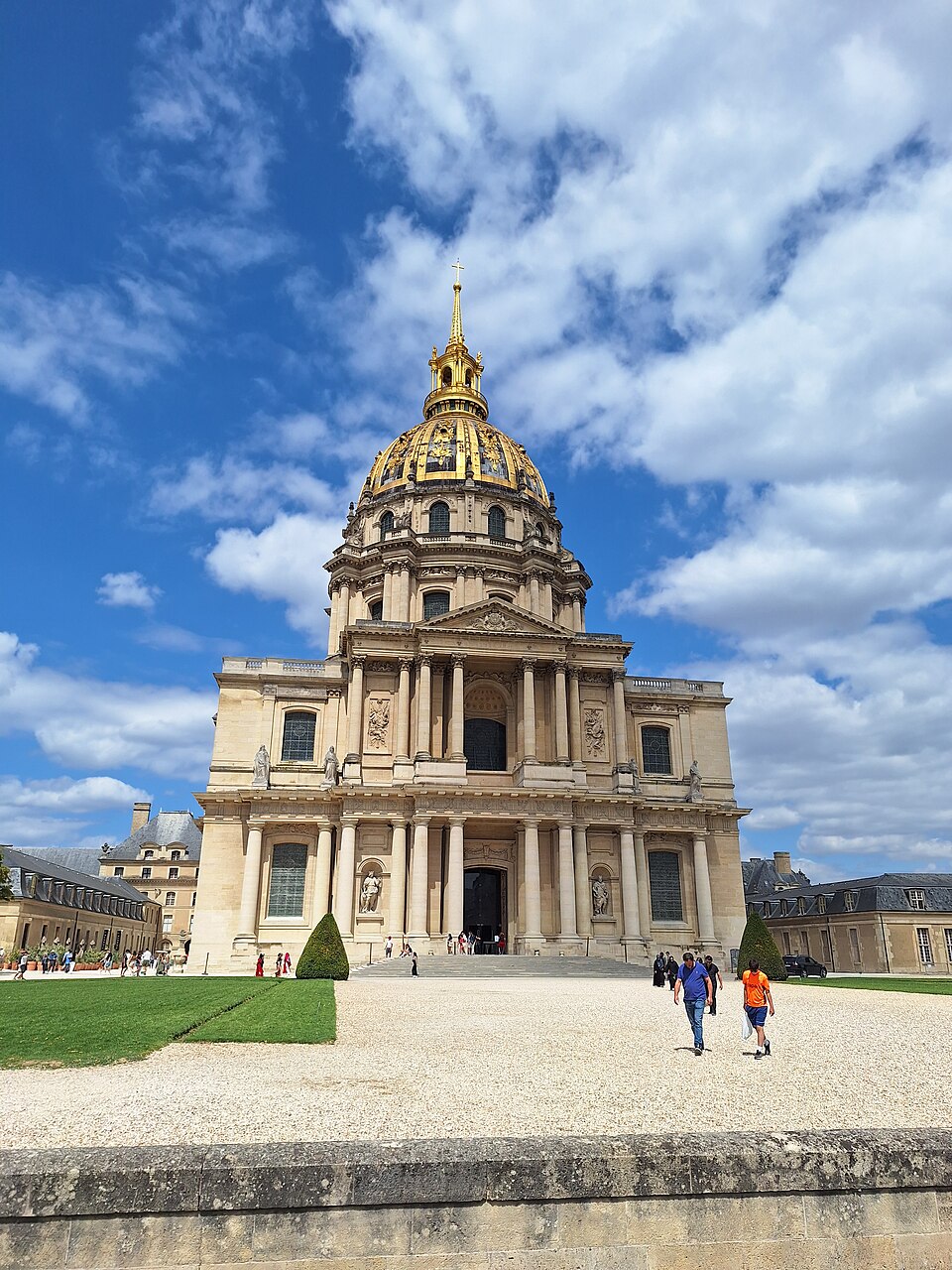
The complex is large and the dome is a separate entrance from the museum; the ticket covers both, but walking between them is several minutes across courtyards.
Napoleon's tomb is viewed from a gallery above, looking down into the crypt, before you go down to it. People photograph from the gallery and leave without going down.
Part of the site remains a veterans' institution and is not open.
The dome chapel is a burial place and quiet is expected.
Security screening applies at the entrances and large bags are not admitted.
Photography is permitted without flash.
Checked 2026-08-23 · Source
The gilded dome from the Pont Alexandre III, with the bridge's lamps in the foreground, is the photograph of Les Invalides that is worth making, and it takes late afternoon sun.
The esplanade gives the whole 107 m elevation, but flattens it; the dome reads better from an angle than head-on.
Inside the dome, the sarcophagus photographs badly from the upper gallery and well from the crypt floor, where the twelve figures around it give scale.
The armour halls are dim and behind glass; the relief maps are the most photogenic objects in the building and the least photographed.
Checked 2026-08-23
Yes. His remains were returned to France in 1840 and the red quartzite sarcophagus, on a green granite base, was installed in 1861 after twenty years of work.
The Musée de l'Armée, created in 1905, covering antiquity to the twentieth century, and the Musée des Plans-Reliefs with about twenty-eight models of fortified towns.
107 m, which makes it the tallest church building in Paris. It was completed in 1706 and its ceiling paintings in 1705.
Marshal Foch, buried in 1937, Turenne, moved here in 1800, and Vauban, in 1807–08.
Louis XIV ordered it on 24 November 1670 as housing for disabled soldiers, and part of the site remains a veterans' institution today.
Three hours if the army museum interests you, ninety minutes for the dome and tomb alone. One ticket covers everything.
Loading the interactive map…
The interactive map could not be loaded.
Last updated:
Source: OpenStreetMap contributors, Wikidata ·