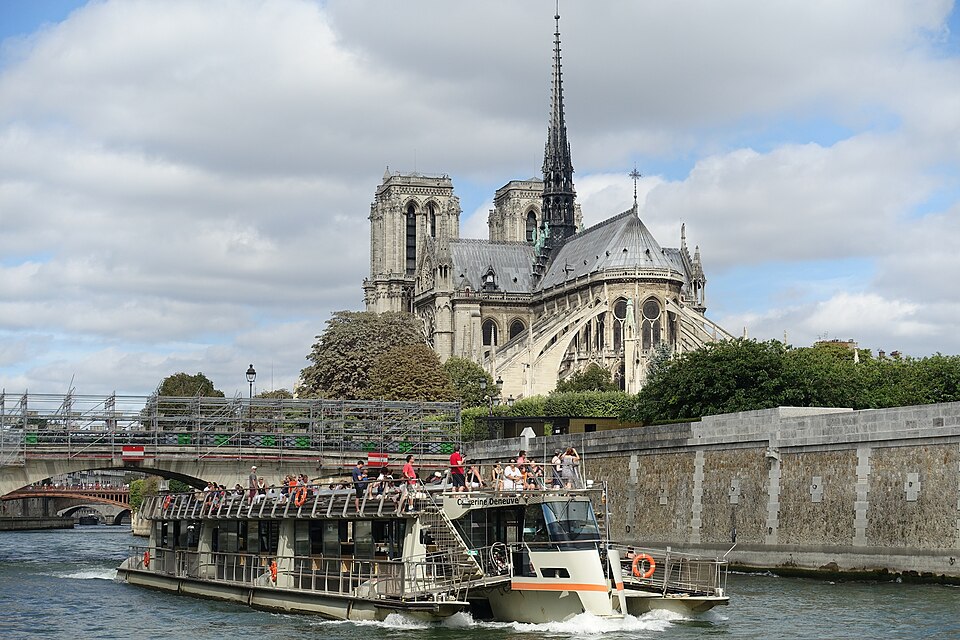
An hour on the Seine is the one piece of organised sightseeing in Paris that earns its place in a self-planned trip.
The boats leave from Port de la Bourdonnais, at the foot of the Eiffel Tower, and follow the river through the historic centre and back. The operator's own description of the route is the honest one: it begins under the tower and goes bridge by bridge past Les Invalides, the Musée d'Orsay, the Louvre, Notre-Dame and the Conciergerie, with a smartphone audio guide filling in what you are looking at.
What makes it worth the hour is not novelty. It is that Paris was arranged to be seen from the water. The stretch the boats cover — the banks between the Pont de Sully and the Pont d'Iéna, with the Île de la Cité and the Île Saint-Louis — is inscribed on the UNESCO World Heritage list in its own right, as an example of a city built along a river rather than merely beside one. The façades face the quays. The bridges were designed to be looked at from below as well as walked across.
An hour on the river also does something practical: it lays out the centre of Paris in one continuous line, so the walking you do afterwards has a shape.
The route runs downstream from the tower into the old city and back, and the order of what passes is the order the city grew in.
Out of the Port de la Bourdonnais the boat passes the Pont de l'Alma and the Pont des Invalides with the gilt of the Invalides dome above the trees, then the Pont Alexandre III — the most decorated bridge in the city, put up for the 1900 exposition — with the Grand Palais and the Petit Palais on the right bank behind it.
Past the Musée d'Orsay, a railway station until 1986, and the long façades of the Louvre on the opposite bank, the river narrows into the islands. The Conciergerie's towers, the spire of the Sainte-Chapelle behind them, and the flank of Notre-Dame come one after another on the Île de la Cité, and then the Île Saint-Louis, which is a seventeenth-century speculative development still recognisable as one.
The boat turns and comes back, which means the second half is the other bank of everything — a genuinely different set of buildings rather than a repeat.
Commentary reaches you through a smartphone audio guide rather than a loudspeaker, so the deck is quieter than the reputation of river cruises suggests.
The sightseeing cruise is one hour, and that is the whole commitment.
Add half an hour before it: the pontoon is a short walk from the tower's north pillar, boarding starts before the departure, and the seats on the open upper deck are taken first by the people who arrive first.
Budget two hours in total if you are coming from anywhere in central Paris, and treat the tower itself as a separate visit rather than something you can slot in around the sailing.
The dining cruises from the same pontoon run one to two hours and are a different kind of evening — a meal with a view rather than a tour with a table.
Late afternoon into dusk is the best hour on the river, and it is not close. The stone goes warm, the bridges throw long shadows, and if the sailing runs into the blue hour the buildings light while you are still on the water.
The last hour of daylight in summer is around ten in the evening and around five in December, which changes what "an evening cruise" means by five hours depending on the month.
Midday sailings are the busiest and the flattest photographically. Early morning is quiet and cold on the water even in summer — the river makes its own weather.
Winter has one specific advantage: the boats are heated and glazed, and an hour on the Seine in January is more comfortable than an hour on the Champ de Mars.
After heavy rain the Seine runs fast and high, and sailings are sometimes cancelled outright when the water reaches the bridge arches. That is a real risk in a wet winter, not a formality.
Several operators run the same stretch of river from different pontoons, and each sets its own fare and its own timetable; the fare for a particular sailing is on the operator's own booking page, which is where to read it before choosing. Bateaux Parisiens is the operator at the Eiffel Tower pontoon this page describes.
Booking ahead buys a place on a named sailing rather than a discount, which matters on summer evenings and matters not at all on a wet Tuesday in February.
The Paris Museum Pass does not cover river cruises, and no city pass makes the boats free — where one includes a cruise, it has bought a ticket from an operator like anyone else.
The dining cruises are priced as restaurant meals rather than as transport, and they board earlier than they sail.
The pontoon is on the right bank at Port de la Bourdonnais, below the road, a few minutes' walk from the Eiffel Tower's north pillar. The steps down to the quay are signposted from the Pont d'Iéna.
Metro 6 to Bir-Hakeim or Trocadéro, or RER C to Champ de Mars–Tour Eiffel, put you within ten minutes on foot. Coming over the Pont d'Iéna from Trocadéro gives the best first sight of the tower and costs nothing.
The quay is below street level and reached by stairs; step-free routes exist but are not obvious, and asking at the ticket office beats guessing at the top of a flight of steps.
Do not drive. The streets around the tower are congested at every hour a cruise sails, and parking is worse than the walk.
The upper deck is open, and the river is several degrees colder than the street with a wind of its own. What is comfortable on the Champ de Mars is not comfortable on the water an hour later.
Seats on the open deck go to whoever boards first, which is the single thing that decides whether the hour is a view or a queue for a view.
The area around the pontoon and the tower is the most heavily worked pickpocketing ground in Paris. The petition-signing and friendship-bracelet approaches both start with someone speaking to you.
Tickets sold on the street near the tower are not always for the boat the seller describes. Buy from the operator's own desk or website.
And check the river before travelling in a wet spell. High water stops the boats, and it stops them at short notice.
A boat is a moving platform in low light, which is the whole photographic problem. Raise the shutter speed before you worry about anything else — 1/250 minimum, faster at dusk with the ISO up to meet it.
The bridges are the pictures. Shoot them as the boat comes under, looking up along the arch, rather than head-on from a distance.
The Pont Alexandre III at dusk, the Conciergerie's towers with the water in front of them, and Notre-Dame's flank from the south bank of the river are the three frames people come back with.
From the water the Eiffel Tower is best at the start and end of the sailing rather than in the middle, where the angle flattens it.
On the open deck, stand at the stern for clean sightlines behind the boat and at the bow for everything ahead — the middle of the deck is where you photograph other passengers' heads.
Checked 2026-08-25
Common questions
Where does the cruise leave from?
Port de la Bourdonnais, on the right bank at the foot of the Eiffel Tower, reached by steps down from the Pont d'Iéna. Metro 6 to Bir-Hakeim or Trocadéro and RER C to Champ de Mars–Tour Eiffel are all within ten minutes on foot.
How long is the sightseeing cruise?
One hour. The operator runs it as a round trip from the tower through the historic centre and back, with commentary through a smartphone audio guide rather than a loudspeaker.
What will I actually see?
Les Invalides, the Musée d'Orsay, the Louvre, Notre-Dame and the Conciergerie, along the stretch of river inscribed by UNESCO between the Pont de Sully and the Pont d'Iéna, including the Île de la Cité and the Île Saint-Louis.
What does it cost?
Each operator sets its own fare and timetable for the same stretch of river, so the figure for a particular sailing is on that operator's booking page. Booking ahead secures a place on a named departure rather than a lower price.
Is it worth doing if I am short of time?
Yes, more than most organised sightseeing in Paris. An hour on the water lays out the centre of the city in one continuous line and makes the walking that follows make sense, which a single monument visit does not.
Can the cruise be cancelled?
Yes. After heavy rain the Seine runs high and fast, and sailings stop when the water reaches the bridge arches — a real possibility in a wet winter, and one that can be decided at short notice.
Nothing non-essential is set before you choose, in regions where consent is required. If you decline, ads still appear but they are non-personalised, and analytics is switched off entirely.