


.jpg)
2 min walk · Paris 7e Arrondissement
square Santiago-du-Chili
- High
- Nature site
Language · 1 published
Museum · Paris 7e Arrondissement, Paris
| Monday | 10:00 – 18:00 |
|---|---|
| Tuesday | 10:00 – 18:00 |
| Wednesday | 10:00 – 18:00 |
| Thursday | 10:00 – 18:00 |
| Friday | 10:00 – 18:00 |
| Saturday | 10:00 – 18:00 |
| Sunday | 10:00 – 18:00 |
Checked 2026-08-24 · Source
Read from the OpenStreetMap access tags; anything not listed has no tag recorded.
Set the group type to family in the planner and the day window contracts to about three quarters of a solo day.
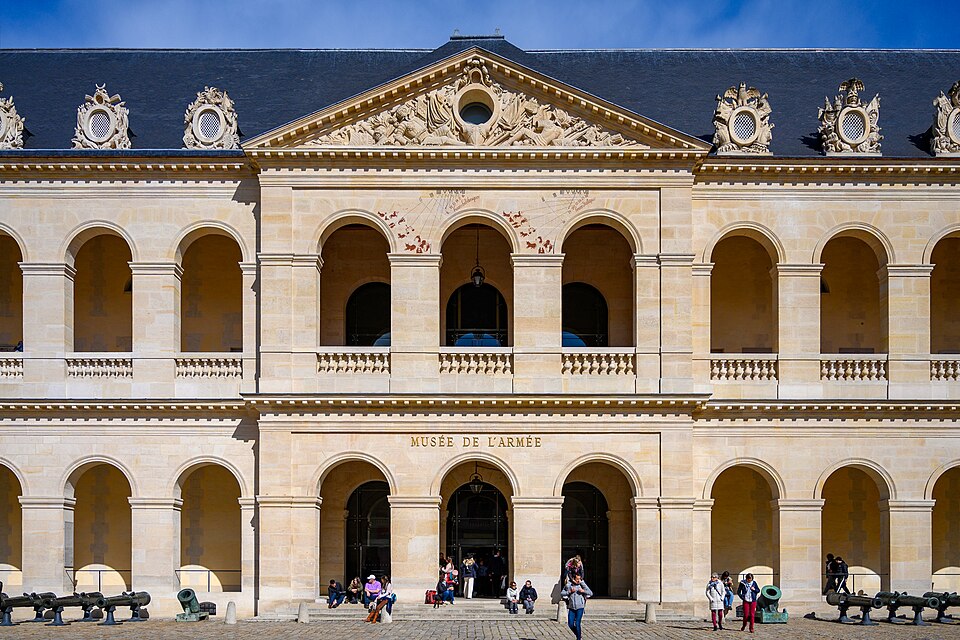
The Musee de l'Armee is France's national army museum, occupying wings of the Hotel des Invalides in the 7th arrondissement, the complex Louis XIV built in the 1670s as a hospital and retirement home for wounded soldiers.
The museum in its current form dates from 1905, when the older Musee d'artillerie and Musee historique de l'armee were merged. Its collection spans from antiquity to the Second World War, and the same Invalides complex holds Napoleon's tomb under the golden dome, a separate ticketed element that most visitors see in the same visit.
Checked 2026-08-24 · Source
The arms and armour collection is one of the largest in the world, with suits of armour, edged weapons and firearms arranged chronologically from the medieval period through the Renaissance.
A modern-history wing covers the two World Wars in depth, including uniforms, weapons and personal objects, and a separate section covers the era of Louis XIV through the French Revolution and Napoleon. The Dome des Invalides, reached from the same courtyard, holds Napoleon's tomb -- a sequence of six coffins nested inside a red quartzite sarcophagus -- along with the tombs of other French military leaders.
The Invalides complex itself, with its long facade and formal esplanade running down toward the Seine, was built from the 1670s under Louis XIV as a home and hospital for army veterans, a function the site partly kept for wounded soldiers into the twentieth century even as its museum role expanded.
Checked 2026-08-24 · Source
Two to three hours covers the main collection at a normal pace; a visitor also seeing Napoleon's tomb under the dome should allow closer to three to four hours for the full site.
The museum is large enough that most visitors choose a period to focus on -- the world wars galleries or the arms and armour collection tend to draw the longest stays -- rather than attempting to read every case in one visit.
The distance between wings, arranged around the Invalides courtyard rather than on one continuous route, means a full visit involves real walking, not just time spent reading labels.
Checked 2026-08-24 · Source
Weekday mornings, particularly outside French school holidays, are the calmest time; the site draws heavy weekend and holiday crowds given its position as one of the most visited museums in Paris.
The museum closes on the first Monday of every month from November to March; the operator's own site carries the exact current closure calendar.
Checked 2026-08-24 · Source
A single ticket covers the Musee de l'Armee, Napoleon's tomb under the dome, the Musee des Plans-reliefs and the Musee d'histoire contemporaine, all within the same Invalides complex; under-18s and under-26 EU residents generally enter free, matching French national museum policy.
The museum is included in the Paris Museum Pass. Its own site carries the current adult rate, which should be checked before a visit.
Checked 2026-08-24 · Source

Metro La Tour-Maubourg and Varenne, both on Line 8, and Invalides, on Lines 8 and 13, sit within a short walk of the complex's entrances.
The RER C also stops at Invalides, on the Seine side of the complex, making this one of the better-connected large museums in Paris.
The main entrance for ticketed visitors is on the south side of the complex, at Place Vauban, rather than through the formal north-facing courtyard most often photographed from the Esplanade des Invalides.
Checked 2026-08-24 · Source
The complex is large and its wings are not laid out for a quick loop, so a visitor short on time should decide in advance which galleries matter most rather than trying to see all of them.
Security screening and bag checks at the entrance are standard for a site of this scale and add a few minutes at busy times; some special weapons displays are behind reinforced glass with restricted photography, marked case by case.
Large tour groups often converge on the dome and Napoleon's tomb first, leaving the arms and armour and world wars wings noticeably calmer for a visitor who starts there instead.
Checked 2026-08-24 · Source

The Dome des Invalides itself, gilded and visible across much of the Left Bank, is the site's most photographed exterior feature, best shot from the gardens on the Esplanade des Invalides side.
Inside, Napoleon's sarcophagus under the dome's oculus is the interior's central image; the long galleries of arms and armour photograph well down their full length, though flash is restricted throughout to protect the objects.
Checked 2026-08-24 · Source
Yes, a single ticket for the Invalides complex covers the Musee de l'Armee, the Dome des Invalides with Napoleon's tomb, and the Musee des Plans-reliefs.
In its present form in 1905, merging the older Musee d'artillerie and Musee historique de l'armee, though the Invalides building itself dates from the 1670s.
Yes, the museum is included in the Paris Museum Pass.
Two to three hours for the main collection alone, closer to three to four hours when also visiting Napoleon's tomb under the dome.
The first Monday of the month from November to March; the museum's own site holds the exact current calendar.
Under-18s and under-26 EU residents generally enter free, in line with French national museum policy; the museum's site carries the current age rule.
Loading the interactive map…
The interactive map could not be loaded.
Last updated:
Source: OpenStreetMap contributors, Wikidata ·