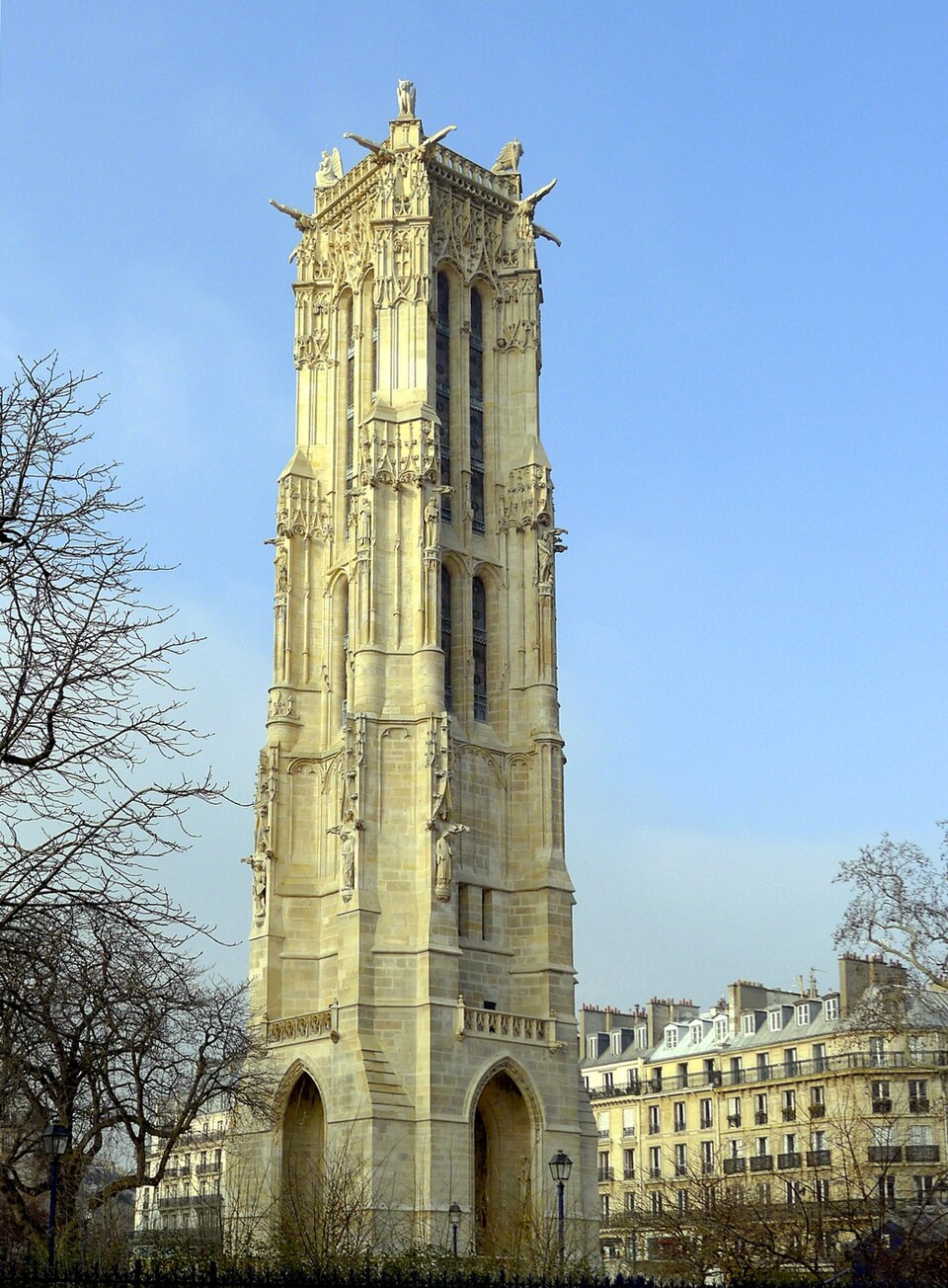
The Tour Saint-Jacques is the last surviving fragment of the church of Saint-Jacques-de-la-Boucherie, a late-Gothic parish church built between 1509 and 1523 for the guild of Paris butchers, whose market gave the church its name.
The Revolution's authorities sold the church as national property and it was demolished for its stone in 1797; the bell tower alone was spared and passed into city ownership. Standing 52 metres tall in the Flamboyant Gothic style, it is a rare freestanding Gothic tower with no church left attached to it.
A statue of the scientist Blaise Pascal sits at its base, commemorating the barometric-pressure experiments he ran from the tower's summit in 1648 to measure atmospheric pressure at height, one of the founding experiments of modern meteorology.
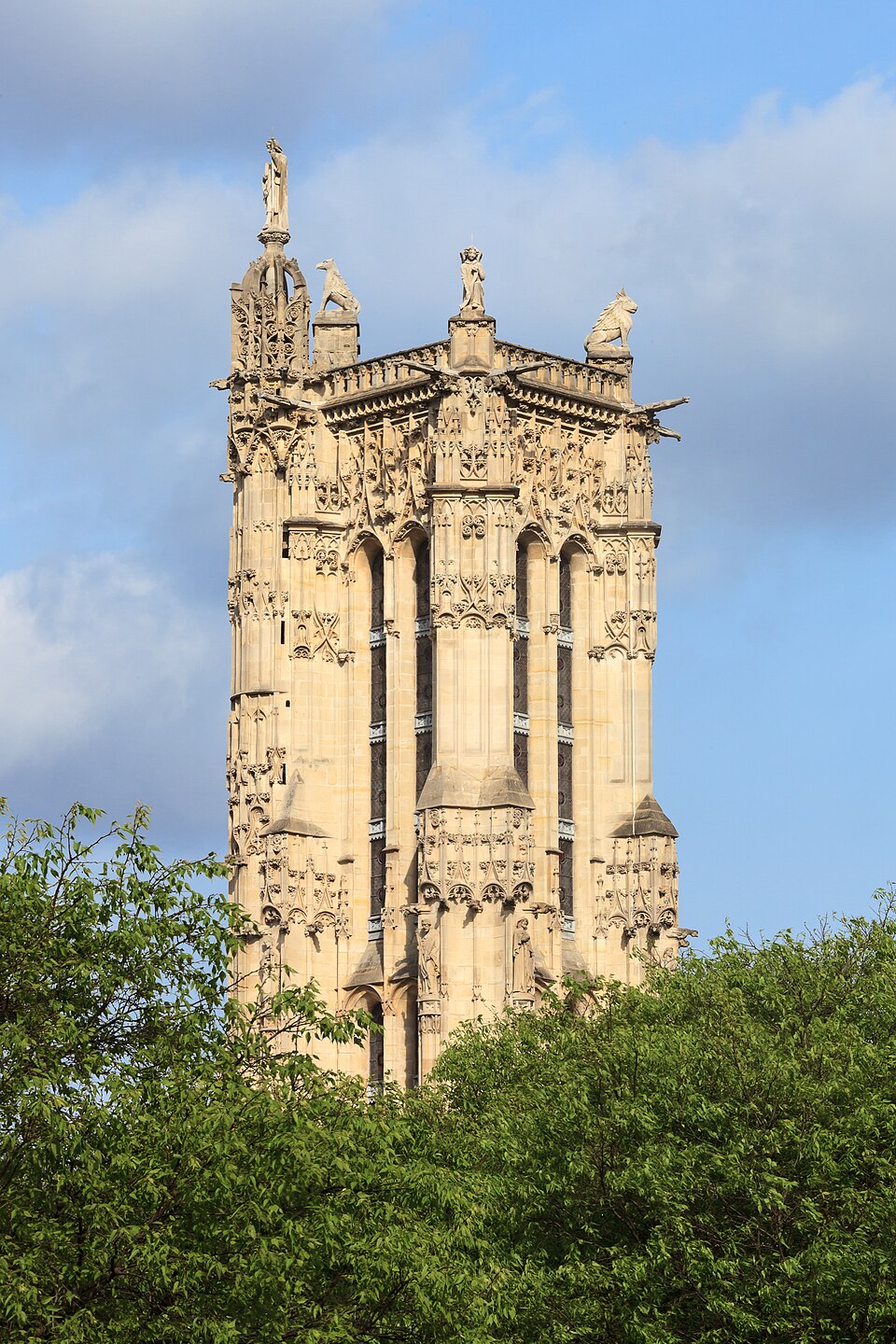
The tower carries a statue of Saint James the Great, the church's namesake and the patron of the pilgrimage route to Santiago de Compostela, at its summit, along with the four evangelist symbols — an eagle, a lion, a bull and an angel — at the corners below.
A meteorological station was installed at the top in the 19th century, part of a network recording weather data across Paris, reflecting the same interest in atmospheric measurement that brought Pascal here two centuries earlier.
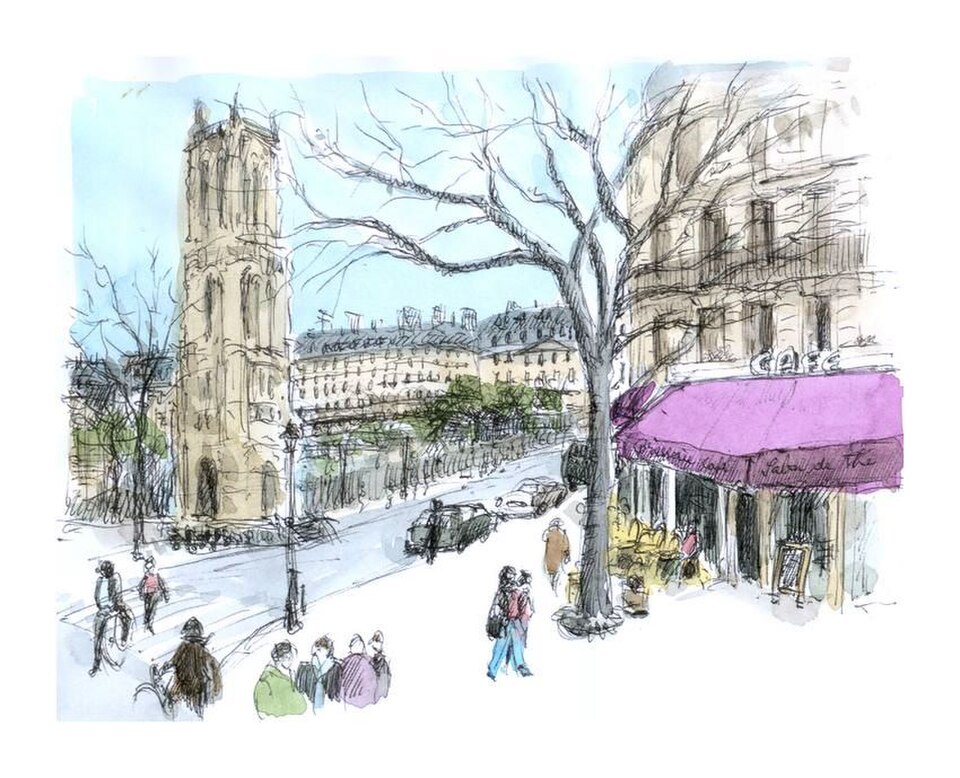
The surrounding square, Square de la Tour Saint-Jacques, was landscaped around the isolated tower in the 19th century after the rest of the church and its cemetery were cleared, and today gives the tower a green setting in the middle of a dense commercial quarter near Chatelet.
A modern statue at the square's edge marks the tower's role as a traditional starting point for pilgrims on the Via Turonensis, one of the historic French routes toward Santiago de Compostela, which is part of why the church was dedicated to Saint James in the first place.
Ten minutes to see the tower and square from ground level; considerably longer — around an hour and a half — for a guided ascent to the summit, when one is running, since visits climb the spiral staircase in small timed groups.
The tower cannot be entered independently at any time; every interior visit runs as a guided group tour, which is also why ascent capacity is limited and books up on busy days.
For the exterior and square, any time of day; the tower is lit at night, which is when its Flamboyant Gothic stonework reads most dramatically against the dark.
Interior ascents to the summit have run seasonally, historically in the warmer months of the year, rather than year-round. Current-season dates and days are not recorded here — check the Centre des monuments nationaux, which manages the tower, before planning around an ascent.
The square and the exterior view are free and open at all times, with no ticket needed to see the tower from the street.
Guided ascents to the summit, when running, are paid and booked in advance through the Centre des monuments nationaux, the state body that manages the tower; current prices, exact seasonal dates and the booking route are not reproduced here, since the schedule changes from year to year — check the operator's own listing before planning a visit around going up.
On rue de Rivoli in the 4th arrondissement, at the edge of Chatelet, close to the Seine and the Hotel de Ville.
Metro lines 1, 4, 7, 11 and 14 and RER A, B and D all converge at Chatelet, a two-minute walk from the tower, making it one of the best-connected sights in central Paris.
The tower cannot be entered without a guided ascent booked through the Centre des monuments nationaux; there is no walk-in or self-guided visit, and turning up hoping to climb it without a booking will not work when ascents are running.
The staircase to the summit is narrow and spiral, typical of a 16th-century bell tower, and is unsuitable for anyone with mobility difficulties or significant fear of heights or enclosed spaces.
The tower stands alone in its square with nothing else close enough to crowd the frame, which makes it one of the easier isolated Gothic subjects in central Paris to photograph cleanly from ground level.
It is illuminated after dark, and the lit stonework against the night sky, shot from across rue de Rivoli, is a stronger image than the same view in flat daylight.
Checked 2026-08-24
Common questions
What was the Tour Saint-Jacques originally part of?
The church of Saint-Jacques-de-la-Boucherie, built 1509 to 1523 for the Paris butchers' guild and demolished in 1797, leaving only the tower.
Why is there a statue of Blaise Pascal at the base?
Pascal ran barometric-pressure experiments from the tower's summit in 1648, an early contribution to the study of atmospheric pressure.
Can I go inside the tower any time?
No — the interior is only open on guided ascents booked in advance through the Centre des monuments nationaux, and only in season when they are running.
How tall is the tower?
52 metres, built in the Flamboyant Gothic style.
Is the square around the tower free to visit?
Yes, the square and the exterior view are free and open at all times.
What is the nearest metro station?
Chatelet, a two-minute walk, served by five metro lines and three RER lines.
Nothing non-essential is set before you choose, in regions where consent is required. If you decline, ads still appear but they are non-personalised, and analytics is switched off entirely.


.jpg)
.jpg)
_-_Flickr_-_Carl_Campbell.jpg)