

4 min walk
Galerie Smečky
- Notable
- Museum
Language · 11 published
Historic monument · Prague
| Monday | 00:00 – 23:59 |
|---|---|
| Tuesday | 00:00 – 23:59 |
| Wednesday | 00:00 – 23:59 |
| Thursday | 00:00 – 23:59 |
| Friday | 00:00 – 23:59 |
| Saturday | 00:00 – 23:59 |
| Sunday | 00:00 – 23:59 |
Checked 2026-08-31 · Source
Read from the OpenStreetMap access tags; anything not listed has no tag recorded.
Set the group type to family in the planner and the day window contracts to about three quarters of a solo day.
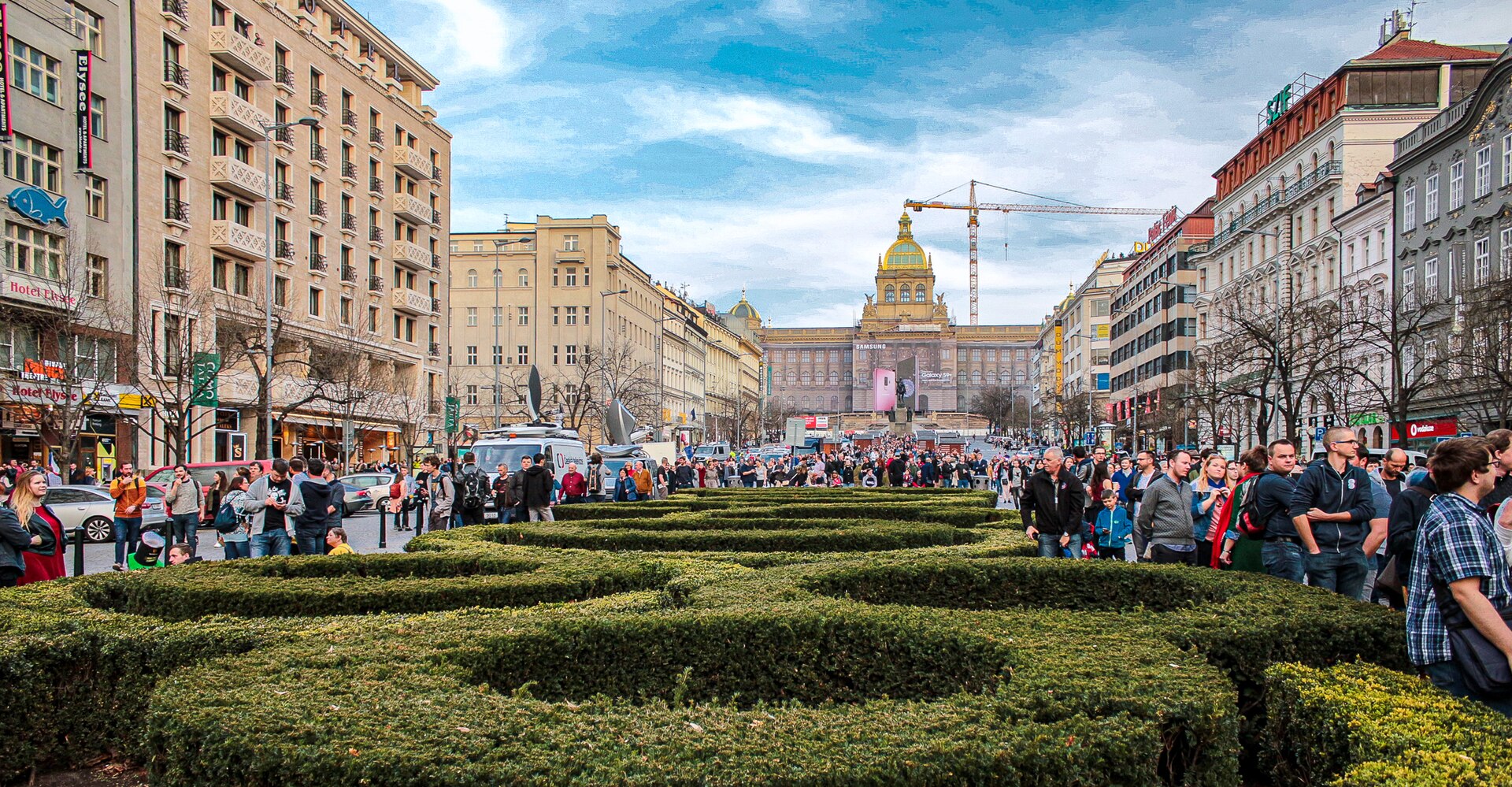
Wenceslas Square is a historic boulevard and public space in Prague's New Town, established in the fourteenth century during the reign of Charles IV. Despite its name, it functions as a long rectangular boulevard rather than a conventional square. It stretches from the National Museum at its upper end to the commercial district near Můstek. The space has served as a traditional gathering point for significant public events, demonstrations, and celebrations throughout Czech history, including pivotal moments in 1968 and 1989. Daily, 24 hours.
Checked 2026-08-31 · Source
The square contains the equestrian statue of Saint Wenceslas by Josef Václav Myslbek at its upper end, a defining landmark of the space. The National Museum building stands prominently at the top. Along the boulevard are numerous commercial establishments, hotels, restaurants, and retail outlets. The lower section connects to pedestrian zones leading toward the Old Town. Various architectural styles from different eras line the space, reflecting its long development history. Wenceslas Square is an outdoor public city square with no scheduled closure days. The upper section remains affected by tram-track and public-space reconstruction planned through June 2027, but the square itself remains accessible.
Checked 2026-08-31 · Source
A complete walk from the National Museum end to Můstek takes approximately fifteen to twenty minutes at a moderate pace without stopping. Visitors typically spend between thirty minutes and two hours depending on whether they are passing through, pausing at the statue, browsing commercial establishments, or combining the visit with nearby attractions. The National Museum requires separate time if entered. The space rewards multiple traversals at different times of day to observe varying levels of activity and atmosphere across its length. Free; no ticket is required to enter the public square. Admission charges apply only to separately operated attractions and events around it.
Checked 2026-08-31 · Source
The public boulevard itself is accessible at all hours as an open urban space. Individual businesses, the National Museum, and any seasonal events operate on their own schedules. Visitors should verify current conditions before travel. The atmosphere varies considerably between daytime commercial hours and evening periods. Daily, 24 hours. Use Můstek metro station for the lower end of the square; it serves Lines A and B and its step-free street lifts open directly in the lower square. Muzeum station serves the upper end and connects Lines A and C. The named Václavské náměstí tram stop is at the square’s central crossing with Vodičkova and Jindřišská streets.
Checked 2026-08-31 · Source
No admission fee applies to the public boulevard itself. The National Museum and any commercial establishments or events within the square area charge separately. Visitors should verify current pricing for any specific attractions or services they intend to use. Budget considerations should account for optional expenditures at restaurants, shops, and other businesses along the boulevard. Free; no ticket is required to enter the public square. Admission charges apply only to separately operated attractions and events around it. The open-air square can be entered at street level without an admission gate or entrance steps.
Checked 2026-08-31 · Source
The square is served by multiple Prague Metro stations. Můstek station at the lower end provides access to lines A and B. Muzeum station at the upper end serves lines A and C. Numerous tram lines operate along surrounding streets. Use Můstek metro station for the lower end of the square; it serves Lines A and B and its step-free street lifts open directly in the lower square. Muzeum station serves the upper end and connects Lines A and C. The named Václavské náměstí tram stop is at the square’s central crossing with Vodičkova and Jindřišská streets.
Checked 2026-08-31 · Source
The high volume of pedestrian and vehicular traffic in portions of the boulevard requires awareness. The space attracts pickpockets and scam operators targeting visitors in busy areas, particularly near commercial concentrations. Visitors should secure valuables and remain alert in crowds. The length of the boulevard offers limited shelter from weather extremes. Some areas have heavy automobile traffic alongside pedestrian zones. The open-air square can be entered at street level without an admission gate or entrance steps. Lifts 425–427 at Můstek were operating on the checked date. Construction in the upper part of the square creates temporary barriers and altered pedestrian routes.
Checked 2026-08-31 · Source
The National Museum facade and Saint Wenceslas statue are frequently photographed landmarks. The long perspective of the boulevard offers compositional possibilities, though traffic and crowds may obstruct views. Early morning hours typically provide clearer sightlines before commercial activity intensifies. Evening illumination alters the character of architectural subjects. Tripod use may attract attention in busy areas and should respect pedestrian flow. The museum interior has separate photography policies if visited. Construction in the upper part of the square creates temporary barriers and altered pedestrian routes. An accessible public toilet is available nearby in the Prague 1 office passage at Vodičkova 681/18 during office opening hours.
Checked 2026-08-31 · Source
The square is 750 metres long, 63 metres wide at the upper end and 48 metres wide at the lower end.
Charles IV established the square with Prague’s New Town in 1348.
It was originally the Horse Market, reflecting its intended role in horse and agricultural trading.
The upper end is dominated by the National Museum, built in 1885–1891, and Josef Václav Myslbek’s St Wenceslas monument, installed from 1912.
A horse-drawn tram crossed the square in 1884; regular tram operation along the square ended in December 1980.
The Na Můstku underpass has seven exits and connects pedestrians with Můstek metro station on Lines A and B; the connection opened in August 1978.
Loading the interactive map…
The interactive map could not be loaded.
Last updated:
Source: OpenStreetMap contributors ·