
1 min walk
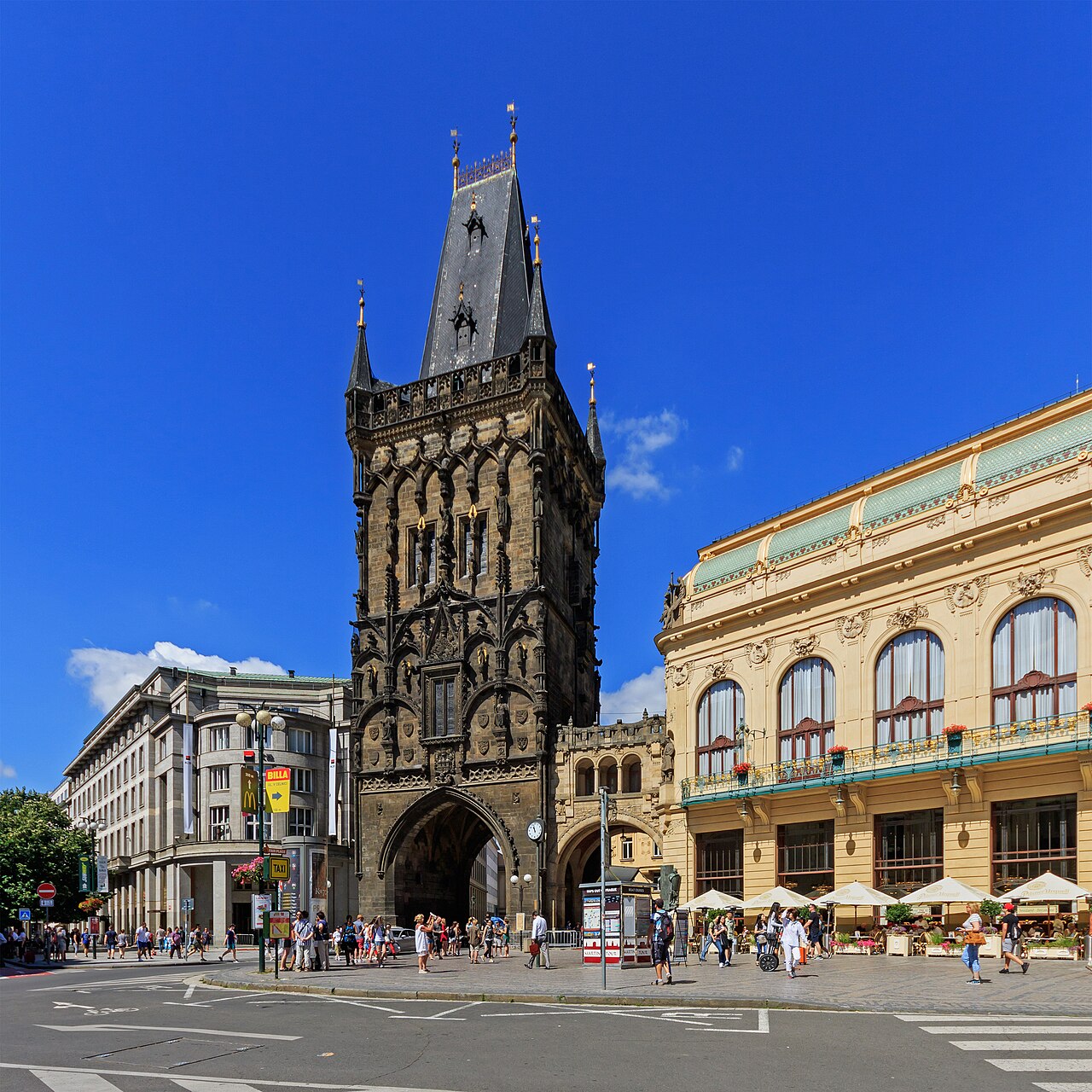
Powder Gate Tower
- Must see · Heritage site
- Viewpoint
Language · 11 published
Art and culture venue · Prague

Municipal House, known locally as Obecní dům, is a landmark Art Nouveau cultural venue in Prague's Old Town. It stands beside the Powder Gate, a medieval city gate, though the two structures are independent of each other. The building functions as a concert hall, exhibition space, and civic building. Constructed in the early twentieth century on the site of the former Royal Court palace, it represents a major statement of Czech national identity and artistic achievement during the Art Nouveau period.
Checked 2026-08-26
The interior contains the Smetana Hall, a principal concert venue named after the Czech composer Bedřich Smetana. Additional spaces include other halls, meeting rooms, and areas for exhibitions. The building features extensive decorative art, including murals, stained glass, and sculptural work by leading Czech artists of the period. There are also cafes and restaurants operating within the building. The architectural and decorative program was designed as a total work of art, integrating structure, applied arts, and fine arts into a unified expression.
Checked 2026-08-26
A self-guided visit to the publicly accessible areas requires approximately one to two hours, depending on individual pace and interest in architectural detail. Concert attendance or exhibition viewing will extend the duration accordingly. Visitors interested in thorough examination of the decorative program, including ceiling paintings and ornamental details, should allocate additional time. The building's scale and density of artistic content reward unhurried exploration. Those combining a visit with nearby attractions such as the Powder Gate or Celetná Street may wish to plan a half-day in this section of the Old Town.
Checked 2026-08-26
Operator-confirmed opening hours are Not recorded pending review. The building hosts concerts and events according to its own programming schedule, which varies throughout the year. Visitors should consult the official website for current exhibition and event listings. The interior public spaces may have restricted access when private functions or performances are scheduled. Seasonal variations in Prague's tourist traffic affect crowding levels in the surrounding Old Town area. Morning visits may offer quieter conditions for appreciating the architectural details without the pressure of peak visitor periods.
Checked 2026-08-26
Operator-confirmed prices are Not recorded pending review. Admission policies differ between the building's various functions. Exhibition spaces typically require paid entry, while some ground-floor areas including certain cafes may be accessible without charge. Concert tickets are sold separately through the venue's box office or website. Guided tours, when available, constitute a distinct ticketing category. Visitors should verify current pricing and availability directly through official channels before planning their visit, as structures and rates may change without external notification. Municipal House also earns time in a prague itinerary because Municipal House is an independently toured and programmed Art Nouveau cultural venue beside, but not part of, Powder Gate. Its value becomes clearer when the stop is compared with the surrounding streets and the other ranked places nearby.
Checked 2026-08-26
Municipal House occupies a prominent position on Náměstí Republiky in Prague's city center. The location is served by metro line B at Náměstí Republiky station. Multiple tram lines also stop at this square. The site lies within walking distance of the Old Town Square and Wenceslas Square for those already exploring central Prague on foot. Its position beside the Powder Gate makes it readily identifiable. The dense pedestrian network of the Old Town means that approaching on foot from any central accommodation is generally practical and offers additional architectural interest along the route.
Checked 2026-08-26
Visitors should distinguish Municipal House from the adjacent Powder Gate, which is a separate structure with its own access and history. The building's operational status changes according to event schedules, potentially limiting public access to certain areas. Photography policies may be restricted in specific halls or during performances. The ground-floor spaces can become crowded when events are assembling or dispersing. Visitors should respect signage indicating private or restricted areas, as the building maintains active civic and ceremonial functions alongside its public cultural role. The polished surfaces and ornate details require attentive foot traffic.
Checked 2026-08-26
Photography policies within Municipal House are not uniformly applied across all spaces. The official website or on-site signage should be consulted for current restrictions. Ornate interiors including the Smetana Hall present significant photographic interest, though tripod use and flash photography are typically restricted in historic venues of this type. Natural lighting conditions vary considerably between spaces. The exterior facade, with its ceramic and sculptural detailing, offers unrestricted photography opportunities from the public square. Visitors intending to photograph extensively should verify permissions in advance, particularly for commercial or professional purposes.
Checked 2026-08-26
No. Municipal House stands beside Powder Gate but is a separate, independent structure. They are adjacent but not connected as a single site.
Yes. The building offers exhibitions and some publicly accessible areas independent of its concert programming, though access varies according to the event schedule.
Guided tours have been offered at various periods. Current availability should be confirmed through the official website, as services may change.
Accessibility provisions are not recorded pending review. Visitors with specific mobility requirements should contact the venue directly before visiting.
Yes. The building contains cafes and restaurants, though their operating hours and access policies should be verified independently.
The building was constructed on the site of the former Royal Court palace and served as a significant expression of Czech national cultural identity during the early twentieth century.
Loading the interactive map…
The interactive map could not be loaded.


Last updated:
Source: OpenStreetMap contributors ·