Smart Self-Managed Tours

Country guide

Croatia

A photograph of Croatia
Photograph · Diego Delso · CC BY-SA 3.0

Croatia meets the Adriatic in two parts that barely resemble each other: an inland north around Zagreb, the capital and the main cultural and economic centre, and a coast whose archipelago carries over 1,000 islands and islets. The whole country is 56,594 square kilometres, divided into twenty counties across four administrative regions, with a population of nearly 3.9 million as of 2026. Split, Rijeka and Osijek are the other cities of any size — the first two on the water, the last inland in the east. Slovenia, Hungary, Serbia, Bosnia and Herzegovina and Montenegro all border it by land, Italy only by sea.

Cities

Every city catalogued in this country so far, ranked by how much there is to see.

Practical information

Language spoken
Croatian
National practical orientation; regional and minority languages may also be used
Dialling code
+385
International calling code; local area and mobile prefixes still apply
Currency
Euro (EUR)
Use the official local currency; card acceptance varies by place
Emergency number
112
Use only for an emergency; tourist assistance may use a separate number
Plug type
Type C and F · 230 V
Check that chargers support the recorded voltage before using an adapter
Tap water
Safe from treated public supplies
Public drinking water is regulated; follow local notices on islands or after disruption

Planning a visit

  1. January: no seasonality data recorded
  2. February: no seasonality data recorded
  3. March: no seasonality data recorded
  4. April: no seasonality data recorded
  5. May: no seasonality data recorded
  6. June: no seasonality data recorded
  7. July: no seasonality data recorded
  8. August: no seasonality data recorded — this month
  9. September: no seasonality data recorded
  10. October: no seasonality data recorded
  11. November: no seasonality data recorded
  12. December: no seasonality data recorded

Top things to see

Ranked by importance — sitelinks, pageviews and heritage status, not editor preference.

  1. Bačvice Beach Bačvice Beach
    02 1 hour

    Bačvice Beach

    Bačvice

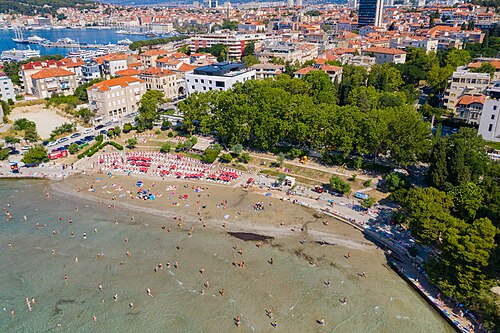
    Bačvice Beach is a sandy beach located on the eastern edge of Split's city centre, within easy walking distance of the historic Diocletian's Palace.

    • Must see
    • Nature site
    • Split
  2. Sustipan Sustipan
    03 1 hour

    Sustipan

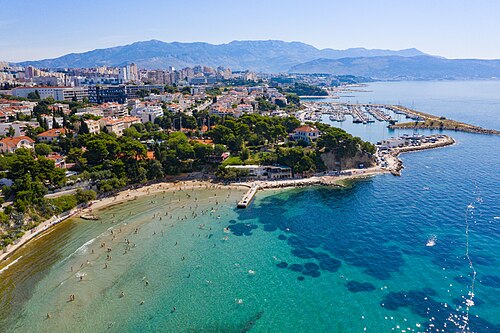
    Sustipan is a coastal park and promontory on the Marjan peninsula, west of Split's historic core. The site occupies elevated ground above the Adriatic, offering views toward the harbour and islands.

    • Must see
    • Nature site
    • Split
  3. Matejuška Matejuška
    04 1 hour

    Matejuška

    Matejuška is a small historic fishing harbour in Split, Croatia, situated on the western edge of the Riva waterfront. This compact working port represents one of the last remnants of traditional maritime life in Croatia's second-largest city.

    • Must see
    • Nature site
    • Split
  4. Kašjuni Beach Kašjuni Beach
    05 1 hour

    Kašjuni Beach

    Kašjuni

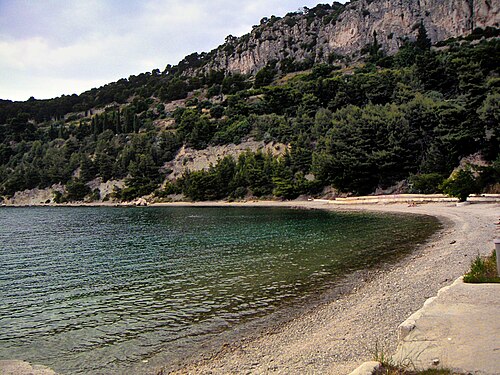
    Kasjuni Beach is a pebble beach on the southern side of Marjan Hill, a forested peninsula west of Split's historic core. Locally known as Plaža Kašjuni, it sits within the protected Marjan Forest Park area.

    • Must see
    • Nature site
    • Split
  5. Plaža Ježinac Plaža Ježinac
    06 1 hour

    Plaža Ježinac

    Jezinac Beach, known locally as Plaža Ježinac, is a coastal bathing area in Split, Croatia. It lies along the Adriatic shoreline within the broader Split urban area.

    • Must see
    • Nature site
    • Split
  6. Firule Beach Firule Beach
    07 1 hour

    Firule Beach

    Firule

    Firule Beach, known locally as Plaža Firule, is a coastal beach area located in Split, Croatia. It sits along the eastern shoreline of the Split peninsula, positioned between the city center and the suburban district of Bacvice.

    • Must see
    • Nature site
    • Split
  7. Solin and Salona Archaeological Park
    08 1 hour

    Solin and Salona Archaeological Park

    Salona

    Solin and Salona Archaeological Park preserves the extensive remains of Salona, an ancient Roman city that served as the capital of Dalmatia. Located near modern Split, this site represents one of the most significant archaeological complexes in Croatia.

    • Must see
    • Nature site
    • Split
  8. Mosor Mountain
    09 1 hour

    Mosor Mountain

    Mosor

    Mosor Mountain rises behind Split as a limestone massif within the Dinaric Alps. The range separates the coastal city from the Zagora hinterland, creating a dramatic backdrop visible from the Riva waterfront.

    • Must see
    • Nature site
    • Split
  9. Solta Island
    10 1 hour

    Solta Island

    Šolta

    Šolta is an island in the Adriatic Sea near Split, Croatia. It lies south of the city in the central Dalmatian archipelago. The island has a long history of agriculture, fishing, and olive cultivation.

    • High
    • Nature site
    • Split
  10. Bačvice
    12 1 hour

    Bačvice

    • Notable
    • Nature site
    • Split
  11. Bene Bene
    14 1 hour

    Bene

    • Notable
    • Nature site
    • Split
  12. Ježinac Ježinac
    16 1 hour

    Ježinac

    • Notable
    • Nature site
    • Split
  13. Mistral
    18 1 hour

    Mistral

    • Notable
    • Nature site
    • Split
  14. Ovčice
    19 1 hour

    Ovčice

    • Notable
    • Nature site
    • Split
  15. Ovčice
    20 1 hour

    Ovčice

    • Notable
    • Nature site
    • Split
  16. Parkić
    23 1 hour

    Parkić

    • Notable
    • Nature site
    • Split
  17. Particela
    29 1 hour

    Particela

    • Notable
    • Nature site
    • Split
  18. Šumica
    33 1 hour

    Šumica

    • Notable
    • Nature site
    • Split
  19. Šumica
    34 1 hour

    Šumica

    • Notable
    • Nature site
    • Split
  20. Sv. Frane
    35 1 hour

    Sv. Frane

    • Notable
    • Nature site
    • Split
  21. Trstenik
    36 1 hour

    Trstenik

    • Notable
    • Nature site
    • Split
  22. Žnjan
    38 1 hour

    Žnjan

    • Notable
    • Nature site
    • Split
  23. Žnjan
    39 1 hour

    Žnjan

    • Notable
    • Nature site
    • Split
  24. Zvončac
    40 1 hour

    Zvončac

    • Notable
    • Nature site
    • Split
  25. Zvončac
    41 1 hour

    Zvončac

    • Notable
    • Nature site
    • Split

Source: OpenStreetMap contributors, Wikidata ·

Common questions

How long should a first trip to Croatia be?

Seven to ten days can pair Zagreb with one Adriatic region or focus on Split, nearby islands and one inland park. Dubrovnik, Istria and central Dalmatia are separate bases; ferry waits make a rapid checklist of coastal towns less efficient than it looks.

What entry documents are needed for Croatia?

Croatia belongs to the Schengen Area, while document and visa requirements still depend on nationality. Consult the Croatian foreign ministry before travel and check the passport used for every border leg, particularly when the route crosses non-Schengen neighbours.

What is the best way to travel around Croatia?

Zagreb, Split and Dubrovnik are common gateways. Coaches and cars are central to coastal travel, trains are more useful inland, and ferries follow seasonal schedules; confirm whether the selected sailing carries vehicles and reserve constrained summer departures.

When is a practical time to visit Croatia?

May, June and September combine warm coastal conditions with less pressure than peak summer for many routes. Island ferries and accommodation are more seasonal outside that window, while inland weather differs, so verify the exact transport dates before building an island sequence.

What money and payment basics apply in Croatia?

Croatia uses the euro. Cards are common in cities and resorts, but cash can still help at markets, small island businesses and local services; check whether a ferry, parking machine or accommodation deposit accepts the chosen payment method.

What practical safety details should I save for Croatia?

Call 112 for emergencies; Croatia uses Type C and F electricity at 230 V. Treated public tap water is recorded as safe, though local notices remain authoritative, and coastal itineraries should keep current ferry, heat and wildfire information available.