
2 min walk · Akhisar
Köfünlü Camii
- Notable
- Place of worship
Language · 1 published
Historic monument · Akhisar, Manisa
Hastane Höyüğü
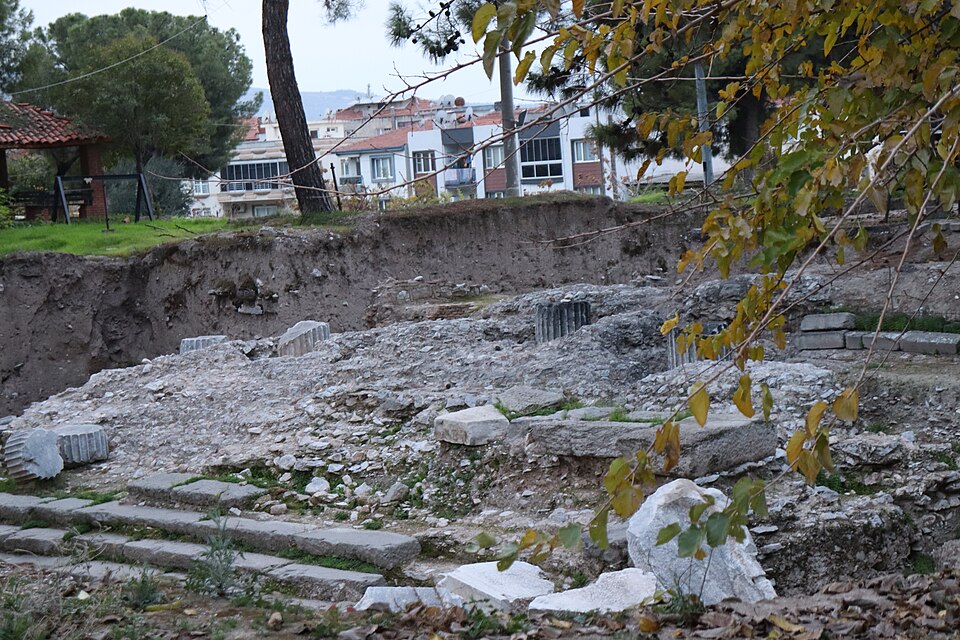
Hastane Höyüğü, the Hospital Mound, is an archaeological tell within the same site area as ancient Thyatira, in Akhisar, Manisa province. It takes its name from the Akhisar State Hospital that once stood on top of it — the hospital has since been demolished, and the mound underneath it is now the excavation. Finds from the mound span an unusually long sequence: from the final stage of the Late Neolithic through the Late Chalcolithic, the Bronze Age, and the Lydian, Hellenistic, Roman and Byzantine periods, making it a longer and earlier record than the Roman-era colonnaded street excavated nearby at Tepe Mezarlığı. A published study of the mound's earliest layers describes settlement continuing from the Late Neolithic through the Bronze Age, and notes that during the Ottoman period the mound was refortified and used as a modest fortress, a detail recorded by the 17th-century traveller Evliya Çelebi.
Checked 2026-08-23 · Source
The mound itself measures about 355 by 360 meters and stands roughly 10 meters high, a footprint of around 12.8 hectares. Excavation, led first by Aydın Adnan Menderes University and Dokuz Eylül University under Engin Akdeniz from 2011 to 2022, and resumed in August 2024 under the Manisa Museum with Dr. Derya Erol, has produced Late Bronze Age potter's marks, fragments of an Anatolian lion sculpture, early Lydian ceramics, Roman period ceramics, a hoard of coins from the Frankish period in Greece, Hellenistic silver cistophori struck under Eumenes II, and faunal bone remains.
The excavation team's own description places a monumental temple structure at the summit of the mound, one of the more significant single finds from the current dig. Because the work is ongoing, what is visible on any given visit depends on which trenches are open that season.
Checked 2026-08-23 · Source
There is little reason to allow more than 15 to 20 minutes here on a typical visit, since the mound is a working excavation rather than a laid-out ruin with a walking route: most of what makes it significant — the depth and length of its occupation sequence — is legible in the site's finds and reports rather than in what a visitor can see standing at the perimeter.
Checked 2026-08-23
Excavation seasons run in the warmer months, so a visitor arriving outside an active dig season is more likely to find the mound quiet, with less to see and less activity to observe than during the summer field season. No separate public opening hours for the mound were found on the Ministry of Culture and Tourism's pages for the area; only Akhisar Museum's hours are posted (08:00–19:00, closed Mondays), and those are the museum's, not the mound's.
Checked 2026-08-23 · Source
No admission arrangement for Hastane Höyüğü specifically is published on the sources this page uses. As an active research excavation rather than a developed ören yeri, it is not clear that it carries a standard ticket at all; that detail is not reproduced here because it was not found.
Checked 2026-08-23
The mound lies in the Kethüda area of Akhisar, close to the Tepe Mezarlığı excavation of ancient Thyatira, so the same route applies: Akhisar is about 55 km north of Manisa city center on the Istanbul–Izmir highway, reachable by car or by intercity bus to Akhisar followed by a short taxi or dolmuş, since there is no rail or metro service to the district.
Checked 2026-08-23 · Source
This is a live excavation, not a fenced heritage park: trenches, spoil heaps and equipment are part of the working site, and a visitor should stay at the perimeter and follow whatever barriers or staff instructions are in place rather than assume open access. There are no visitor facilities on the mound itself — no toilets, no shade, no signage aimed at the public — and during an active dig season parts of the area may be closed to anyone outside the excavation team without notice. Published research on the mound also notes that it has already been damaged by modern construction on and around it — the demolished hospital being the most obvious example — so what remains beneath is not a fully intact sequence.
Checked 2026-08-23 · Source
The mound's shape — a low, wide rise standing about 10 meters above the surrounding ground — reads most clearly from a distance rather than up close, so a shot taken from the road or a nearby vantage point shows the tell's profile better than one taken standing on it. Close-range photography depends entirely on what trenches happen to be open and unobstructed on the day, since the dig's working areas change season to season.
Checked 2026-08-23
An archaeological mound, or tell, in Akhisar whose occupation runs from the Late Neolithic through the Byzantine period — a longer and earlier sequence than the Roman-era ruins excavated nearby at Thyatira's colonnaded street.
The Akhisar State Hospital once stood on top of the mound. The hospital building has since been demolished, and the excavation underneath kept the name.
About 355 by 360 meters across and roughly 10 meters high — a footprint of around 12.8 hectares.
It is an active research excavation rather than a developed tourist site. There is no fixed visitor infrastructure, and what can be seen depends on which trenches are open during a given excavation season.
Aydın Adnan Menderes University and Dokuz Eylül University excavated from 2011 to 2022 under Engin Akdeniz; the Manisa Museum resumed excavation in August 2024 with Dr. Derya Erol.
Both sit within the same ancient site area in Akhisar and are excavated by the same museum team, but they are treated as separate points here: the mound holds the earlier prehistoric-through-Byzantine sequence, while the colonnaded street a short walk away is the Roman-period city center associated with the Thyatira of the Book of Revelation.
Loading the interactive map…
The interactive map could not be loaded.
Last updated:
Source: OpenStreetMap contributors, Wikidata ·